June 24, 2022 · 43 min
"It's not personal. It's just a dog thing." Sara Caron, SFTD CPT, on how training shifted her POV
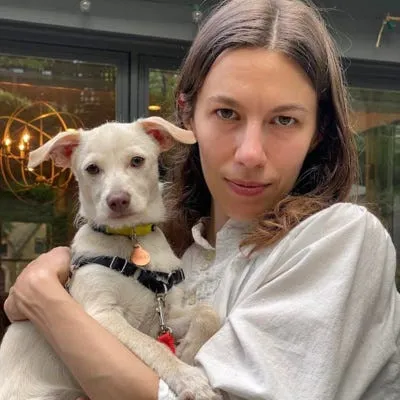
Sara Caron had a leash-reactive dog, and as she started to research a quick fix for the problem, she threw out a wide net and tried lots of things. With guidance from this podcast, she began to see a way of dog training that made sense to her. When felt she had reached a plateau in her own solo study of animal behavior, she enrolled in the School For The Dogs Professional Course last year. She got another puppy shortly before starting the course which allowed her to see some remarkable differences in a dog raised with science-based/reward-based training methods versus one who was not. In this episode, Sara and Annie discuss some of the parts that have made the School For The Dogs Professional Course a life-changing experience for its graduates: The individualized attention, access to the SFTD community of trainers, classes, in-depth material, and the guest speakers. They also discuss the process of finding one’s place in the professional world of dog training.
Transcript
Sara Caron
I developed this deeper relationship with dogs where, prior, dogs might have to me been one thing and dog training might have been one thing, but now it kind of has its – I can see its links to my own life and all these cultural things that we deal with. Yeah. So it just kind of kept getting more and more interesting to me.
Annie
Sara Caron. I am so happy to have you here. Why don't you introduce yourself and we can just go from there.
Sara
Sure. I'm Sara Caron. I'm a recent graduate of the School For The Dogs professional Cho. And I'm in Milwaukee, Wisconsin.
Annie
You know, I think I told you this, but my dad's family's from Milwaukee.
Sara
Oh cute. You did tell me that.
Annie
Although I've never been there, but the main association I have with all things Wisconsin is that my grandmother when she would yell at my dad would be, I remember her always saying “Baaaab.”
Sara
Yeah. That sounds about right. Yeah.
Annie
His name was Bob and I remember drawing a cartoon of her when I was like seven and I spelled it out like B-A-A-A-A-B.
Sara
That's adorable. So yeah, I'm from Chicago. I grew up in the city, but I've been living here long enough that that sounds very, very familiar.
Annie
[laughs] So I guess let's maybe just talk chronologically about how you got to the professional course. And then I guess we can talk a little bit about what that experience is like, because we are welcoming in our next cohort at the end of August, and I would love for anyone else who's interested in becoming a professional to sort of hear about what the experience was like for you.
Sara
Cool. Yeah. I'm kind of jealous of that new cohort actually. I wish I could do it again. It was so fun. Well, do you know that I was like a School For The Dogs podcast fan girl?
Annie
Uh, no. Well, I guess I knew that you found the professional course through the podcast. Actually as did Leeyah, and sometimes it really makes me feel like I've done something right with my life when I remember that, because often I feel like I'm talking to no one by myself in a room. [laughs] But if it got both you and Leeyah to the professional course and into my realm, then I feel glad. I mean, I'm just glad to know you, but I'm also just psyched to see what you guys are doing.
Sara
Oh, that's sweet. Yeah, cause at that time I was kind of digesting lots and lots of dog media and I started – the funnel started wide and I kind of narrowed it down to more and more logical sorts of information.
Annie
Well, so what got you interested in looking things up to begin with, and then I'm curious about like the range of things that you found?
Sara
Well, so I had a dog. My partner and I kind of share this dog who, we don't live together, but we own a dog together. I don't know, it was during the pandemic. And then like many other people, I was spending lots and lots of time at home with my dog and kind of refocusing on my relationship with him. And I think it started out, I just wanted to fix behaviors of his. He was reactive to other dogs on leash and some stuff like that, and I kind of just wanted a fix for it. So I started thinking that I could really buckle down and kind of tune up his training.
So it started wide. It started with like, you know, I would digest sort of like balanced training media. And then I was just as I started to learn more about –
Annie
So what were you doing just like going into Google and Googling dog training?
Sara
Yeah, basically. Or like going into podcasts and searching dog training podcast, essentially, and just kind of taking things that people were suggesting. And yeah, I think School For The Dogs podcast was the first podcast that I found that was science-based, that seemed to be accessible for a lay person. And that is sort of why I started getting obsessed with it. And from there I kind of developed a deeper understanding of animal behavior and from that I was able to be more discerning in my further education, I guess.
Annie
Cool. Well, that's really, really nice to hear.
Sara
I mean, I was reading all the bad stuff. When we first got our dog, I was doing the Cesar Millan, I was doing like, from the worst to the –
Annie
Like “Shh!!” That kinda thing?
Sara
Or yeah, I would make him like, we would see a small animal outside, like a squirrel or something and I would make him sit for some reason. And I thought that was…
Annie
Humans are obsessed with sitting.
Sara
Oh, it's just the worst.
Annie
[laughs] I could think of worse.
Sara
Yeah, that's fair. But now in my head I'm like, oh, I can't believe I ever did something like that to him. You know, I never really used any techniques that were super aggressive, but I definitely would just do things that were sort of clueless like that. Like make him sit, or push his butt down to sit. It's all about Sit. It was this awful sit obsession.
Annie
You know, I think there's a training company. I could be wrong, I think they're like compulsion trainers with shock collars and stuff. And they're called Sit Means Sit.
Sara
Yeah. I think I've seen that.
Annie
Well, it's amazing though, to me now how much nonsense people are willing to believe, or how brainwashed we are about dogs and dog training. Last night – do you know about Jeff Gellman?
Sara
Uh, no.
Annie
I only recently discovered him and his videos are something, but one of his big techniques is called bonking and it involves taking a rolled up towel and smacking a dog with it really hard.
Sara
Oh God.
Annie
I was at a party last night and someone was like, “Oh, you're a dog trainer? We have a dog training issue. Every time we watch our neighbor's dog, the neighbor's dog pees on our rug.” And just, just to see what would happen. I was like, “Well, what you need to do is get like a good sized bath towel and roll it up tightly and then put rubber bands on each side and lift it up as high as you can, then just like whack the dog as soon as the dog pees.”
Sara
Oh. [inaudible] would have to be psycho.
Annie
And they were like, “I don't know if that would work on a small dog, would it?” [laughs]
Sara
That's really democratic and generous of them.
Annie
You think they were just being polite? Like, but I don't think so. I don't think they were like, clearly this person is crazy. I think they were just like, I don't know if that'll work.
Sara
Well, that's, what's scary about it too, is that, you know, you have a certain level of authority. So they're probably like, oh yeah.
Annie
Well, I mean the only authority is I said I was a dog trainer. They didn't know me other ways, but anyway. But right. Anyway, I promise that right afterwards, I was like, I'm totally kidding. Let me actually talk to you–
Sara
Just take your dog to the vet and then make sure you take him out every hour.
Annie
There you go.
Sara
No problem.
Annie
Or pick up the, the rugs that probably smell like pee. Yeah. No towels are required.
Anyway, so I forgive you making your dog sit all the time. I mean, I certainly did that a million times too. And sometimes actually, I find, I don't know if this has happened to you, but like when other people now ask Poppy, for instance, to do things that I think are kind of silly or how would you say, like silly or anti-progress? Like, she's jumping and someone's asking her to sit or something like that. Like sometime, even though here I am, I own a fricking dog training studio in New York City, like, this is what I do with my life. I'll get tripped up, like the words will get caught in my mouth. And I have to summon up everything I can to redirect the person and redirect Poppy. Does that ever happen to you?
Sara
Yeah. You know what, my dog Chili, it kind of embarrasses me because I feel this way about sit, but she has an amazing sit. She'll sit anywhere when anyone asks her to.
Annie
What's embarrassing about that?
Sara
Well, it's just that –
Annie
We should all be so embarrassed. [laughs]
Sara
I'm like, did I put so much training energy into Sit that she just has this totally foolproof sit?
Annie
Good.
Sara
I guess. I'm like, wow. Maybe I should work on something more, just a little more meaningful, but it does the trick. I mean, uninitiated greeters are impressed, usually.
Annie
I mean, a default Sit is not a bad thing if only because people are gonna say to her, sit, sit, sit, sit, five times in five seconds. So if she's gonna sit anyway, despite them even asking.
Sara
Yeah, that's true. It's like it's like a tool and I gave her to navigate the world a little better, I guess.
Annie
Totally, totally. People are much more willing to deal with a sitting dog.
So you were whittling your way towards figuring out a kind of dog training that makes sense.
Sara
Yeah. And I think it was, just the more that I read, the more a kind of positive reinforcement or science based approach just made sense, which is why it's often so confusing when people seem to have lots and lots of knowledge, but they don't get to that same place.
Annie
The thing that gets me in any conversation about balanced training, punishment based training, whatever you wanna call it, training that defines LIMA differently than I would, I guess you could say. It's the associations the dog is making, it's the classical conditioning, right? Like how do you account for that? How do you account for the dog not associating getting whacked with a towel with the room that he's in and the person holding the towel and everything else that was in the environment when that happened?
Sara
Oh sure.
Annie
How do you deny that? And do you just accept that whatever effects that might have will happen after the client is no longer in your purview, or that it probably just won't be so bad?
Sara
Yeah. And it's this idea too, that, sure, of course punishment can create behavior change, but kind of at what cost? And going through the apprenticeship, I got another dog right before I started the apprenticeship. And she was 12 weeks old when I brought her home, and then probably like 20 ish weeks by the time the apprenticeship started. And kind of working through that with her and having a dog who's learned how to learn. Kind of seeing the difference between her and our older dog, who we got when he was a little older and who I was a clumsier trainer for. Just kind of the ways that they navigate the world are so different and her ability to yeah. Her confidence in interacting with the world and understanding that her actions have an effect on her environment are pretty incredible.
Annie
That's really cool.
Sara
Yeah. It's so great. Just seeing that, it's like really inspiring that she's like this full little being that just loves to learn and loves to work on her little projects and stuff.
Annie
Yeah. I love that. I love that about dog training. I love feeling like I'm watering a plant that's thriving, I guess, is a way to put it.
Sara
Yeah, definitely.
Annie
That I'm giving this animal what it needs to exist happily. And it's not about – I think that can be reduced to like, oh, well, what you enjoy spoiling your dog? But it's more about giving them the tools they need to figure out what works and then creating environments where they're going to be getting the things that they want by engaging in behaviors that are acceptable.
Sara
Yeah. And also just like a slightly deeper understanding of canine enrichment and a dog's species specific needs has given me a lot more grace as a dog owner. Just more patience and more humor living with dogs when they're just doing dog things that, you know, can be inconvenient or annoying. Just kind of having that pause to be like, it's not moral, it's not personal. It's just a dog thing, who cares.
Annie
Right.
Sara
Like we'll just work on it. It's not really about me. It's like, okay. So she wants to shred up my stuff. So I'll give her her own things to shred or her own things to chew or her own place to dig.
Annie
It’s not about her trying to control you.
Sara
Yeah. She's not trying to mess up my life. She's just trying to –
Annie
Maybe she is. Maybe.
Did you have dogs that you trained growing up at all?
Sara
We had dogs, but they had no formal training at all. And I'm amazed at the way many family dogs must have lived in the nineties. Like I think, yeah, we would like give them a milk bone as a present every now and then, and I don't really recall them having any toys or it must have, it was, it was a little bleak.
Annie
Yeah. It's funny that you say the nineties cause I've just been writing this part of my book about how little dog training has actually changed in the last few centuries. And you're saying the nineties and I'm thinking like, oh, it was kind of like the 1890s.
Sara
Is that true?
Annie
Which part?
Sara
Like that it hasn't changed that much. I sometimes I feel like…
Annie
Well, I think we have a lot more, I think we have, I mean, we do have so much more information about the science of behavior than ever before and techniques to implement change with all kinds of animals, not just dogs. And it's relatively recent, really only just started in the nineties that people started to use clicker training, positive reinforcement training, although it was being used with other animals prior to that.
But all the hugely popular trainers right now who are using aversive methods and catch poles and prong collars, and I mean, I guess electric collars, they didn't have way back when, but pretty much all those other things, they did.
Sara
Yeah. Fair enough.
Annie
Thinking along those lines.
Sara
Yeah. I guess though like anecdotally, I feel like maybe I'm primed to see it, but I do kind of feel like I see more dogs at least on harnesses, or dogs slowly sniffing things in the neighborhood.
Annie
Oh, I mean, I'm not saying there hasn't been huge amounts of progress. I think there has been, but I also think we have a long way to go and a lot of, and I think that the majority of people out there who are training their dogs or thinking about dog training are not aware that there even is a science of behavior and that we're using technology that stems from research that's done and being done. And that there are canine cognition labs, that those exist as a thing.
Sara
Yeah, I think about that sometimes also in context of my historic family dogs, just what the majority of people expect when they get a dog or why people decide to get dogs.
Annie
How so?
Sara
I would kind of like to see the research on that, I guess.
Annie
Oh, why like what's changed about why people get dogs?
Sara
Yeah. Or like what's the picture that people hold in their minds when they decide to adopt a dog. Do they expect the dog to be kind of like a piece of furniture or what need is it serving for them?
Annie
That would be an interesting study. Study why people get dogs.
Sara
Yeah, just because some of these main, these training frustrations that many people have or reasons that dogs are surrendered to shelters and what have you seem to be many times sort of normal dog behaviors.
Annie
Yeah.
Sara
So that's always kind of confusing to me.
Annie
Well, you know, going back into the history of dog training or like the modern history, I guess, people started to bring dogs into their homes, I think largely for the first time, like only after the industrial revolution, you know, when suddenly there were more people living in cities rather than on farms where like the dogs were certainly outside dogs. But more than that, you know what the single biggest reason why we have dogs inside now more than ever before in pets, more than ever before?
Sara
Oh, no? What is it?
Annie
Flea protection.
Sara
Oh, what?
Annie
Flea protection.
Sara
Wow. What a simple technology.
Annie
I think it was, let me look up the name of the book. Pets in America: A History by Katherine Grier. I think that's where I learned that. Yeah, just blew me away that this simple thing that we so take for granted.
Sara
All these other consequences, like the fact that you own a dog training studio in New York City is also then caused by flea protection.
Annie
Right, right. Which is crazy to think about, but here's what else is crazy to thinkell,. Well, there are other advances too, like think she talks about vaccines that helped make sure that more dogs lived past puppyhood. And certainly the whole world of dog breeding and like taking out our desire to practice eugenics onto dogs instead of people also led to there being so many dogs.
But what I thought was interesting when I really started to thinking about like the flea protection, the vaccine, da da, da, da, like that's science that I can't tell you about. It's science that, like, I don't understand, like I can't explain exactly how flea protection is made or vaccine is made. Like, I'm not that smart. But people who understand that way better than I do have been able to make these advances that have affected our lives.
The basics of the science of behavior I can explain, I mean, as I have on this podcast, like a pretty broad, basic understanding that I think you could probably explain to a 10 or 11 year old. I mean my daughter's three and I already see her putting this stuff into place working with our dog. Like that's a kind of science that is much easier to understand by someone who doesn't have some sort of advanced degree, like I don't. And that also has the power or I hope is having the power of helping dogs live better, healthier, happier lives.
But then there's this other way in which it's still kind of on the down low, even though it's so much less complicated than something like, I don't know, parvo vaccine. You know what I mean?
Sara
Yeah. Yeah. It seems like it's easier to understand just because it has more of a relationship to your lived experience.
Annie
Right.
Sara
Cause it just describes it. So that must be what that's about.
Annie
But it's still treated as some sort of like a pseudoscience where – well, I mean, I guess there's people who think that vaccinations is aren't real either, so. [laughs]
Sara
Yeah, I know. I just, I keep wondering throughout this whole dog training education of mine, I have wondered why I didn't learn this stuff sooner. Like why animal behavior isn't a bigger part of just regular high school education at least. Like, did you learn about any of this in your earlier life?
Annie
Uh, not that I remember, no. I certainly though had like biology and chemistry and environmental science, all of which I remember none of.
Sara
Uh Huh.
Annie
I remember the xylem and the phloem are things.
Sara
I don’t even know what those are.
Annie
It has to do with celery.
Sara
Okay, cool.
[laughing]
Annie
Um, yeah, I mean, it's amazing. Or like, I mean, God, the levels of calculus that I was doing, and yet this stuff isn't covered. At some point I learned that like after or during the Cold War, they started making kids do much higher levels of math and science. Like they got away from, like, they kind of rushed through the basics to get people to the point of graduating high school with relatively complex abilities. Cause I remember doing math homework and my dad who was like a much better student than I ever was, was like, I never got close to doing this kind of math. I have no idea what you're doing.
Sara
Wow. That's really interesting. I like, I hate that this is like a stereotype about someone who went to art school, but I'm so extremely deficient in math.
Annie
But isn't it amazing how just a little bit of basic math will get you far. And I think like a little bit of basic behavior could really help people, too.
Sara
Yeah. That's so true.
Annie
Like a little bit of basic math, like I can figure out percentages. I could multiply fractions if I really had to. [laughs]
Sara
Yeah, my high school algebra teacher, she would give us an assignment and then as soon as we were done with the assignment, we could leave the classroom. And that's where my math education completely ended. I would just finish my math homework as fast as I could and immediately leave the class.
Annie
You know what, that's really interesting though, because have you heard of the fluency project?
Sara
No.
Annie
I was at a seminar a few years ago, it was about behavior and this guy was there from the fluency project. I reached out to him a couple times to try and get him on the podcast. And I think I never heard back. Maybe I need to reach out again, but I think mainly they help businesses make their workers more fluent at stuff.
And as an example of fluency and what fluency means, he gave everybody worksheets that had little math problems on it, like two plus five. And it was just like a page of like, I don't know, 30 little math problems like that, like adding single digits. And he had us all fill it out and was like, note how fast you did that. You didn't have to stop and be like two plus three is, and then like count it out or like do different steps, like you just knew. And that was like his example of fluency of how it has to do with that automaticity and speed with which you could do something like add single digit numbers.
Sara
Hmm.
Annie
And so it's almost like your teacher was helping you build fluency and also rewarding you, or at least like negatively reinforcing you, like now you can leave.
So you decided to do the professional course. Were you thinking like I wanna become a dog trainer or I just wanna learn more about this stuff. What were your specific goals?
Sara
So I didn't necessarily have a clear goal in mind. I didn't know whether I really wanted to be a dog trainer professionally or not when I started the professional course. I think I was just really interested in the topic, making progress with my own dogs and had kind of felt like I had reached the limit of what I could teach myself. That's sort of how I approached it. And I would sometimes think at the beginning of the apprenticeship, like, do I even really like dogs? Like, do I like dogs or am I just really interested in dog training? And now I think people who know me would think that that was like an absolutely psychotic assessment of myself.
Annie
Well, to be fair, like dogs is not one thing, right?
Sara
Yeah. That's so true.
Annie
Do I like humans? A lot of humans, I like.
Sara
I developed this deeper relationship with dogs where, prior, dogs might have to me been one thing, and dog training might have been one thing, but now I can see its links to my own life and all these cultural things that we deal with. Yeah. So it just kind of kept getting more and more interesting to me.
Annie
What's an example of something you can no longer unsee? It's putting on the dog training, the dog training glasses.
Sara
Well, not even just not sort of specifically. Well I can't unsee all dog body language. I think, I feel like I walk out into the world and it's just so loud. There's dogs out there and I just, I see like every little glance away from something that a dog does or every little subtle body language type thing. And that is a little bit like maybe I wish I could unsee that part.
But just kind of how, the bigger cultural stuff is more, like, just how punishment is used in interpersonal relationships and then on societal levels too, like the carceral system or just these bigger structures that now it seems so clear that there must be a better way to do it. We’re just kind of falling into this pattern because punishment can be reinforcing for the person who's punishing and all those sorts of effects. Does that make any sense?
Annie
Yeah, a hundred percent me. Yeah, I never thought that dog training, that like deciding to become a dog trainer was like gonna be something that would change my worldview, and I think when I started impact interpersonal relationships? Like that's I was talking to my friend, actually Libby, who does a lot of work behind the scenes on this podcast last week, and she was talking about her values. And I used to write wedding announcements for many years, engagement announcement, and I interviewed couples all the time.
I remember the word ‘values’ coming up a lot when people would talk about why they were choosing this particular life partner. And I recall a much younger version of myself thinking like, it was just such an empty word to me. Like what did that even mean? Like we share the same values, like what, like you love your family? Like, because it, people rarely elaborated on what their values were. They just said that they had values that they shared.
And and she was talking about her values in a kind of broad way. And I suddenly thought like, oh, I actually think I have values now that I could define pretty clearly, and that is a hundred percent thanks to the fact that I became a dog trainer. I think prior to that, I might have just given sort of like large generalizations about stuff, like I dunno, family and health or something.
Sara
Yeah, definitely. I totally feel the same way. That was like the big plot twist for me, cause I think really early on, when I would think about dog training, I would just think about, oh, I'll get my dog to stop pulling on leash. I'll solve a singular issue. And now it's just clear how better communication and communication that kind of takes an individual's perspective into account is just more humane. And it's had this kind of remarkable therapeutic effect for me personally, too. Just kind of being able to define that value system and apply it, kind of test it in my relationship with my dogs, where it's both – for me, it's easier because their dogs. They're dependent on me in a way that no human animals are, but it's also more difficult cause I can't just verbally communicate with them in the same way.
Yeah. But kind of testing it with the dogs and then letting it bleed out into all my other human relationships.
Annie
So tell me about the program from your point of view.
Sara
Yeah. I sort of chose it because of the scale. It seemed like one of the only programs that had such a small cohort and could give such sort of individualized attention. CauseI already had kind of an understanding of the basics of animal behavior. I would learn that I could get better at it, but I already kind of felt like I had decent training mechanics at the time as well. So it was the scale, the individual attention and the combo between self-study, and then the check-ins with the office hours. And then access to the School For The Dogs community in general, sort of all the resources that you have. Like all the trainers, all the classes, all of that shadowing aspect of it. And then also the guest speaker part of it, being able to engage with people that I wouldn't have been able to on my own.
Annie
Well, that's great to hear. Where do you see yourself going with dog training?
Sara
Excellent question. I don't know, when you started working professionally as a dog trainer, did you have this period of time where you were like, I know how to train a dog. I understand lots about animal behavior, but kind of where you're trying to find like a niche, like a specialty sort of thing?
Annie
Yeah. I mean, I don't think I thought of it so much as like I need a specialty. I actually think in the decade ish since I decided to become a dog trainer, I think there's a lot more specialization happening, which is a really, really good thing. So don't think a specialty occurred to me so much as sort of trying to figure out how to communicate all that I knew that I knew with new people and their dog. Because every individual is different. Every dog is different. There are no two situations that are exactly the same. And how do I communicate the solutions that I have in mind that I know will work broadly speaking to this individual.
And also just, I guess, figuring out what I liked and what I was into was like a bit of a challenge and a process, but I definitely had like an epiphany moment a month or so after I graduated the Karen Pryor Academy, I went to the Association for Professional Dog Training conference, which I think was just such a good thing to like, just get out, cause I also did like a remote program. I think it was really great to be able to just go and meet a whole bunch of other dog trainers and just hear what they were doing, and see what this larger world was like.
And I really had an epiphany at that point of like, there is so much cool stuff in this world. Like, this is just like such an exciting area that I knew nothing about a year ago. And I think like what I really want to do is figure out how to bring this amazing stuff to more people or like just turn people onto the fact that this exists as a world, as a profession, as an interest. And that that felt more exciting to me than realizing like, oh, what I really wanna do is deal with dogs who have aggression issues or whatever.
So I guess that was my like moment of clarity. But to get to that point, I still worked like millions of kinds of cases. But I guess with time realized that like, just one on one, the thing that excited me most was the intro session. Like helping shift people's point of view and in such a way that like, oh, I think I've helped this person even realize that there's this path that they can take. And even if they never come back to School For The Dogs, I never hear from them again, I think I've turned them in the right direction. And like that to me is incredibly gratifying.
Where I don't know, there are other trainers who like, what makes them really happy is seeing a major result, a major change in a dog going from unable to be home alone at all, to being okay alone, or being able to walk past another dog on the street. And while those changes are exciting to me, it's not as exciting as that initial, like helping people sort of have an aha moment.
Sara
Yeah. That's actually quite useful, ‘cause that little perspective shift is also really important to me. Like I think as a dog trainer, I am really excited to just work with more dogs and understand how techniques are kind of applied to various individuals and sort of that troubleshooting and kind of experimentation is really exciting. And just this whole field, it can be so expansive. I'm really interested in just kind of fulfilling dog's needs, and just everything that you can do for a dog just based on enrichment is pretty exciting to me, and then consent behavior stuff I'm really excited to learn more about and put more into practice.
Yeah, but just that little bit of education, that little bit of perspective shift can make such a huge difference between a dog and person relationship.
Annie
Well, thanks so much for talking. And we should mention that you're doing a lot of client communication these days for us.
Sara
I sure am. Yeah.
Annie
And they are meant for people who haven't worked with us before. But if someone wants to learn more about the professional course, they could book one and get you on the horn.
Sara
That's a very nice idea. I hope somebody does that. I would love to chat with someone about it.