December 31, 2021 · 48 min
SFTD's Behavior Therapy Trainer Jen Nastanski on working with guide dogs, competitive Obedience and more (Also featuring special guest: Melanie Friedson)
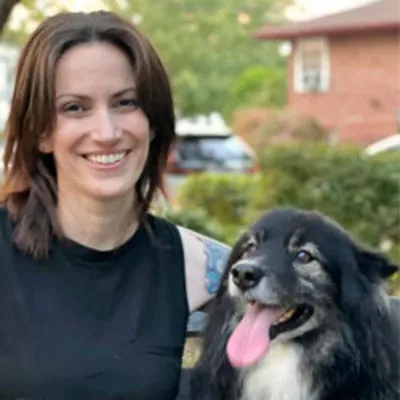
School For The Dogs' Behavior Therapy Trainer Jen Nastanski came to work at our New York-based facility after two decades of working with dogs at professional and competitive levels. She tells Annie about getting trained to be a trainer at PetSmart, getting involved in competitive Obedience using positive-reinforcement-based techniques, teaching (and helping to raise) guide dogs, and, most recently working at New York City's ASPCA, working to enrich the lives of dogs seized and held in custody by the NYPD.
Special guest on this episode: Annie's friend Melanie Friedson, mom to Bichpoo, Herschel Stanley.
Transcript
Annie
Can I include your funny dog voice on the podcast? I don't have to attach it to your name.
Melanie Friedson
[funny voice] Of course. It's not funny. It's just how it is.
Annie
[laughs] I should introduce you and say that you are –
Melanie
You can. I'm not ashamed of my dog voice, Annie.
Annie
You are one of my best friends, Melanie Friedson, human owner. How do you refer to yourself when it comes to Herschel?
Melanie
[voice] I'm his mom.
Annie
Okay. Mom to Herscshel Stanley [laughs]. 12 year old cavapoo?
Melanie
Bichpoo.
Annie
A bichpoo, of Washington, DC.
Melanie
Yep.
Annie
Anyway, so it's the last day of the year. And I'm putting up the last podcast episode of the year. But I thought it would be more fun if it was in your dog voice than in my normal human voice.
Melanie
Oh, okay. So you want me to say that?
Annie
Yeah.
[laughing]
Melanie
If you like this podcast, please support us! This is Herschel Stanley Friedson’s mom!
[intro and music]
Annie
Jen Nastanski.
Jen Nastanski
Hello.
Annie
Hello. Thank you for being on School For The Dogs podcast. And thank you for being part of School For The Dogs since, what, has it been two months now? Something like that?
Jen
Something like that. Time is a little nebulous right now.
Annie
Remind me of your official title, cause I'm bad with titles.
Jen
I'm a behavior therapy trainer.
Annie
And you've been doing private lessons. You've been doing Day School, right?
Jen
Mm-hmm, yep.
Annie
Have you been doing both Misfits Day School and regular Day School?
Jen
Yeah, I haven't started Puppy Day School yet, but yep, I've been doing Misfits and Day School.
Annie
Can you explain what those two things are to people who do not know our nomenclature?
Jen
Yeah, and it's been fun to learn, too. So Day School is a drop-off program, and the dogs come in the morning for a set amount of time for a three hour period. And we alternate sort of rest period, relaxation. We do some crate training. We only take between three and six dogs at a time. They have to generally like other dogs and be able to tolerate being in a crate or being in a pen.
And we do sort of some controlled play time. We try to pair the dogs by size or play style. We take lots of break periods to make sure the play is cooperative and safe.
And then we get the dogs out one on one and just do some obedience training. If they're ready, we do loose leash walk around the neighborhood. We have quite a few neighbors who are friendly shopkeepers and they invite us in. They do practice greetings with us. They're sort of always happy to help and visit with the dogs.
Misfits is a program later in the day. That's a little bit more of a one-on-one program. These are dogs that can't tolerate being alone, or watching while a trainer works with another dog; dogs that can't get along with other dogs, that have leash reactivity that just need a little bit more intense focus.
Yesterday in Misfits, for example, I had a little cavalier who is pretty low confidence in the city. He's new to the city and he's been very fearful of dogs. So for his first misfit class, we had him paired with a fake dog. We had a stuffed dog in a pen as sort of the distraction.
And then this week in Misfits, I had my real dog Poptart, Poppy, and she was sort of a helper dog, also behind a pen. And he's not quite ready to play with her, but he's starting to warm up, getting more confident. It's a safe way for him to interact without being overwhelmed. And he's starting to make real progress. So he's more of a misfit dog that needs a little bit more training and one-on-one attention than Day School.
Annie
We should specify that we hold these at our studio, not in the owner's home. But you're also doing private training, and day training.
Jen
I do. So I'm currently doing, I have a couple of regular day training clients. I take the dogs out, I go and pick the dogs up from the owner's home. And we go out for either an hour – I even have one dog that's up to three hour sessions. He has some kind of long socialization sessions. He's had some field trips with me. I've taken him in my car with my dog and gone to the park and walked around on leash together, helped build his confidence around other dogs. So that’s more, that is sort of training one-on-one from the owner's home.
Annie
And then you're also teaching classes, right?
Jen
Yep. I have started with Calm Canine, which is sort of a general obedience, but also a lot about relaxation and settling behaviors, especially in the city and around distractions. And I'm starting to teach Prep School, which is a basic obedience class also with sort of some mild distraction work.
Annie
I feel like I'm so unused to hearing the word obedience
Jen
[laughs] Well, and I probably have some terms that are a little old school. I definitely was a, I'm a reformed dog snob. I used to show dogs at obedience. So the word obedience comes outta my mouth a lot.
Annie
Well, I think obedience has come to mean manners in the world of dogs regardless of whether or not it is about obeying. Do you know what I mean?
Jen
Sure. It's, it's more cooperative now than…
Annie
It’s, well, we aim to make it more cooperative. But there's still, I mean, I grew up, I calling dog owners masters, which seems crazy to me a little bit now.
Jen
Well, and I know I still automatically say owner, which is pretty outdated. I think the move has been more to the word guardian.
Annie
Yeah. Well, you know, we like on social media and whatever, we usually say, like the dog's human.
Jen
Mm-hmm.
Annie
Which, I mean, I still say owner too, in the same way I guess I still sometimes say obedience, just to speak a language that people understand.
Jen
Exactly. It's kind of a shorthand, a common shorthand.
Annie
And legally you are the dogs owner, right. Legally dogs are property. So it's kind of like an accurate term
Jen
That's sort of the unfortunate part of it, that the dogs have fewer rights. We are their owners. They are property.
Annie
Yeah. I mean, I think there's actually, like, you could say there's like a master and slave thing going on.
Jen
Yeah. Sometimes I'm like, oh my gosh this is Stockholm syndrome.
Annie
Like, well, but it's a step up from how most domesticated animals live in this world, which is like not, you know. It’s not taking naps on West Elm couches.
Jen
Sure. Well, it's wild to me how the expectations for dogs have changed over the years. Dogs in the home, dogs' behaviors, how we approach those behaviors. There's been so many shifts kind of back and forth, and it's, I think at least in New York City in particular, I feel like I'm seeing owners wanting a more positive slant and a kinder, more cooperative kind of training, versus the old rigid obedience standards that I feel like there used to be.
When I started with Scorch, my AKC novice obedience dog, and rally a obedience dog – I toyed a little bit with competing with my mixed breed, but he couldn't compete in AKC. So with my dog Scorch, he's 14 now, but when he was about a year old, we were starting to look into competing and taking more advanced classes and there was a big divide happening.
And it was very hard to find trainers past the basic level who weren't using punitive methods and part of why we didn't continue – we titled up to a particular level of obedience. Oh my goodness. It was so it was so long ago. So he was a young man when we were training, and this was in Florida as well. This was not in New York. He's the love of my life, first of all, he's my heart dog. He is a border collie samoyed cross, as it turns out.
Great dog to work with, but he would get very frustrated with me. You know, he was pretty – well, he still is. He's a very high drive dog and he is pretty fast and intense and he tended to forge ahead, and I was unwilling to give him leash pops. I just, I was uncomfortable. I tried it. I didn't like it. I had to do it with other types of career training.
Annie
Let's back up a little bit. How did you first start working with dogs in any capacity?
Jen
Oh my. I was 17 years old and I was kind of dog obsessed. We had a cairn terrier that I was taking to obedience classes, and she wasn't that into it. But I think I was hooked. And I was volunteering at an animal shelter and working at Petsmart as a teenager. And some of the trainers kind of took me under their wing. And that's when I started, I got introduced to the world of competitive obedience and rally.
I was interested in agility as well, but money and time and being very young, I had to pick a sport and I picked obedience cause that's where all my friends going. And they all had fancy purebreds and I had this shelter mutt. But we still, you know, I enjoyed it. My shelter mutt had some health problems, so he unfortunately couldn't compete very long. And that's when I stumbled upon this, this oops litter of border collies and the best dog I've ever had.
Annie
Can you explain what it obedience is the way you're referring to it?
Jen
Sure. So when I say that too, when I tell people, oh yeah, he's got obedience titles. They're like, oh, what does he know? Does he know shake? Well, no. Like, I mean, he kind of does, but he's not into that. Yeah, people I think don't realize that there's still competitive dog sports like this. Obviously agility is what people are generally familiar with as a competitive sport where the dogs are going over the jumps and the ramps. And then there's conformation showing, which is like Westminster, where the dogs are competing to a standard, a breed standard.
In obedience, there are several levels, and some of the requirements changed over the years. But generally the dog is expected to work with the handler, on leash and off, in an obedience ring with a judge present. You're only allowed to speak or give commands at particular times. You're only allowed to praise your dog briefly between exercises. They have to work basically for–
Annie
What are the exercises?
Jen
So the exercises, the judge lines up the dog and the owner and they call out a heeling pattern. So they'll tell the dog and handler to forward, and the handler will tell their dog to heel. And the dog is expected to walk along at the left side. Generally looking up at the handler is sort of the fashion nowadays. When it originally started, I think the dogs could look ahead.
And the judge calls forward, left turn, halt. And when the judge calls halt, you have to come to a stop, and without giving any commands, your dog is supposed to sit down next to you. Then when the judge calls forward, again, you start off, you can say heel and the dog is expected to return to a brisk pace next to you. They call changes of pace. They call fast and slow. And then you repeat the heeling exercise off leash.
You also do a figure eight, pre COVID. The figure eight would be the same heeling position, the dog at the left side. The judge calls forward, and there would be two stewards, two volunteers standing still in the ring, and you would do a figure eight around them. I think post, I believe they're using cones and they're not going back to humans, which is, I'm appreciative of it. It just sort of makes things a little easier to arrange for obedience trials and distractions.
But so then after that, there's a recall. The dog is left on a sit, stay. The handler goes across the ring, waits for the judge's signal. You call the dog to come. The dog sits in front of you and then is called to heel. All of this is on the judge's command. So it's exercises like that.
In more advanced levels, there's also some elements of jumping, retrieves, retrieves over a jump. The hardest thing for us, and part of the reason that I stopped advancing, was the stays. Scorch was able to do it, but in the first level of obedience, the companion dog title, it's a one minute sit stay, and a three minute down stay in a group, with the handlers across the ring. And the dogs–
Annie
Wait, just while we're talking, I'd like to look at – what do I even look up on obedience dog training? I get like terrible videos – what do I Google?
Jen
Okay. So I would look up AKC competitive obedience. See, and this is sort of the problem, the word obedience, I think the connotations – when the sport started, it was very old school, lots of shepherds and big dogs and army trainers. And it's changed, but the culture kind of hasn't caught up all the way yet, if that makes sense. I can send you some videos of Scorch working. I do have some YouTube videos of him.
Annie
So this was your first introduction then to dog training.
Jen
Yes. I mean, yeah, this was really, at the time I was doing some pet training. I also did some competitive classes–
Annie
Were you doing pet training as–
Jen
So Petsmart, I ended up actually going through their apprentice program. God, this, yeah, this was like 19 years ago now.
Annie
Wow. What was that like? Was that like more old school?
Jen
No, actually it was pretty good. Actually at the time it was, it was pretty – clicker training, very reward heavy. We're not allowed to do corrections if I remember correctly. It was actually pretty pleasant. I ended up with a couple of regional trainers and I shadowed their classes.
You know, I do feel like the big box stores do have some good trainers. They sort of get a reputation fo You don't know what you're gonna get. But I worked with some great trainers there, and very talented people, and they pulled me into other areas of dog training too.
There was a big manual. There was a kind of a guide book and curriculum. There might have been a test. I can't remember. And there was some shadowing as well as assisting at the time. Again, I'm not sure if it's like that now. At the time the training director in the area, in the Florida area, was pretty on her game. She had a good team under her. So I got lucky to start with people that were involved in other areas of dog training as well.
Annie
So you sent me this video of you doing some obedience work that I'm looking at now. And I wanted to try and explain it to those who are listening.
[music]
So you're in a pen, and you're walking very briskly, and there's a judge walking around. You’re alone. He's on your left side, looking up at you. The judge is following you. Is he giving you commands?
Jen
Yes. So he's saying, the only things he's saying are forward, a few times, and this is very minor stuff. So scorch is right next to me and very attentive. This level, we're completely off leash. So you'll see the stewards come in and set up for the figure eight. He loved that part. He liked showing off.
Annie
We should do classes based on this.
Jen
Oh, I would love to. This was so much fun.
Annie
So people could get their titles. Right?
Jen
Yeah. And I believe, especially with COVID, they started doing a lot more virtually.
Annie
It seems like it's a lot about walking really super nicely.
Jen
It is about precision. So in the first part, he–
Annie
Now you’re throwing a dumbbell.
Jen
Oh yes. This was his favorite. He was always very vocal for this part. So it is about precision. They do take off points for how straight he sits, how straight he is in the heel position. So initially, because he was so excited to be in the ring, he got some points off for being a little bit wide. So meaning his rear end stuck out a little bit. And now that he's a little more focused and a little more engaged in what he's doing, he's sort of tightened up his position.
So then, you start with 200 points and they kind of mark you off for every little error. And I also threw the dumbbell and it landed outside of the ring. So the judge had to stop all the proceedings and give me back the dumbbell, and poor Scorch was nearly vibrating with excitement and desperation to get to the dumbbell.
There's as much human element as there is dog element. So it really is cooperative.
Annie
Did you have like dumbbell throwing sessions to make sure you could throw it right?
Jen
Yes. I was terrible. And I was, I was so nervous in the ring. It got even worse when I was in the ring. And this was for the title. So you need to pass, basically, you start with 200 points, you need to get a passing score and pass each element of the exercises three times to get your title. So this was for our title and we did get it.
Annie
Did you use a clicker?
Jen
Yes. We did use a clicker for some of that.
Annie
Who wouldn't want a dog to walk nicely right next to them looking up adoringly. I mean, you're using, when you're teaching random client now to walk their dog well on a leash on the streets of New York City, that's part of what you're teaching.
Jen
Yes, absolutely. I mean, I tell people when I'm like, oh, just noodle and do a figure eight around distractions. I mean, this is literally, that's how I taught it. Everybody asks me about like, when do you train your dog? And it's, it's on walks, especially in the city. Or, you know, if I'm bringing my dog to work with me, it's all training. I work on heel position and I'll work on figure eights and it doesn't have to be perfect when we're out and about, but it's the same skills. They're just a little bit looser out and about, but it's the same thing.
The other type of obedience we titled into was rally, which is a little bit of a lighter version of obedience.
Annie
What I know about rally is it looks a lot like what you were just doing. It's just, you're following signs that are written down on the ground.
Jen
Yes. It’s a little more exciting and probably a better starter for some people and dogs than competitive obedience. You can speak to your dog a little bit more in the ring. There's a lot more interesting movements. It can be a lot less repetitive. I used to teach rally classes just for fun because it's, again, it's just something different to do with your dogs and something to mix up the walk sometimes.
Annie
You were doing this stuff in Florida and then at some point you ended up in New York in the rescue world. Connect the dots.
Jen
Yes. Well, there's sort of one more big step. I mean, I did pet training for a few years in Florida. And I also was a vet tech, on the job trained vet tech for two years, which was amazing. And I learned a lot. But I also learned that I preferred behavior. So then I applied for a job as an apprentice guide dog trainer at Southeastern guide dogs. Andthey had their own apprenticeship program and I learned how to train guide dogs. I applied and just I ended up passing the, the tests.
And I started out training the adult dogs there. So the dogs in the program, they’re bred on campus. And the dogs are raised by puppy raisers for a year to a year and a half. And then the dogs after that, they get some basic obedience while they're with puppy raisers.
And then they come to the campus and get trained daily. They live on campus and they get trained daily by the guide dog trainers for a few months. We go on all kinds of field trips, teach them all kinds of commands around, stopping at curbs, finding obstacles. And then they get matched with clients with, with students, visually impaired students.
So the organization has a fantastic set of trainers. But the guide dog training world in the service dog training world at the time was pretty reluctant to add food into their training, or a lot of reinforcers. It was mostly praise-based training. We had some of the kind of old school training collars.
That was tough for me. After I'd been sort of struggling with this divide that I was seeing in pet training, I was kind of thrown back into it again, in guide dog training. And my boss, the director of training, Rick, he's a great trainer. And even though we came from different backgrounds and we had different training styles. I like to think there's a lot of mutual respect between us. He was a very, very good trainer, very unemotional, very fair. So even though we trained differently, you know, I could see how the dogs responded so well to him.
And we talked a lot about our training philosophies, and I had a particular dog that I enjoyed working with named Freckles. Freckles was a little golden retriever, Labrador retriever cross, but she had a white blaze up her nose with freckles on it, hence the name. And she was really struggling with the training. She couldn't quite get matched with anybody. She had like ‘lackluster’ in her harness.
And Rick sat me down and said, Alright, you can try clicker training with Freckles. And if you can make this dog a guide dog, then we will try clicker training. Cause one of the other schools was starting to investigate it. We weren't sure if we wanted to.
So I started working Freckles with food, and she got matched in my next class. And she retired as a guide dog. She just passed, I believe last year. But she was a working guide dog and she was fabulous at it. She went to college with a young girl, who has now graduated, is on her third guide dog.
Annie
Aww.
Jen
And we did end up doing more positive training after that. I actually switched over to the puppy raising program and worked with the puppy raisers all over the Southeast. They have 250 of them, and Scorch my dog in the videos that I showed you, he was my right hand man. He traveled with me everywhere, was demo dog.
Sometimes he was rude. I definitely had to learn some lessons about controlling a big goofy male dog who might be pushy with some of the other dogs. Scorch had some strong opinions about some of the intact males in the program.
Annie
Oh, you mean he wasn't a perfect angel?
Jen
Oh, imagine that! He taught me a lot, boy. He was a little different than the Labradors. [laughs]
Annie
I think that's an expectation of dog trainer dogs, that they should be perfect.
Jen
I know. I always say in the neighborhood, I'm always trying to go incognito. I don't want my neighbors to know what I do! Cause they see the reality sometimes when I'm tired and don't feel like training.
His leash manners, his leash manners were terrible by the way. His whole life, this dog who heels beautifully in all these videos, couldn't get him to loose leash walk to save my life. Now, finally, at the age of like 12, he started getting there. At 14, like, we got it. So, I mean, it's not easy even for trainers.
Annie
So you were going around the country talking to puppy raisers?
Jen
Yeah. So I was sort of the rep for the school, and obviously, the local groups in Florida, I could see more often, but they were groups of volunteers. They would have like one volunteer group leader called an area coordinator. So they would hold regular meetings, and basically I would go out to a meeting.
And if they wanted me to teach, I would teach like a new skill. I started doing training videos and examples of new protocols, cause again, we were kind of doing a switch. So a lot of the long time raisers weren't familiar with – we didn't do clickers. Cause that was just one too many things. But they weren't that familiar with marker words or using food in training.
So we sort of, I flipped some things on its head a little bit, but again, I had such good willing trainers, and our puppy raisers were so fantastic, and some of those dogs were so strong and powerful and I don't know how those people handled it. They would hand the dog to me be like, wow, that's amazing. I'm like, yeah, cause I don't live with this dog. Like this dog is a lot. Cause some of the labs have rough adolescent periods.
But it was, I mean it was so incredible. And I actually, that was a really good way to learn about genetics too. Cause I got to work with large populations of related dogs whose backgrounds we knew. They had a very closely sort of monitored breeding program and pedigrees, even though the dogs weren't registered, and we did bring dogs in from outside populations. And things like resource guarding, we would just see it right down a line of dogs, usually golden retrievers.
Annie
Wow.
Jen
So yeah, it was fascinating and it was, it would be in varying degrees in a litter, but you would see it. It was just, it was amazing. But all that being said, and I loved my job. I did not like Florida. I am a New Yorker. I'm from New York, and I hate the heat. I hate the humidity. It just wasn't for me. So I actually stayed in Florida longer than I wanted to due to family obligations. And as soon as I could, I applied for a job at the ASPCA. I didn't hear back.
So I went to New York City, so I got on a plane and I showed up at the door and said, Hey, did you guys check out my resume? And at first they just kind of sent me on my way. And a friend of mine talked me into going back. I really wanted to work for them. I really was hoping it would be a match. And they called, the HR people pulled up my resume and I got an interview and I ended up getting the job.
I ended up moving up a few months later, started working at – I really missed shelter work. You know, I had started volunteering at a shelter when I was 17 and started my dog career. And that was really, I missed it. I was passionate about it. I liked guide dog training, but I really like working with the dogs that need help. That's really more my area of interest, I think.
So I started working at CARE, which is a part of the ASPCA. And it is for dogs who are being held as evidence in cruelty investigations. So that was a very, very different set of dogs. And I probably learned more from those dogs than any book could have ever taught me. Those dogs were incredible. And it just, I couldn't even sum up how incredible it was to work with these dogs, some of which were, I couldn't believe they were alive.
And some of them would trust us right off the bat, even what people had done to them. And some dogs would come in and be absolutely fearful, but we needed to find a way to safely examine them. And they didn't want food or they were guarding food or they were trying to bite everybody. I had to kind of learn some different approaches and really had to learn to read sort of micro expressions, predict how they were feeling.
It was incredible to see what responding to a dog and listening to them and letting them that you hear what they're saying, how fast that built trust versus food toys, anything else. Just like if a dog told me to back off and we'd say, okay, okay, that's fine. Just that little moment. You would see the little glimmer of hope. Oh, those dogs were amazing.
I fostered a few. I ended up adopting a dog not from the ASPCA, but I did adopt a dog from a cruelty case in Massachusetts. So I also got a COVID puppy.
Annie
Those dogs being held as evidence, they can't go anywhere.
Jen
Correct, until the case is resolved. And that's tough. There's a very dark, emotional side to it that, I mean, I was expecting, but you just can't prepare for it. And sometimes the animals are held in limbo. A big part of my job was determining safety for adoption. And I do feel very strong that shelters should be doing the best they can to place animals that are safe for the general population. So sometimes that meant making decisions on dogs, “bad dogs” or aggressive dogs, they're not bad or aggressive all the time.
Annie
Or they might be considered geniuses in other situations. We were just talking about the $40,000 guard dog training program.
Jen
Yes! That's why I was saying I've got some dogs that would do it for free. You can't control the aggression, but it's there!
Annie
Right. There was a website that we all trainers were looking at on our chat that was like–
Jen
Pretty punitive methods of training.
Annie
Give us your dog and $40,000. And we will make him into a guard dog.
Jen
And the different things that he would do, like room checks and car searches. And oh, it was,
Annie
We were all saying like, there are a lot of good guard dogs out there available. Take my guard dog, please.
Jen
We did actually end up, it was hard to find – in the shelter world, it can be hard to find alternative placement. We did have one dog – my coworker Maria ended up fostering a dog from one of our cases that was a pretty, you know, we were worried about him. He was a pit bull cross and fairly big powerful dog. And he was just mouthing everybody. Didn't appear aggressive, but obviously the staff was, you know, concerned about handling him.
But we started working him and we're like, man, this is a really, really cool dog. Like, sometimes the dogs that trainers like are the dogs that annoy everybody else. Cause we like dogs that are smart and like thinking 45 steps ahead and are really obnoxious. So that was this dog, and Maria, one of our trainers, ended up fostering him. And she does search and rescue with one of her personal dogs and has a pretty good working dog background.
So she did some assessments and videoed him and he ended up going out. He's doing some kind of search, I believe he's a working canine doing – so nothing aggressive. But he is doing some kind of motivated searching. And so that was one of the best endings we got to see was a dog really doing what he wanted to do, and just what he was meant to do apparently.
Annie
So this brings us back to what we were talking about a little bit before we started recording, which is how important it is to – I mean, probably being held in this limbo for some of these dogs was like a better situation than whatever they had been living in.
Jen
Yes.
Annie
But more than that, how important it is to have – part of being, I think, a dog lover is wanting to see dogs in their element as much as possible.
Jen
Well, and you know, this dog was not a bad dog. Like this dog was not a bad dog, but in a pet home, he would've been a nightmare.
Annie
Right, right. But we were talking about it in terms of, about clients who go to extraordinary lengths to make it possible to not have to rehome a dog as if rehoming a dog is is a failure, when actually in many situations rehoming the dog would be the biggest success for the dog, right?
Jen
Sure. Like if you think about, if somebody has, I don't know, like a Scottish terrier and they're having a barking problem and the dog is wanting to chase squirrels. You know, a Scottish terrier might be a small dog, but they can be a very powerful dog. And if they get frustrated, they might nip you, bite first ask questions later. I had a cairn terrier, so no judgment, I like terriers. I think that's just part of what you have to like about them. That they’re teeth first sometimes and think later.
But that they're very forward minded and they're high drive. And if you try to make that dog live in a box and never have an outlet, if you try to make that dog just a pet, I'm not saying that that high drive Scottish terrier can't be a pet, but that he really needs a chance to engage in what he's meant to do. Like if he doesn't get out and get a chance to dig, and run around, and ferret things out in a safe, enclosed area where he can't get away.
Annie
As dog trainers in New York City, I think sometimes we see people with dogs that need, physically need more space or need more time.
Jen
And it's not a judgement, if that is not what you signed up for. And that may be the dog you get, when maybe that wasn't the relationship you wanted with a dog. Maybe you didn't wanna be out hunting rats every night. You know, I'm a crazy terrier person. I would love to do that with my dog. But you have to want it. And then if you want a dog that's gonna lounge on the couch, then maybe, you know, the Shih Tzu or the pug is the better option.
Annie
Well, I know there there's so much out there, sort of there's so much snobbery about in the world of, the purebred dog world. I think about the designer dog, the doodle. Where I think, like, you know, for how many centuries have we bred dogs who can thrive in the environment that we're asking them to live in? Like, whether that's hunting or chasing or pointing, or like, looking cute and being quiet on the princess's lap.
Jen
Right, right. And I think it's OK to want to breed dogs for pet. Like doodles obviously fill a niche that people were looking to fill because there are so many of them.
Annie
And of course there's well bred doodles and not well bred doodles, but there are plenty of people out there who turn up their nose. “Well, it's not really a breed,” da da da. Like fine.
Jen
Oh. And I was absolutely one of them. Again, as I said in the beginning, I am a reformed dog snob. And so I, hi, my name is Jen. I used to be a dog snob. I absolutely was on the train. All doodles are crazy. It’s a breeding disaster. And actually shelter work, cruelty work changed me. Because we had a dog come, well, we had a couple of doodles come through.
But there was one in particular that came through that was just the absolute cutest thing. He was a big doodle. He was so sad. He was emaciated to within an inch of his life. And he was so sweet and so affectionate. And that was sort of like a, it sounds stupid and simple unless you've been in this dog world. But at that moment, I realized that doodles are just dogs. Like, how could I judge this dog in front of me? It's not his fault he's a doodle. And for whatever reason, it's been drilled into me that that was unacceptable and it just stopped –
Annie
And there's a reason people like these relatively small non shedding dogs who are often very smart, that have some attributes of whatever other breed like, and it's not a crime to want something that looks like a Teddy bear.
Jen
Right. And I think the unfortunate thing is it's the stock you start with. If these breeders aren't starting with good quality doodles or Poodles or Goldens, and aren't doing health checks before they breed the dogs, and verifiable health checks, you know, taking structure and temperament into account. It's unfortunate that there are doodle breeders that are very clearly taking advantage of the dog shortage that many cities seem to have right now, including ours.
Annie
But going back to what we were talking about, about clients with the dog that's just like the wrong dog for their household. I feel like that's a weird part of a dog trainer's job, as I see it, is sometimes to have to point that out, say like, nothing against you as a dog owner, but this is just not a good fit.
Jen
I've had people cry with relief when I've told them that, because they're afraid to tell people that this might not be a match and that maybe they and the dog's quality of life would be better if the dog was somewhere else. And people are afraid to say that because they'll get judged. And again, I probably, there may have been a time where I would've been one of them, and there’s no point to it. There's no purpose. Like rehoming a dog is best for people and dogs. There's no reason to keep suffering if it's not a match.
But it is a hard thing to hear sometimes I think, as an owner too. It's a hard point to know when to bring that up if you notice it as a dog trainer, if you think it might not be a match, but you're not sure if the owner's on board.
Annie
It's so hard. I feel like, it really is a lot of therapy that, like private dog training –
Jen
[laughs] We do so much, we do so much therapy, dogs and people. It's just, I think that, you know, I think that walks with a dog should be enjoyable for both the dog and the owner, for example. But at the same time, I think the expectations have to be realistic for what the dog is going to be able to adapt to.
Annie
Now you're doing private training and it's like –
Jen
Going into people's homes. And sometimes it's a very stressful, emotional situation that we're walking into. It really is. And there's attachment and guilt. And a lot of times too, I think in New York City, we have the extra neighbor-shaming component. Whether it's, you know, barking has to be stopped because of people in the building complaining to management, or just neighbors screaming and shouting in fear when they see the dog. So sometimes asking the dogs and people to cohabitate in New York City is, really, there's an extra layer of tough, that dogs just don't necessarily encounter in other places.
Annie
Yeah, yeah. Where, like, in other places, your next door neighbor might be a thousand miles away. Right. That's true. I've never thought about that, that you have more eyeballs and ears on your dog because we all live in tight quarters and people have these high expectations.
Jen
Yeah. In the suburbs, it was very much like a cry it out was normal and the dogs would just get over it after a while. Cause nobody was around to hear it, cause nobody lived close enough. It's a very different lifestyle. I do think in New York guardians owners tend to address things sooner, with trainers, because the dog can't just be put in a backyard and put away. They sort of have to deal with things as they crop up sometimes.
Annie
That's such a good point.
Jen
Yeah. It's just been an interesting transition, especially having trained in the suburbs before, it's sort of a different, it's the same problems, but the dogs do get out for leash walks. So the training opportunities come a lot more regularly. They can encounter people and dogs in crowds. It can be a little ambient.
Annie
That's so true.
Jen
Instead of like that one-on-one, Oh my God, there's a person coming from 2000 feet way and I can see them walking the whole time. And now I'm gonna bark. Like that's sort of the suburb experience.
Annie
Yeah. Maybe that's one reason why dog sports are not as popular, in my experience, in urban environments. I mean, one, obviously, space. But also like you could work with your dog without having to go to an arena to do it.
Jen
Yes.
Annie
Maybe that's why people in the burbs who are going to do those things. Need a project.
Jen
Yeah. They have to like make their own distractions. We live around the distractions. We don't need to make up anything. I do try to find, I mean, I like it that New York has so many green spaces, even little green spaces. Obviously I'm not letting the dogs climb into things, but there's so many places that I can stop and let the dogs sniff and decompress. Like we try to have mini sniffaris on a lot of my training sessions.
Annie
Oh, sniff-fari. That's such a good word. I love that.
Jen
Oh yeah. I forget who coined it. I think I saw it in Whole Dog Journal, but, you know, decompression walks just sounds so formal. Sniffari. It made me giggle. I feel like a five year old saying it, but I love it sniffari. And it's just, I let the dog lead and sniff for as long as they want and they can weave and bob. The studies are showing that sniffing actually lowers a dog's heart rate. And I certainly want that for my dogs in New York City.
Annie
Yeah. That's so funny. Sniffaris. Anything we haven't touched on?
Jen
Oh my gosh, we’ve touched on so much.
Annie
I know. We’ve touched on so much. Well, I'm thrilled that you are part of the School For The Dogs team.
Jen
I'm thrilled to be here.
Annie
It's really interesting and exciting to hear your path.
Jen
It's fun. I just, I enjoy working with dogs. So many of my clients are so into the training or, you know, into seeing what the dogs are doing. It's just nice. It's nice to work with happy people and happy dogs! After shelter work, it's kind of nice.
Annie
Well, I'm glad that we're able to provide you with that.
Jen
You'll have to meet Poppy. I've started bringing –
Annie
Our Poppies!
Jen
We'll have to have our Poppies meet. You know, I've started bringing my Poppy to work, my dog Poppy. And I understand you have a dog named Poppy, so we’ll have to get together.
Annie
Yours is Poptart, right? Her official name.
Jen
Yes. She's Poptart. Well, yeah, when we register her, it's gonna be.
Annie
Ours is Popsicle.
Jen
Popsicle! Oh, I like it.
Annie
Well, she started out as poppy, but she has become Popsicle. [laughs]
Jen
I did see, I saw a video of her playing with Anna's dog, Ginger, and just bobbing all over Ginger's head and Ginger just putting up with it, lying down and just going Alright. Poppy looks fun.
Annie
Yeah. She's still like a puppy. She's just like a little over a year.
Jen
My Poppy as well. she's like a year and a half. So.
Annie
My biggest complaint, not really my, I mean, I don't have any complaints about Poppy. I love her to death, but the thing that I'm having the most trouble with is, and it's not a training challenge. It's just about time, is like finding the time. Specifically I wanna work with her and her nails, cause she has really bad –
Jen
Oh, that's on my list too, same, oh my goodness, we have parallel Poppies right now.
Annie
I need to like–
Jen
I know, we have to do it a little bit every day. Here's the dog trainer dilemma. Like the dog trainer's dog isn't getting trained. Because I'm doing five minutes every day with client dogs and writing about it, talking about it. I don't wanna get home and do five minutes of training with my own dog. And I just gotta, I just gotta do it.
I'm so tempted to just sit on her and do it, but no, I need to be kind and do it slowly. She had handling issues when I got her.
Annie
Maybe we need to have like accountability meetings on it. Or make a date.
Jen
I like it. Have scratch board sessions. Yes.
Annie
I’m serious.
Jen
I am too.
Annie
I need to set a date, I think, in order to make this happen. And if I just have no one to be accountable to, I probably won't do it. Not out of lack of interest. Just–
Jen
All right. Now we're gonna do it. Reminder, it's just ADD I can't focus on – I have all these other things to focus on. I can't remember to do that. I'm lucky I feed and dress myself.
Annie
Yeah, we need dog trainers to work with us. That's part of also what dog training is. It's like keeping people accountable, you know.
Jen
That's true. People are surprised when I tell them I take classes that I've never stopped taking classes. I take classes online. I've taken classes with, with Denise Spenzi online for years. Cause I don't know everything about dog training. I certainly don’t know how to decondition all the nails.
Annie
You don't know everything about dog training?
Jen
I’m outta here! I wish you well on your endeavors!
Annie
Why did we hire you?
[laughing]
Jen
Sorry. Sorry. I may have missed rep’d. I don't actually know everything.
Annie
Jen. Thanks for talking. I'm sorry this went went on longer than –
Jen
Thanks for having me. No, no that's okay. I hope we got some good content. I'm happy to get on any soap boxes anytime you want. No this was great. This as fun.
Annie
Yeah. Really, really interesting. Alright. Well I will talk to you soon and see you soon.
Jen
Sounds good. Thanks Annie. Bye.
[outro and music]