March 3, 2018 · 60 min
Meet Annie and learn how School For The Dogs came to be

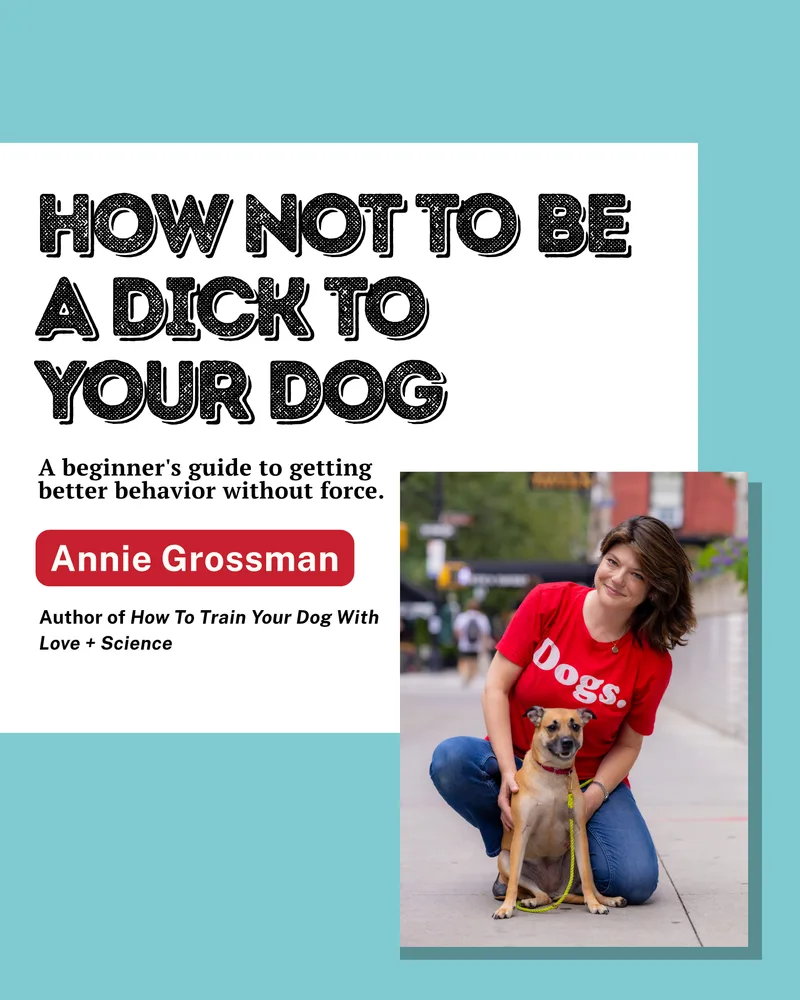
In our very first episode, meet your host, dog trainer Annie Grossman, School For The Dogs' co-founder. Learn about her journey from average-jane dog lover to passionate defender of ethical dog training and ownership.
NYC-based dog trainer Annie Grossman loves to find engaging ways to help both dogs & humans approach training as an exercise in better understanding all animal behavior. She specializes in working with puppies, teaching tricks, & prepping dogs for commercial work.
Transcript
[Intro]
Hi! My name is Annie Grossman and I’m a dog trainer. This podcast is brought to you by School For The Dogs, a Manhattan-based facility I own and operate along with some of the city’s finest dog trainers. During this podcast, we’ll be answering your questions, geeking out on animal behavior, discussing pet trends and interviewing industry experts. Welcome to School For The Dogs Podcast!
Annie: Hi! This is Annie. Thanks for tuning in to our very first episode. I’m here with my co host, Amos, a 12 year old yorkipoo. Say hi Amos! [barks] Good job, buddy! Some of you might know me from School For The Dogs. Those of you who haven’t been by School For The Dogs, if you are in New York City, definitely come on by. We’re located on East 2nd Street near Avenue A. We host classes, play groups, private lessons and I’m sure that during the course of this podcast, we’ll talk about lots of the going-ons at School For The Dogs, and you’ll get to meet some of our trainers but also some of our students, both human and canine.
So as this is our first episode, I wanted to take some time to talk both about how School For The Dogs came to be and my background in dog training. The dog training we do at School For The Dogs is called many different things, sometimes it’s called award-based training, sometimes it’s called clicker training, it’s called positive reinforcement training, and in the next episode I’m going to go into some detail about each of these labels and exactly what they mean. But part of the reason why I really wanted to go into some depth about how I got into dog training is because I started out really knowing nothing and I had a lot of misconceptions which I think are worth mentioning. Before I started really studying dog training about eight years ago, I had no idea that dog training wasn’t just one thing. And I’m pretty sure I would’ve rolled my eyes at the notion that there could be all these different labels, and styles, and points of view about dog training. I really knew nothing. And when I started to learn about dog training, the way that we do it at School For The Dogs, it was like suddenly things came into focus in a way that I could never have expected. My world view shifted and, again we are talking about dog training here and I know that it might sound ridiculous that someone’s entire life philosophy could change because of something like dog training. I know how absurd that sounds. But it was really true for me and part of the reason I feel so passionately about, not only training dogs, but helping people understand dog training, is because essentially I feel I’m helping people tap into what they already understand but perhaps don’t recognize about animal behavior. And we all know a lot more about animal behavior than what we give ourselves credit for, because we are animals who are behaving all the time. And while I don’t think that dogs are people or people are dogs, the basics of why we do what we do and why they do what they do, is essentially the same because the science of behavior is not species specific. So I believe that by learning to train your dog, you can not only improve your relationship with your dog, but I think you can improve your relationship with others and you can improve how you interact with the world around you. So for me, dog training really is about much much more than down, sit, heel, stay. I will talk about how to get your dog to sit down and heel and all of those nice things, but I hope that people listening to this podcast will take away more than that.
But that’s why I wanted to talk about sort of my background because I really came in knowing nothing and kind of, like I said, having a sort of eye rolling attitude about not just dog training but the entire pet sector. I think I always really loved dogs but it wasn’t something I was proud about loving. But I was from a very early age, an entrepreneur, and I started a dog walking business when I was just 10 years old, walking my neighbor’s dogs. I believe I got one dollar per walk. And I got my first puppy when I was 12 years old, it was a gift from my mom. And Zeke was a Wheaten terrier, he was sweet, he was fluffy, he was a really great dog. But he jumped up a lot and he peed all over the place. And my parents way of dealing with these issues was to alert to what they have learned about dog training. When they were kids, my dad’s method was to bite the dog’s ear, which he said was how mommy dogs related to their puppies. And my mom’s technique was basically to say “No” in the absolute deepest voice she could muster. It was like “NO!” And, not surprisingly, neither of these methods proved that effective. So my mom called in a series of dog trainers. I actually don’t really remember that much about them, except this one trainer who was slightly better than the others. I think her name was Rita. The main exercise I remember her having me do was to teach the dog a down-stay by stepping on his leash about six inches from his collar, so that he really had nowhere to go other than to stay in a down. I don’t think I saw her as an expert or a teacher as much as I saw her as someone who was hired to come in and solve a problem, like a plumber is brought in to solve a problem. And I certainly didn’t see dog training as any kind of legitimate extra-curricular activity, it wasn’t something that, you know, you would put on your college application. It’s interesting how something like horse-back riding is still much more accepted as a hobby. And it’s true that maybe things would’ve been different if I’d grown up somewhere else, but I grew up in Manhattan. And I didn’t know anyone who belonged to a 4H club, I didn’t know people who showed dogs, I didn't know about dog agility. I think my interest in dogs was something that I always felt like I needed to play down because I was worried people would make fun of me for being just so bonded to my dog and so excited about spending time with dogs. But with hindsight, I see that Rita was probably the first person who made me think even in just some sort of small way, that it wasn’t something that I needed to be ashamed about. However, I wouldn’t say she left me feeling particularly inspired, I was a middle schooler and whenever I did any day dreaming about what my life would be like as an adult, I pictured myself as Julia Roberts or Audrey Hepburn or someone glamorous. I pictured myself as an actress, or an archaeologist, or a powerful business woman. And Rita was no Audrey Hepburn. She had stringy hair down to her knees, she was severely overweight, she had buck teeth, she lived alone with six cats, and while I’d like to say I saw through all of that and I saw this really interesting person who saw something in me, I didn’t. So I remember when she said to me, you know, “You would make a really great dog trainer”, I was almost offended. It was almost as if someone said, you know, “One day when you grow up, maybe you can become a janitor.” But I remember her saying this to me and I think in some way, it must have stayed in my brain because here I am talking about it all these years later.
I didn’t become a dog trainer right away, I didn’t become a janitor, I didn't become Audrey Hepburn. I did become a journalist. And I started working at the New York Observer right out of college. I worked at the New York post a little while too. And I was really a generalist, I was sort of a lifestyle generalist. I wrote a lot about weddings, actually. Which is funny because it’s particularly not an area of interest of mind, but it was my beat for a while. I wrote about food, I wrote about beauty, I wrote about trends. And very occasionally I would pitch a story to an editor about something relating to dogs, especially after I got my dog Amos in 2005. But I was kind of wary of the whole pet journalism sector because I felt like it was an area that wasn’t taken seriously, and so many of the stories that I would read and that editors seemed interested in assigning were like about how people would spoil their pets as if they were humans. And it just wasn’t really my style. I didn’t think my dog was a replacement child that I was spoiling. I saw him really as my best friend, who happened to be a dog. And I felt like I could take good care of him without treating him like a child. The whole notion that taking good care of him meant that I was spoiling him, rubbed me the wrong way. And I don’t think I thought too deeply about it, but overall it just felt like not a place I wanted to put my focus as a journalist at that point. But I did write the occasional pet related story. And in 2007, I actually wrote a piece about how there were a lot more people than ever before who were interested in becoming dog trainers, because of the success of the show “The Dog Whisperer With Cesar Millan.” And I remember when I was writing this story, it was for the New York Times, my editor asked me to double check some parts of the article before publication. So I sent an email to Parveen Parhuti, who at that point was the president of the certification council for professional dog training, and I wrote to her “Would it be accurate to state that some trainers believe in behavior modification theories that relate to broader ideas about the similarities in the ways humans and many other animals learn, while other trainers favor pared down methods about understanding the canine psyche and communicating with the dog as a pack leader?” And she wrote back, and I’m quoting here “You are putting the legitimate field of behavior science on the same level as myth, misinformation, and marketing. What you’re asking is similar to asking whether the statement, some people think the earth is round, but others take the view that it is flat, was accurate.” So currently, things that she totally hit the nail on the head here and I can’t believe I even emailed her that question. But my past self, the one who wrote her that email, read her response and just thought like “Whoa, lady. You really take these stuff super super overly seriously.” And I forwarded it to my editor with a note “Sounds like some serious insider baseball.” Now I look back and think, “How could I have been so wrong about how I saw dog training?” But the truth is, it wasn’t so much that I was wrong in what I thought about dog training prior to, let’s say, 2010. I was just innocently ignorant. And I believed in the myths and marketing that Parveen mentioned. I just didn't have all the information. And I think that’s true of a lot of people who have really good intentions and are working with their dogs and trying really hard and perhaps not seeing results and not seeing dog training as part of the bigger picture as it relates to animal behavior. Yes, there’s skill involved. Yes, I think there is a certain level of artistry about it. But before any of that, it’s an application of behavior science. And when you can start to see it in those terms, I think it really changes everything. But it can be scary to sort of take the leap and accept that it is an area that you maybe don’t already know all about. It can sound like zealotry when people talk about it as a science. And once you see it in that way it’s really hard to unsee it. And now, being on this side of it, I appreciate the frustrated tone of Parveen’s email to me because I have since then, many times been in the position of trying to explain the legitimacy of science-based dog training. And it turning into an argument where it feels like I’m trying to convince someone that the world is round and not flat, which is a frustrating position to be in. It’s kind of like gravity, right, you can not understand gravity, you can choose to not believe in gravity, you could not know about gravity. But that doesn’t mean gravity is not affecting you all the time. And it’s the same thing with accepting that there is a science of behavior and we are all affected by it as much as we are affected by gravity. And I think that dog training, it’s kind of like we have taken what we know about this science and developed technology to use it to our advantage, not unlike people who have a really excellent understanding of gravity have developed technologies to use gravity to their advantage. Whether that means building planes or drones or whatever else. But anyway, we have plenty of time to go over the details of the science of animal behavior.
Let’s get back on track and go back to the story of my life. I was in my 20s, I was working as a journalist, things were going well, and then around 2009 everything just kind of came to a slow stop. It just became harder and harder for me to make a living. A lot of the publications I worked for regularly closed, a lot of the editors I’ve written for regularly lost their jobs. And it just started to become so hard and I just couldn’t figure out how to make it work anymore. When you’re self-employed, you’re always hustling, you’re always selling yourself. I think you really have to be into what you’re doing in order to keep that up. And I just lost it somehow. I just was no longer into it. It felt like I was working harder for fewer rewards. And of course, the main reward had been financial, was making a living doing it and I had thought I was building a career and it was only going to get easier and easier. So like a lot of people at that time, I had this super lone moment of feeling like “Oh my god! What am I going to do?” How am I going to support myself?” I tried to get a job as a bank teller and got rejected, I tried to get a job as a barista. I remember at one cafe, bringing in my resume, and while I was there, four other people came in with their resume to apply for a job. It was like there were no jobs. It was a really scary time and I didn’t know what to do with myself. So I sublet my apartment, and moved back in with my mom into my childhood bedroom, which was literally a walk-in closet with a window. And I just worked at peering my lifestyle around to make it as simple as it could be. And it left me with a lot of time to bring my dog to the dog park. And I used to bring a notebook, and I would literally make lists of things that I liked. Things I liked to do, things I liked to eat, just stuff I enjoyed. Because I knew that I had to find some way to make a living where I could be engaged with what I was doing. Where I could be excited about what I was doing. Because in my own experience, I’m just not good at half-assing it. If I’m not interested in something, I’m not good at faking it. It’s kind of funny that I did this because today, as a dog trainer, I’m always telling my clients how important it is to really catalog what is rewarding to your dog. What do they like to do? What do they like to eat? Where do they like to go? Who do they like to be with? Because whenever you are trying to affect any kind of behavior change whether it’s in a dog or in yourself or in someone else, you need to know what currency you’re working with. And what’s rewarding to me, might not be rewarding to someone else. What’s rewarding to one dog, might not be rewarding to another dog. So creating these kinds of lists, was actually a really great training tool whether you’re working with dogs or humans. Anyway, my lists were kind of all over the place. You know, I was thinking maybe I should become a baker, maybe I could be a makeup artist, and everything in between. But the thing I kept on coming back to was that I just really loved sitting in the dog park making lists. And I loved watching the dogs, and I loved hanging out with my dog, and I loved talking to people at the dog park about talking to their dogs. And I thought “You know, wouldn't it be amazing if I could just figure out a way to do this for a living. And Rita’s words were still there, deep in my memory. And when I wrote the article for the Times about people increasingly wanting to become dog trainers, I had looked into different programs just a little bit. Different programs to become a dog trainer. And I haven’t been encouraged with what I found. Most of them were correspondence courses and a lot of them just looked way too eager to take people’s money. And part of what I had written about in that Times article was that it is not a regulated field, it still isn’t. There are very few reputable certifications and there isn’t a clear path to becoming a dog trainer. There is no specific degree that you need, there are no specific requirements. Really, every dog trainer I know has taken a different route to get to where they are. And while there are undergraduate programs that can help you become a dog trainer, and there are certainly graduate programs, you have to know what to look for, you know, it’s not like “Oh! I want to become a lawyer so I’m going to take the LSATs and I’m going to apply to law school.” And it’s not like that at all. And my survey of what was out there, made me feel like I was at risk of taken advantage of. And again, it’s hard for me to think back and really put myself into the mind that I had back then, but I don’t even know that I knew what it is I wanted to learn if I were to go to some kind of program to become a dog trainer. Like I said, I don’t think I thought of it as an application of a science, I think I saw it as an industry where people came in and solved problems. But I’m not sure what I thought I was going to learn as far as techniques go. I think it had a lot to do with charisma and equipment and magic words. I say magic words because sometimes today, I’ll ask my dog to do something, you know, “Roll over” or something like that and someone will say “Oh! What word did you use to teach him how to do that?” And it just seems like the most ridiculous question to me at this point. It’s not about the word, there’s not like certain thing you have to say or a gesture you have to make that’s going to suddenly make your dog do all the things you want him to do. And that's clear to me now, but I think maybe it wasn’t back then. And so when I thought about going to a program to become a dog trainer, I think I thought that there was going to be some kind of magic involved. And to just jump forward in time a little bit, now I know not only is there no magic involved, but I say to my clients all the time “If what I’m saying doesn’t just inherently make sense to you. Please tell me. Because in that case, I’m not doing a good job of communicating.” That doesn’t mean that people still don’t sometimes want magic, and that’s why people make the weird “psst” noise that Cesar Millan does and that kind of thing. I’m just not there to give you magic. And it’s understandable because when people have a new dog or they’re having a serious problem with the dog, you want that magic wand. You want that secret word. And many times I have felt when I’m walking into someone’s home, as a dog training expert that they're expecting me to say something that’s going to cure everything and I feel like “Gosh! You know what, I could tell these people to jump up and down three times on their left leg and yell the word “Strawberry” really loudly and I bet they would do it.” So anyway, let’s go back in time again to me sitting at the dog park, thinking about the fact that I love to hang out with dogs and watching dogs and talking to people about their dogs. They’re not really thinking seriously about becoming a dog trainer only because they have no idea what that would involve and it seemed like a potentially frivolous thing to do. So one day I’m in Lionsburg, Brooklyn at the dog park with my dog and this guy walks in and he had a clicker hanging on the end of his leash and a beautiful white pitbull. And I didn’t know what a clicker was, I knew it had something to do with dog training, but I struck up a conversation with him. And I didn’t know this at the time, because actually a very well known comedian whose name was Joe Mande, he wrote the book “Look at this Fucking hipster”, he’s been at Parks and Rec, I’ve sort of followed his career since then. And he’s a really impressive guy. But at that point, all I knew was he was some dude in a dog park with a clicker on his leash. And he told me he had gotten it from his dad. And his dad had been a criminal prosecutor, who upon retiring, decided he wanted to become a dog trainer and he got his education at the Karen Pryor Academy and now was a professional dog trainer. I thought “You know, his dad sounds like a pretty serious person who wouldn’t be taken in by a bunch of charlatans, so this program that he went to must be something worth looking into.” So I contacted his dad, who’s name is Lou Mande and I went to go visit him in Philadelphia. And I remember he showed me all these amazing things his dogs could do. He asked the dog to walk backwards, and the dogs walked backwards. He asked the dogs to play dead, they played dead. And it was all very quick and clean and it seemed very easy. And he explained to me that yes, these were tricks but really, the training that he had done to achieve this place with his dog was not that different than training that might be done with seeing eye dogs or bomb detecting dogs. It was just a different application of the same kind of training. And I certainly had never thought in those kinds of terms before. And he brought me into his library where he had just binder after binder after binder of all the syllabi from Karen Pryor Academy, all the homework he had done. And he all just had one bookshelf after another of books about dog training, dog behavior from like every possible different angle. And my mind was blown. It just had never occurred to me that this was such a serious area of study that all of these kinds of books could exist. And at some point I think I mentioned Cesar Millan, since he was really the only dog trainer that I knew anything about since my days with Rita. And Lou was like, “You know, Cesar Millan’s really not where it’s at.” And certainly in the Karen Pryor community he’s kind of a Voldemort type character and again, I remember thinking like “Oh, these dog trainers take themselves so seriously. And clearly, Cesar Millan knows what he’s doing since he has and he’s a millionaire. And I don’t know why dog trainers seem to be so touchy.” Now, the present day version of myself definitely does think that Cesar Millan has been probably the worst thing to happen to dogs in the last 50 years. I think he’s been the cause of a lot of misinformation and a lot of pain and suffering for both dogs and people. And I’m sure that this will be a topic that will come up again in this podcast. But I don’t want to get too much into my hatred of Cesar Millan right now. I’m just mentioning it because it’s just another reminder, at least to myself, of how much I’ve changed and how learning about good dog training really transformed not only how I think about dogs but how I think how people think about dogs and the world in a much broad way than that. Anyway, shortly after that visit to Lou Mande’s house, I applied and got accepted to the Karen Pryor Academy which is largely an online program, but you’re also paired with a mentor with whom you do a two day workshop every six weeks. I did mine in Endicott, New York with a wonderful trainer named Steve Benjamin. And I just dove right in. I think it cost about 5,000 dollars at that time and I put the whole thing on my credit card. I remember the guy I was seeing at the time was like “Are you crazy? You need to save up for this. You have no idea what you’re getting yourself into. You’re making an irresponsible decision.” And I was like “No. I have to become a dog trainer so that I can make a living and then I’ll be able to pay off the credit card. I can’t save up the money to become a dog trainer because I don’t have a job to be able to do that.” So in a way, he was right. It was an impulsive choice that maybe wasn’t super well thought out. In the end, I went through the program and I did pay it off working as a dog trainer so, ha!
Karen Pryor Academy was founded by Karen Pryor who is thought of as kind of the founder of clicker training. And I’ll talk more in the next episode about exactly what clicker training is. But she definitely is a hero of mine and what she did that was so innovative was she took the writings of the graduate students of B.F. Skinner, who’s thought of as really one of the founders of the science and philosophy of behavior. And figured out how to apply what they were doing in university laboratories to training dolphins at a marine park that her husband owned in Hawaii in the 1960s. And in the 80s and 90s she began bringing the tools and technology she had used to train dolphins to the world of dog training. She started the Karen Pryor Academy, I believe, in 2007. And there is now something like a thousand graduates brought out all over the world. It’s an excellent program and there are other really good programs that are out there right now. There are also some not so god programs. And I think that the Karen Pryor Academy was just an excellent starting place for me. It just presented an entirely new way of seeing learning as a whole, not just dog training. But made me see that we are all learning all the time. Behavior is happening all the time. And at the job of a teacher, or trainer as we call them when we’re working with dogs, is to set a path in which your learner is going to have the best possible chance to make the choices you want them to make. Ideally, there shouldn’t have to be any force involved. And prior to going to Karen Pryor Academy, I never saw that learning could be something that was just 100% fun and enjoyable. Today, at School For The Dogs, when our front door is closed, it’s a glass door, we have our dog students begging at the door trying to get in. I call it playing reverse hooky. And now, I think that’s how students should feel. They should be that excited to go to school. And it breaks my heart when I think of myself when I was a kid and how much I hated school. You know, anything we do in life, we do because it’s being reinforced in some way. And that reinforcement can either be positive reinforcement which means something’s being added to the equation in order to make it more likely that the behavior is going to happen again, or it can be negative reinforcement, which means the behavior is being encouraged because you’re avoiding some kind of pain. Negative reinforcement really is coercion. You’re doing something because you don’t want to get into trouble or you don’t want to get hurt, you don’t want something bad to happen. And for me, going to school was all about not wanting something bad to happen, not wanting to get into trouble, not wanting to get yelled at or get a bad grade. And learning in that way is just no way near as enjoyable as learning can be if positive reinforcement is the go to teaching method. Karen Pryor Academy also made me see just how stupidly fun dog training could be. I saw that it wasn’t just about problem solving. It wasn’t just about keeping dogs from peeing where they shouldn’t. And that dog training wasn’t necessarily something you had to do with a purpose. Prior to KPA, I’m sure I saw no value in teaching a dog tricks. But now, trick training is one of my favorite things to do with my dog and with clients because, as I always point out to my clients, dogs don’t know that some behaviors are silly and some are important. To them, a sit is as silly a behavior as a roll over. It’s all just something the human wants me to do. It’s all a behavior. And that too just made so much sense to me when I started to see that behavior is happening all the time, that training was happening all the time. It wasn’t just when I decided I wanted to train my dog that we were doing dog training. Dog training was just constantly happening and I only occasionally tuned into it. The very first thing in KPA that they had us teach was a lip-lick. I taught my dog to lick his nose. And I remember thinking “No way. There’s just no way that I’m going to be able to teach my dog to do this.” But I did and I also learned so much from that exercise. And in that way, I think it’s kind of like teaching a kid chess or an instrument. You may not be teaching practical skills but you’re building their ability to learn and enriching their lives in the process. Really, I don’t think KPA was a complete education for me, but it was a really great start. It opened up my eyes to what being a dog trainer could mean. And what a career in dog training could look like. That said, I have to admit that I spent a couple of months after I graduated, sitting at my desk, just totally puzzled. Like, “Okay. I got this degree. I’m now a Karen Pryor Academy certified training partner, and now what? How do I do this? I had never taught a lesson, I had never taught a class, I’d never even sat in on a class and in New York City there was no one who I clearly felt like I wanted to mentor me. Like I said, I had studied with this guy Steve Benjamin but he was in Binghamton, New York and I was a little lost again. Really confused as to how I could parlay all that I had learned about this amazing field into an actual career. So this was late 2010, and a couple things happened that got me out of this rut. The first big thing was that I went to the annual conference of the Association of Professional Dog Trainers. That year it was in Atlanta. And I didn’t really know much about it. I kind of went on a wim. But I was just so desperate to figure out how to do this thing, that going to a gathering of several thousand dog trainers seemed like it could only be a good idea. And it really was up until that point, the only professional dog trainers I’d ever met were Rita, Lou Mande, and Steve Benjamin and the two other women who were in my KPA class. In Atlanta, there I was suddenly in a sea of dog trainers and I saw that not everybody was of the Karen Pryor mold. There were lots of different kinds of dog trainers. And the Association for Professional Dog Trainers is not an organization that offers any kind of reputable certification or licensing, they don’t limit who can or can’t join, as far as I know. So it was kind of interesting to see that there was and still is a divide in the dog training realm between people like me who are on the more science-based positive reinforcement side of things and those who still use methods that are more rooted in coercion and punishment. And I just want to say, you know, positive reinforcement does not need to be all hearts eyes with dollars?? All the time and punishment is certainly a part of life. And I look forward to talking in detail about what punishment is and what reinforcement is. But I really do believe that it’s our responsibility to use the least aversive techniques and the least coercive techniques and the best research we have about dog behavior in order to get what we want from our dogs. Anyway, when I was at this conference in Atlanta, it was the first time I saw how awesome the dog training industry was. Every single person I met was doing something interesting with their dogs. People were service dog trainers, there were people doing every kind of dog sport that I had ever heard of, and plenty I hadn’t ever heard of. There were business coaches there who specifically worked coaching people with dog-related businesses. There was a trade show where they sold a million kinds of dog toys and books on every subject having to do with dogs. And of course, the best part were the lecturers and the panels which really delved into dog evolution and the different areas of the rescue world. And I just saw what a multi-faceted, interesting, exciting world dog training was part of. But what was also interesting was I saw how easily this whole world could be dismissed or reduced down to stereotypes about women like Rita because only six or seven months prior to that, I had been someone who might have been that dismissive, someone who thought dog training was Cesar Millan full stop. So on the one hand I was there as a dog trainer or an aspiring dog trainer, on the other hand I was still a cynic. Where that cynic was still inside me, I was still that New York journalist who saw how it all could be reduced down to a bunch of people taking their dogs too seriously. And I’ve kind of had an epiphany where I realized I’m not sure I want to be a dog trainer as much as I want to be someone who could communicate from this world to the people in the world I had lived in previously. I saw how dog training was seen by people outside of this buble. And well I wanted to figure out a way to pop the bubble to undo people’s notions about what dog training was as if it were some contained thing and instead to help people see dog training as something that is fun, and exciting, and interesting, and awesome, and also as something that cannot be separated from our lives with dogs and contains so much goodness that applies to the world outside of pet ownership as well.
Of course, I had no idea how I was going to do this, but fortunately two other big things happened not that long after I returned from Atlanta. One was that I met Kate Sinisi who is now my partner in crime at School For The Dogs. And we actually met through a message board that was run by the Association Of Professional Dog Trainers, turned out that we literally lived across the street from each other and we were both in a similar place in our lives of trying to figure out how to start careers as dog trainers. Kate was working as a graphic designer and pursuing her own education in dog training, and like me was kind of just stumped as to what the next steps were to turning this interested passion into a living. So we decided to join forces and figure out how we could do it together. The other important thing that happened around that time, which really helped me get some solid footing as I tried to figure out how to build a dog training business was that I got a really lucky break and that I was offered a job as an associate producer for the Animal Planet show “Too Cute Puppies And Kittens”. I really have no background in television but I knew the executive producer and she felt that my knowledge about dog training combined with my journalism experience would make me qualified for the job. And it was just such a great opportunity in so many ways, largely because it gave me the financial balance I needed in order to figure out how to start and set up a dog training business. It also gave me a lot of hands-on time with puppies and with breeders on set. Which I think offered me a really unique and important education because today I usually work with puppies after they’ve gone into the homes of their owners. But at “Too Cute” I got to work with puppies from really, the day after they were born until they were eight or ten weeks old and I learned a lot watching them during that crucial developmental period. And it was also interesting because it was the first time that I got labeled by others as a dog expert. And that was eye-opening to me because I knew I was still pretty green, I had only just started learning about how to train animals but I saw how magical it seemed to others. And while I saw that what I was doing onset really wasn’t that complicated. I also saw that to everyone else, it seemed like some sort of special hidden talent. And my inclination was to say “No, no no! I’m not doing anything special. This is how you can train a dog to do this, let me show you.” But the reality is I was working on a set, everyone there had a job, no one was there to learn about animal training, so I just accepted the accolades and moved on, but it was certainly an early lesson in how easy it would be, as I’ve said before, to teach people that they need to jump up and down on one foot and yell the word “strawberry”. It’s like we somehow have gotten to a place where we see ourselves as so separate from the entire animal kingdom rather than seeing ourselves as part of it that anyone who was able to tune into how animal behavior works just seems like they’re some kind of sorcerer. I remember in particular this one incident where we were shooting a scene with a whole bunch of mini Aussie Shepherd puppies and ducklings. And I was the designated duckling wrangler and they wanted me to get the ducklings to walk over this little bridge to the puppies in a line. And really, all you have to do with ducklings is put them on any kind of relatively narrow path and they’re going to line up and walk one ahead of the other on their own. So I basically had to do nothing except put the ducklings onto the ground and let them do their thing but everybody just thought that I was some sort of duckling whisperer or miracle worker that I could get them to walk in a line. And I think it’s seen as false humility when I was like “No. This was really easy to do.” Anyway, “Too Cute” was a lot of fun. I was there about a year and the many hundreds of hours of footage I had to watch of puppies certainly helped inform my dog training in the long run. And it also got me really excited about applications for animal training beyond the living room or classroom. Today at School For The Dogs, we do occasionally do commercial work with some of our dogs. And I love it! I think it’s really fun for the trainers. I think it’s really fun for the dogs and I think dog owners love to show off all the good training they’ve done with their dogs on set and to be able to say my dog does modelling, or my dog does T.V. commercials. Kind of in the same way I think people like to say their dog is a therapy dog. It’s a way of saying, you know, my dog is so well trained and it doesn’t just mean that he’s well-behaved in my apartment it means that he is so smart and so well-behaved that he can improve the lives of other people as well. Anyway, during 2011, 2012, during the time I was working at “Too Cute” during the week, on the weekends Kate and I were constantly powwowing, trying to figure out how to be dog trainers. And at some point I said “You know, I really think we need to have a physical space where we can do dog training.” Most dog trainers, at least in New York City, work out of people’s homes and if they teach classes or lead playgroups it’s usually at a dog day care center. And early on, I really felt that so much of dog training was literally about space management. Literally managing where your dog is spending his time is a big part of any dog training puzzle. And also managing where your human students are spending their time if you're a trainer, and dog trainers like to point out that unlike most teachers we have to work with two species of animals at once. So, I felt like if we could have a physical space, we would be setting ourselves up for success. We would be setting our human students and our canine students up for success. We did teach briefly at a dog day care. But when you’re teaching on a dog day care, you really can’t control the space. I mean, I think you can control the space enough to make it workable for training dogs. You’re working in a place where there are four walls, there are gates, you know, all that is certainly important but, but part of controlling a space is controlling how your students feel in the space. And I found myself really concerned more than anything with how my human students felt in a dog day care, because I felt really stressed out. I felt stressed out by the lighting, by the smells, by the barking, sometimes the dog day care workers would be in the other room yelling at the dogs. And like, even forgetting my students, I felt like i couldn’t be the best teacher or trainer I could be if I didn’t feel comfortable. So we decided to turn my living room into a training studio. So we put rubber mats on the floor and bulletin boards on the wall and kind of decorated it as if it were a kindergarten classroom. And we started holding classes there and private lessons and somehow it worked. It took off. We could only have about four or five dogs there at a time, but classes started filling up. And we didn’t have much overhead and we sort of miraculously found that it worked. And looking back on it now, it seems kind of hilarious because it was kind of ghetto, I mean, it was in my living room and it was all sort of thrown together. I mean, it was thrown together with a lot of love, and I think that was obvious to anyone who came. But it was definitely not as polished as what we’re doing now, but I think Kate and I felt like we’d arrived. We’d figured out how to be dog trainers, we had our own classroom. How could it get better? You know, we’d made it. And it was a really exciting time.
Then on December 29th, 2013, I was home alone with my cat and my dog, eating take out Indian food. When the smoke alarm went off and I went into the training studio, and smoke was just bellowing towards me. So I grabbed my dog, my cat, my keys, wallet, coat and I was out of there. My neighbors managed to get out too. But the whole building was totally wrecked. Fortunately no one was hurt. Turns out it was just some freak electrical thing that happened in the wall with old wiring. And anyway, there went School For The Dogs. Literally up in flames, and my apartment along with it. Fortunately the building didn’t have to be totally demolished, but there was no clear timeline of how long it was going to take for them to make it liveable again. And while I could survive on people’s couches, School For The Dogs certainly couldn’t. So, it was a difficult time and it really felt like “Oh God. Are we back at square one? Here we built this thing and it’s not like we’re going to be able to recreate those in someone else’s living room.” So I said, “You know, let’s try and reach out to our clients and see if they can do some kind of fundraiser to put together an off money to get an actual, legitimate retail space.” So we did. We were able to raise 20,000 Dollars on Indiegogo. It was enough to put down security on a little storefront we found on East 2nd Street. It was a really grungy, like Qi-Gong Acupuncture place that was like carpeted with cockroaches and smelled like old socks and cigarettes. But we ripped everything out and Kate’s dad, who is an Architecture contractor, built out the space. And made a little retail area in the front and we opened that up in June 2014. A year after that, slightly a larger place in the same building came up for rent and we moved there. And that’s where we still are today. We hired our first full time employee later that year. The following year, we hired Anna-Marie Johnson who is now our studio manager and basically third in command. And we have four or five full time trainers, four or five part time trainers, and a full time receptionist. And we’re pretty much at capacity. Schedule-wise and student-wise there’s stuff going on at School For The Dogs everyday during the week from like 8 AM until 8 PM and all day and the weekends as well. If you’re in the New York area, I really hope that you’ll come by School For The Dogs at some point. Like I’ve said, we’ve really tried to make it a place where people can feel comfortable, where people want to come and hang out, because people want to go where their dogs want to go. But certainly, dogs end up going where their people want to go too. And there’s always the tendency to think about dog training as if it’s something that we’re doing to a dog and really though, I think it’s about communication. Sometimes, my clients would giggle and say “Are you training the dog, or are you training me?” And I always go back to the word ‘communication’. Communication goes two ways. So, those of us who work at School For The Dogs are trying to help people better understand their dogs and dogs also better understand their people. And so much of that begins with this space where everybody is choosing to be, where everybody wants to be. You know, I mentioned our dogs who play reverse hooky. Well, our human students are paying to be there. They’re signing up on waitlists to be there. They’re giving up their weekends and evenings to be there. And as a business owner, of course, that’s hugely qualifying but as a teacher and a trainer, I feel like “Yup! That’s how it should be.” The way I see my job is to make learning so much fun for both our dogs and our humans, that they don’t even realize it’s happening. They just know that they're in a place where they feel good and that they’re going to take any opportunity they have to be there. So that pretty much brings us to the present day. I foresee doing less talking about myself in future episodes because the details of my life are quite inconsequential. Just thought I’d wrap this up with a little bit of awesome powers for any Mike Myers fans out there. Anyway, thank you so much for listening and I hope this has been a helpful little window into who I am and where I'm coming from.
Fun dog fact of the day: Did you know that Tibetan Terriers are not actually terriers? They were mistakenly named terriers by European travelers to Tibet, because they do indeed look a lot like terriers but they’re actually more closely related to the Lhasa Apso and the Shih Tzu.
Just wanted to give a shoutout to one of my favorite Tibetian Terriers, Tashi, who lives in LA with his human Jessica. Tashi, Amos is here and he sends you a big old butt sniff. ‘Till next time!
[outro]