October 31, 2024 · 34 min
Dogmas & Dog Ewoks: How Halloween can polarize dog lovers
Everything seems crazy and awful right now in the world and then, on top of it all, people are… putting costumes on dogs.
Anamarie and I delve into the weirdness and ethics of dressing up dogs. Additionally, we talk about Brian Hare and Vanessa Wood’s Atlantic article about a third wive of domestication in dogs, and the Monks of New Skete’s feature in the Associated Press. Ultimately, my 5-year-old sums up the spirit of the episode by sharing her own impromptu thoughts on how we should consider our dogs comfort above all else.
Notes
Brian Hare and Vanessa Woods in the Atlantic
The Monks of New Skete in the AP
Time stamps
00:00 Halloween conversations with a three year old
02:32 Dog Halloween Parade Concerns
06:57 Dog Training Philosophies and Stereotypes
16:00 The Monks of New Skete in the news
31:31 Halloween conversations with a five year old
Transcript
This transcript was made automatically from the audio, so it may contain small errors.
So last night on the couch with my three-year-old who was feeling very excited about Halloween. And she was talking about how she was going to wear a costume for Halloween. But then she's like, Grandma's not going to wear a costume. And I said, no. And she said, the couch isn't going to wear a costume.
And I said, no. She said, the lamp isn't going to wear a costume. I said, no. And she said, and she said, Poppy's not going to wear a costume. Poppy's our dog.
And I said, actually, you know, though, lots of people do put their dogs in costumes. And she goes, what are you talking about? It really cracked me up. And it relates to today's episode, which is a conversation. Anamarie and I had...
About, among other things, Dog Halloween. We touch on a lot of other interesting topics too, but before I play you this episode, I just wanted to mention two things really quickly. One is, if you're in New York City, please come by the Museum of the Dog, Saturday, November 2nd. At 1 p.m., I will be there in conversation with Alex Pasternack of Fast Company Magazine, and I'll be signing copies of my new book, How to Train Your Dog with Love and Science. Also, this week...
The audio version of the book was published. It's currently the number one new release in pets and animal care on Amazon. I hope you will check it out. It was narrated by Eunice Wong, and she just did such an amazing job. It's a really enjoyable listen.
You can find it on Audible or at audiobooks.com or on Amazon. Just search for How to Train Your Dog with Love and Science. And yeah, if you've read it and you've enjoyed it, please go ahead and leave a review there. And if you want to upload your receipt at AnnieGrossman.com slash book, I will send you a sticker and a custom clicker that actually has the title of the book on it. It's very cute.
I think you'll like it. And I appreciate your purchase and hope that you've liked the book. Let's live with dogs in harmony. Good dog training is the key. You don't need to cause pain if you use your brain.
Train your dog with love and science.
I'm feeling frustrated by two things that I feel like I need to talk about. So first, the world just feels so screwed up right now in so many ways. Everybody's struggling. I can't tell the regular news from like SNL. And I've been preoccupied by running the business and my kids and the book and everything else that it's like I almost forgot about Dog Halloween.
This year. Yeah. Which has been something that I have had a bee in my bonnet about for a long time. But this year, a friend of my family's who doesn't know me as a dog person necessarily, she's like, oh, did you bring the kids to the dog Halloween parade in Tompkins Square this weekend? And I was like, no.
For those who are not in New York City, the Tompkins Square Dog Halloween Parade is really big. People come from all over and the park is packed with dogs in costumes. And here's the thing. I sort of feel bad that I have all these feelings about this because it's like, what kind of Scrooge is going to piss on people's... Desire to do something cute with their dogs.
But I mean, I can't go because like I just see signs of stress left and right. And I see like fights waiting to happen between two stressed out dogs that are wearing these outfits in this cramped environment. And to be sure, I think plenty of dogs, you can put a costume on the dog and it's like absolutely no big deal and everyone's having fun. Whatever. But the way that it's become about the people and the people showing off their creativity, this outlet for human expression that involves doing something that could evenly possibly stress out some dogs, I find really...
Barbaric is maybe too strong a word, but I think there's two things going on, right? Like one level one, there's like a whole level of just like the insanity that is bringing your dog to such a crazy environment. It's like people bringing their dog to like farmer's markets or festivals and stuff like that. And your dog's like not happy. And then adding to it that your dog is probably wearing a costume.
I guess you could say it is about spending time with the dog, but it also is this weird like dog as accessory thing, which forget the feelings that I have about like concern that the dogs are stressed out, which is a concern. But anyway, more than that, I also feel like there are so many stereotypes about people who are obsessed with their dogs. And I feel like this kind of fans the stereotype flames. You don't want to be lumped in with these people. I just feel like it skews things too far in a direction that feels like, again, it's about dog as accessory.
It's like Paris Hilton toting around her dog in her handbag. And I think some of these people probably like truly are really thoughtful, wonderful dog owners, like maybe most of them or all of them. I don't know. But it's still too close to that stereotype for my comfort. Yeah, I was looking through the pictures when you had brought this up to me and I was like, they're all pretty much.
Small dogs, which like small dogs in general already tend to have higher levels of anxiety. I think it is a little bit different in New York City compared to other locations where a lot of small dogs don't necessarily go out and about all the time, right? And so like maybe like their big event of the year and it might be the big event of their life to go to this event is like it's asking a lot of the dog. Right, like big event and not in like a good way. No, like it's like their bar mitzvah.
Yeah, correct. There's a whole range of people that aren't even dressing up their dog and they're just bringing their dog to because they're like, hey, this is where a bunch of dogs are. I know from my family that there are people in my family who think what I do is completely ridiculous. It's like the fact that anyone should bother spending time training. Yes.
A dog is silly, you know, because dogs are beneath us. We can push them into their place. And if you can't handle having a dog, you maybe just shouldn't have one. And also the dog's issues are just the people's issues. People are just projecting their issues on the dog.
So, of course, the dogs are crazy because look at how people treat their dogs. I feel like I have lived my life in that kind of with like that static around me and which, you know, I feel like dog training is about helping someone you love live more happily in your life and it can be a hobby. And if that is what people want to spend their money and time doing, I mean, you can put a lot of time into like refurbishing your kitchen, but it's not like improving your kitchen's life. At least you're doing some kind of hobby that has a direct benefit to someone you love. Something that I've been thinking about as of late, I joke that I'm like a bad dog trainer because my minimum expectations for my dog are we cuddle, we chill on the couch, right?
But there's people that love to teach their dogs tricks and of course that's like a whole level of enrichment but I don't even bother to do that. Tying this back into Halloween, I would think that there's a large portion of the dog trainer world, backslash the dog owner world, which again is still a small segment compared to most people, that do agility, do nose work, do protection dog sports, whatever. And I think it would be interesting, like obviously Halloween costumes are a completely different thing because like dogs are really passive and not engagement. But like, how are we gauging dogs motivation to engage in those kinds of activities? I think dogs get a hell of a lot out of agility and nose work and all that kind of stuff than they do than obviously dressing up as a Halloween costume and being like arm candy.
But for a lot of agility and stuff, there are drives to get titles. Like where is this about the person and where is it about the dog? I think that a kind of version of that is, which I know you've seen, I know I've seen with clients through the years, is dogs who aren't dog park dogs but have owners who want to be dog park people. They're like, well, I got a dog because I wanted to go to the dog park. But then someone ends up sometimes with a dog who's never going to be cool at going to the dog park.
Yeah. Well, a lot of people think that dogs are like unequivocally dog social. I always rationalize it to people. You don't like every person you meet. And with dog parks where there's so many different dynamics going on, dogs are coming in and out.
And some days you'll have one dog there. Some days you'll have 40 dogs there. Particularly like some places like Tompkins Square Park. I always kind of joked and called that like a tourist dog park. Yeah.
Because that I felt like people knew Tompkins, right? People know Tompkins because it's by all the bars. It has the Halloween parade. But you would just have like people just like, hey, I'm in the neighborhood. When I realized it was it was like Dog Halloween, I was like, oh, like, do I want to say anything about this?
And I was like, oh, my God, I can't even bring myself to talk about this. I'm not even going to look at the pictures. I just can't. I just have to pretend this isn't happening this year. Then you sent me the pictures from Tompkins and Tompkins, which I hadn't looked at because I was avoiding it.
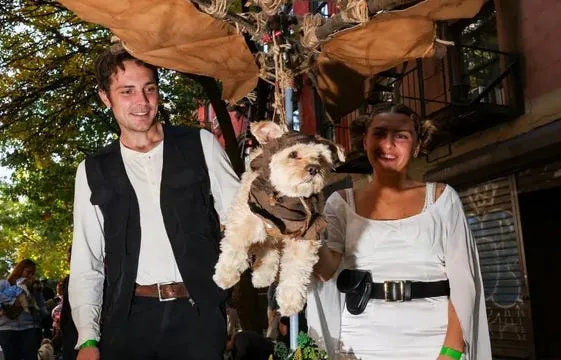
I was like, okay. And there was this one photo of a dog in some sort of furry costume as if the dog wasn't furry enough. Yeah, yeah. And hanging in the air, it was like the dog was like on an IV bag being pushed through the street. And behind it is a guy dressed as Han Solo and a woman dressed as Princess Leia.
It was the flying Ewok. Yeah. Which I actually was thinking after I said this, I'm getting really technical here. In Star Wars, they've been on little drone things, little bikes, but you never had an Ewok not attached to a drone. And so I was really confused at the whole aspect, the Ewok flying through the air.
Yeah, that was one of the enigmatic things about it. But not only was it like the world's most cringy dog costume. But one of the people with the dog was a former School For The Dogs intern. Yep. And I'm just like, did they learn nothing?
Or did they just not care? Does the interest of being like, you know, clever and artsy and showing that you came up with this idea of having your dog, you know, fly through the sky like an Ewok, go above and beyond, like, or maybe that dog is really into that. Yes. To be fair, we do not know. We have no content.
Maybe the dog, like, really? Yeah. Potentially. Potentially. But again, is the dog into that when there's 20 bajillion people yelling and screaming the dog around you, right?
Like, that's a different question. I just think that there comes a point where you need to think about how much of it is really for you and how much of it is really for the dog. And I guess people are going to say that they know their dog and they know what's best, which I would like to be true. But the fact is, when I see how uncomfortable so many dogs look in these situations, I can't help but wonder if people just don't know how to read dog. It reminded me, actually, there was an interesting article that came out in The Atlantic last week about how there's like this, like what they argued was like the quote unquote third wave of like domestication.
It was written by Dr. Brian Hare and his wife, Vanessa, and they're in charge of the... Duke Dog Lab, and they do a lot of stuff with service dogs. And he mentioned, obviously, the first wave of domestication with dogs was dogs from wolves, right? And then you could argue that this second wave of domestication was all the breeding that happened in the 1800s.
And he doesn't necessarily mention it, but how that all related to... Social Darwinism. It's like eugenics survived in the form of dogs. And then the second argument that the third level of domestication was what he was arguing for was that there's like this idea of breeding very special dogs that are service dogs. And I had a very interesting like reaction to it because it was, and given again that like my background is shelter animals, it was implying that like...
And obviously they have, you know, skin in the game in terms of service dogs. And yes, you know, you do want to breed a service dog that is going to be like bred for service. But like the kind of implication that service dogs are the only ones that can really be like designated as like... Truly friendly or X, Y, and Z. Like I had a lot of concerns about that kind of argument because there's just so much more nuance to understanding what makes a social dog than just saying it's genetics and this kind of like one-off.
One of the arguments he made was that some service dogs are showing that they have like higher level of oxytocin and all that kind of stuff. I don't know. I think you could have a service dog that probably wouldn't want to be dressed up in a Halloween costume and, you know, gone through a Tompkins either. I think that's hard for any dog. And to say that, like, we're breeding dogs that like implying that they're like bulletproof.
First of all, so few dogs are bred for temperament overall. Wouldn't it be great if all dogs were bred for temperament? But I think we're very far from that happening. The way that I kind of felt it was written was like as an aside was like, oh, these service dogs are bred for temperament. Oh, but X, Y, and Z, they go through like super, super intensive protocol.
So like I could see how this would have been interpreted by the general public of being, oh, I can just get a service dog and, you know, it will be the perfect dog. And not to think about like we haven't parsed the differences between like the 18 months to two years that these dogs are experiencing of like daily, Training, socialization, handling, all that kind of stuff. And it didn't highlight that there's a whole number of service dogs that fail out of the program. So I just felt like, I don't know, like... I think there is so much more that we don't know about how dogs can handle resiliency and cope with different experiences.
And I don't necessarily think that means that we need to put dogs in a bubble and bubble-proof them, but managing their exposure to things like Tompkins is probably a good idea. Yeah, for sure. So the other thing that happened, actually just happened when I sat down at my computer this afternoon, the window that I opened, I never set this up, but it like gives me random news sites, like clickbaity. And there was a story from the AP that just came out yesterday, and it's in the religion section of the AP. It says, learning about God from dogs, Orthodox monks breed and train canines in upstate New York monastery.
Oh, the Monks of New Skete are new news? Right. As if we haven't. For 35 years? Yeah.
So first of all, as someone who like just wrote a book about dog training that I really hope people will read and is brand new, it hurts a little bit to see the Monks of New Skete, which first published its first book, what, in like the 70s? Yeah, that's what I'm saying. This isn't new. Second of all, I mean, I write about the monks of New Skete in my book as having set a lot of people on a very bad path, I think. Oh, 100%.
And there's a picture of a guy holding this puppy. The guy, who I guess is a monk, is staring at the sky howling like a dog. Yeah, I can see it. The dog's lip-licking like nobody's business. Yeah, the dog has his tongue all the way out of his mouth, like waving its flag of surrender.
Get me out of here. And it says, Brother Luke, an Orthodox Christian monk, holds his 10-week-old German shepherd... After he and his fellow monks sang morning prayers in their church nestled in a forest, Brother Luke walked back to his residence to be greeted by a different kind of choir. Lucy and Iso excitedly woofed as they spotted the Orthodox monk who heads the monastery's German shepherd breeding program. For nearly six decades, the monks of New Skete in upstate New York have financially supported their community and deepened their spiritual life by breeding German shepherds and running on-site week-long training programs for all kinds of canines.
Then there's a quote. One of the things that a dog teaches is about God, forgiveness, and love, and connection. Those are attributes of God. Okay, so what I picked up on is this quote.
The vast majority of America's 100 million pet dogs doesn't need a professional trainer. But many do if their owners want their company in public places. Or if they're struggling with behaviors ranging from chewing furniture to lunging at neighbors, said Mark Goldberg, a trainer in Chicago and former president of the International Association of Canine Professionals. Like, there are so many things wrong with those three paragraphs. Like the perpetuation of the idea that like dogs don't need training is ridiculous.
Like the former president of a training organization would say that dogs don't need a professional trainer. Like that's the whole point of why you have organization. In a note for listeners, the International Association of Canine Professionals, they are considered more of like on the balance side of things. Their code of ethics or code of context for their members basically says like they don't support any ban on any types of tools. You can't, you shouldn't critique other members for using whatever types of tools they want.
Which would 100% tie in to the monks being certified by this organization. Mark Goldberg, he co-wrote their most recent book, The Art of Training Your Dog. Oh, yeah, I know. How to gently teach good behavior using an e-collar. And actually, I have the book right here because I quoted it in my book.
First of all, this book, which is all about using an e-collar, does not once use the word punishment. This actually came up in my language study, was that the Monks of New Skete book was, it's a study, they basically analyzed five books. The paper came out in like 2017. It was like a Cesar Millan book, Monks of New Skete, Victoria Stilwell, and something else. And basically the conclusion of the study was that like all these books...
We're gobbledygook. Like using things that have clearly defined terms within the science, like you couldn't find a consistent definition across the five when you should have a consistent definition because there is a consistent definition. Which only leads to confusion for dog owners who, you know, you pick up one book and then someone tells you to pick up another and you're like, what the hell am I reading? It relates to what, you know, even Watson was saying over 120 years ago, which is, you know... We approach psychology, I mean he was talking about human psychology, but that we approach psychology looking inward rather than outward and it's impossible to say that like what I feel is sad is the same as what you feel is sad, but rather than looking at things that are actually observable and that like we can all agree on.
Yeah. So the monks of New Skete, again, because they're not anything new, and what was also clearly not described in this study is that the monks of New Skete are actually like quite well known for perpetuating the alpha rule. Well, you want to explain what an alpha rule is? Yes. If your dog doesn't do something, you're basically forcibly pushing it down on the ground and basically rolling it onto its back, i.e.
to put it into a quote unquote submissive state. And thus to exert your control level over your dogs. And possibly growling in its face. Correct. So there was this great book by a Polish American history professor.
I read her book while I was researching my book. Yes, The Genealogy of Obedience. It's a great book. It's a great book. It's like the history of dog training.
Yeah, exactly. So basically, Justinia did this like very in-depth, some of it's a little bit difficult to read in the sense of like it's tying into like some very like large social and like humanities thought processes, Foucault and all that kind of stuff. But she goes into this like really nice breakdown of like basically training books and dog training methodologies from the early 1800s to basically now. She talks about the Monks of New Skete because, again, their first book was like in the 1970s. And so I just pulled this up.
I pulled up the text. So she's talking about the first book, How to Be Your Dog's Best Friend by The Monks of New Skete, a book that has interestingly become synonymous with traditional training, even though it is actually one of the first manuals that focus to a greater extent, this is interesting, on the human-animal bond than on providing detailed how-to instruction. The monks, however, advocate the technique of punishing the dog by rolling him onto his back, exposing the dog's belly, and pinning the animal to the ground until he stops fighting the procedure. The maneuver was referred to as an alpha roll and was promoted as a technique that imitates the mother's dog correction of an unruly puppy. And this part's great.
In the illustration, accompanying the description of this technique in the book, the man pushing the dog into the ground has a wistful, almost caring expression on his face, as if he was connecting to the spirit of the dog's wolf's ancestors. I think this is part of the problem that we've discussed previously is like within dog training, it's beneficial to you to say that you have some type of special juju and energy. And so like nothing that the monks are doing is anything special, but they don't use terms that are established within the industry of reinforcement, punishment, anything like that, because they want to say that they're doing something special. Like at the end of the day, everyone's using the same principles. What this article implies is they have this mystical, magical thing that brings them closer to God.
That's what they're saying in this article. But they don't explain what it is. The text is about shock collars and pushing the dogs to the ground. They did go back on the alpha roll thing at some point. Yes, they did.
Yeah, yeah, yeah. But then the latest book they publish is about... E-callers. I remember there was this joke a couple years ago about like what what are the like expected things that you would have in a like dual income now kids household in New York City. I distinctly remember going into people's houses and it was like the joke was like decorative art book, multiple pillows on your couch, like a bar card.
And three or four dog training books that they had picked up for their puppy. And it was always really interesting to see what they had. It was usually there was like a Monks of New Skete, maybe a Cesar Millan, and then it would be like a Sophia Yin book. And you're like, I don't understand. I was like, there's such a range of possibilities that you are reading.
I'm glad you're also seeking training so we can like help clarify these things for me. But they've unfortunately done a very good job of marketing themselves. What gets under my skin about it is the same way that... Cesar Millan's whole shtick is about like, if you become a better person, it will make your dog better. Like salvation for your dog through your own salvation.
It's a sort of sticky idea that bothers me because it's because it sounds really good. But there's not a lot of meaning behind it. And the same thing here. Like, OK, I'm glad monks of New Skete that dogs have brought that dog training and dogs have brought you closer to God. I mean, for sure, I feel like dog training has changed my viewpoint of the world, but I also feel like I could explain I could really explain how.
Well, isn't that the argument that people had against behaviorism? It was too reductionist.
But no, I understand what you're saying. I think, yeah, I think there is this. Yeah. I mean, that was actually another piece of text that was in the Justine's book, The Genealogy of Opinions, was talking about Cesar Millan, even though he never doesn't necessarily say this, but it was like basically all faults of the dog were based on the emotionality normally the woman owner. She was too emotional.
She was too needy. It was reduced at that sense. I think Cesar Millan's ideal person was one that was not overly emotional. Like, I'm sure he has lots of thoughts on Topkin Square Park. According to that kind of dichotomy, I guess I would think I'm soft because I'm not, like, yanking my dog into position.
But I also don't think I'm, you know, dressing up my dog for my own kicks without paying attention to it. The dog's needs. Yeah. Which we don't always know, but at least we can do our best. Yeah.
And I think, again, like his his logic of what a dog's need is a dog's need is like much more simplistic. Right. A dog doesn't need to sleep on the couch. A dog doesn't not to say that your dog should live out. You know, I don't think he would say have your dog live outside, but like your dog doesn't need his food cooked for him.
He doesn't need. Yeah. This obviously is silly because, again, going back to this whole idea of domesticating dogs, dogs are different than wolves. And we can't expect a dog to live off very basic things when we purposely bred them to be highly sensitive to our needs. Oh, here's the line that I wanted to find.
This is from Justinia. She described, so the dynamics of the process suggested above can be easily traced through a close analysis of specific episodes of Milan's show. Here, I will briefly look at two episodes. Both episodes deal with canine aggression, and in both, the root cause of the aggression is diagnosed by Milan as an excess of love that results in the human's ability to structure the human-canine relationship. Additionally, in both cases, excessive love for the dog clouds the female, human's evaluation of what should matter most, the relationship with other humans.
The two episodes are highly exemplary of Mulan's methods. In both cases, there is very little actual dog training involved. It is the owners of the dogs who are forced to confront their supposed emotional issues, which are diagnosed as underlying the dog's misbehavior. The subjects inevitably break down crying once they understand how guilty they are of letting their runaway love for their dogs ruin not only their dogs' lives. But also their interpersonal relationships with other friends and family members.
In each episode of the show, Cesar Millan takes on and inevitably successfully resolves in two cases which are brought to his attention by so-called whistleblowers, friends of family members of the struggling dog owner who contact Millan in what they view as a last-dick attempt to help the owners deal with the dog's problems behaviors. Um, so it's, yeah, it's this idea that, like, there was someone, like, outside looking in and being like, oh my god, my family member is a psychopath in relation to their dogs. Like, they need to be fixed. Um, and I mean, I don't, you know, when your dog has aggression, yeah, sure, like, I sincerely disagree. The situation probably needs to be fixed.
But is it because of their runaway love? No. Like, that's silly. Yeah. Well, this notion that dogs' issues are the human issues, at least as a dog trainer, seems completely backwards to me because I know that the people who come, the people who seek out...
Dog trainers are generally very thoughtful, concerned people who have it together enough to even realize that their dog might have a problem that could be helped. They're not necessarily like the neurotic dog does not does not necessarily belong to the world's most neurotic person. I mean, they might. Yes. I do think, yeah, but that's like definitely like a stereotype.
Positive reinforcement non-aversive trainers have constantly had to like fight against is this idea that like positive reinforcement means like no holds barred. We let the dog do whatever the hell they want. I actually was doing like a little brief job interview thing the other day and they were like, tell us about your management style. And I jokingly was like, what? I think it's a very positive reinforcement, but, you know, like not positive reinforcement permissive, positive reinforcement with boundaries and they left.
I think that's something that like positive reinforcement trainers have had to battle for a very long time is that this idea of like, oh, if I'm going to do positive reinforcement, like it must mean that the dog gets to run loose. And like, you know, that was something that I, you know, was constantly battling with a lot of dog owners. And I think I've mentioned this before, where it's like... These people would be like, oh, I really want my dog to sit on the couch with me, but I don't want my dog to think it's dominant. And I was like, no, your dog's not thinking it's dominant.
If you want it to sleep on the couch, sure. Like, now if your dog is resource guarding the couch, no, you're not going to let your dog sleep on the couch. Right. That would be permissive versus if it's a situation where you're choosing to sleep on another section of the bed because your dog is guarding it, then this is something that we need to talk about. But like...
You can let your dog on the couch if you want to let your dog on the couch, right? Your dog's not sitting there like contemplating, you know, the existential takeover that they're going to have once they got let onto the couch. But that's not how some people's logic is. And I think a lot of that was perpetuated in early 2000s by Cesar Millan, where you're only getting snapshots of these people's relationships. On the television show within 45 minutes.
I think that set a lot of people back. But again, as Justine said in her book, none of these arguments are anything different. Same old, same old. All right. And all this to say, everyone have a happy Halloween with your dog.
Well, I've noticed some people online suggesting introducing dogs to Halloween decorations, the way they socialize them. And I think that's a good way to celebrate the holiday with your dog. Last year, one of my neighbors had this really great decoration. It was like this like dead body wrapped up like a Gulliver's Travel Barbie mashup. It's like this mummy wrapped up and then there's like a bunch of Barbies carrying it across the lawn.
It was pretty great. See, that's creativity I can get behind. Bailey didn't have any reaction to it last year. She did spook a little bit yesterday. There was someone had like a ghoul thing hanging in the wind yesterday in a blue slightly.
And so she kind of just like perked up at that. She reacts to a lot of things that she thinks look more like dog adjacent. A couple years ago, we walked through the FDR Memorial in D.C. and there's a very large statue of his dog, Fala. That no one in my mind, except my dog Bailey, would think is normal dog size.
But she picked up on it like nobody's business, that even dog shape. And she started losing her goddamn mind in the middle of it. It's like five feet tall, isn't it? I know. It was horrible.
She's reacting to statues. So that's the dog that I don't train to everyone. Continue listening. Have a great Halloween. Have a happy Halloween.
Thanks so much for listening. I hope to see you at the Museum of the Dog this Saturday. But before I sign off, I have someone here who said she really wanted to contribute to this conversation. Hi, my name is Magnolia. I'm five years old.
I go to kindergarten and this is what I want to say. You should always be nice to your dog on one, no matter what. I want to say about Halloween. Sometimes you may dress your dog up for Halloween, but have you ever thought about what your dog would like? Your dog may feel uncomfortable.
Or too tight. So that's why I think you should never put a costume on your dog. Even if it's really cute? Even if it's really cute.