October 18, 2023 · 67 min
Dog Daddy, Part 1: The face of modern "bad" dog training
A trainer who goes by the name "Dog Daddy" has millions followers and has recently incited arguments on social media: His critics accuse him of harming dogs and calling it training; his fans accuse his detractors of being sissies who can’t face reality. These two vociferous groups are facing off online and at his in-person events around the world.
Annie puts the saga into the context of a larger (and longer) story about the use of force and coercion in dog training, and gives a nuanced explanation of what defines "balanced" training and what defines trainers that takes a "LIMA" approach. She also investigates Dog Daddy’s background and uncovers some surprising information about how he initially positioned himself to potential clients.
PLUS: The podcast has a new jingle, to go with its... new name!
LIMA guidelines and the Hierarchy of Procedures for Humane and Effective Practice
Dog Daddy archive.org page
Brandon McMillan’s training maraca
Jeff Gelman on how Positive Reinforcement ruined his life
Facebook Page: The Truth About Griffin Shepherds
Transcript
This transcript was made automatically from the audio, so it may contain small errors.
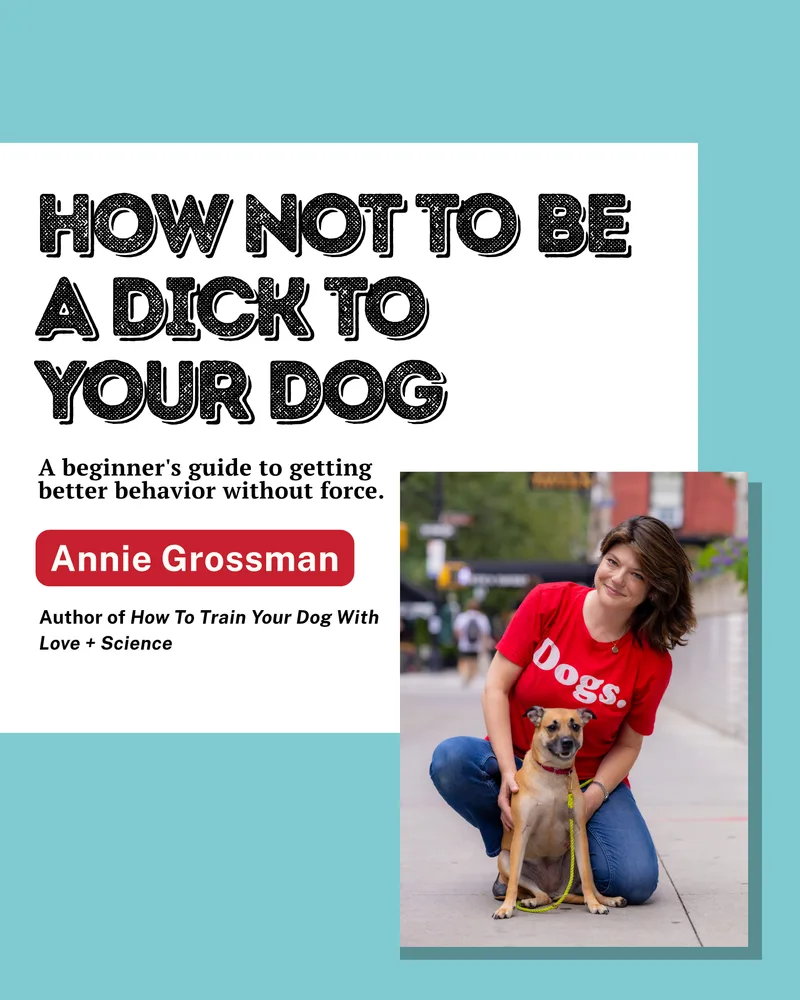
Hey everyone, Annie Grossman here with School For The Dogs. I would like to start off with a couple quick announcements. First of all, as you might have noticed, the podcast has a new name. You're welcome to continue calling it School For The Dogs podcast if you'd like, but I am officially changing the name to How To Train Your Dog With Love and Science. This also just happens to be the title of the book that I have coming out in June, being published by Source Books.
I am so excited about this book, and I don't know, just changing the podcast name seemed like a good way to shepherd it into this world. There's certainly a lot of overlap between the podcast and... And the book. And I will be sharing some excerpts of the book on the podcast. And of course, it also seemed like a good excuse to get a new jingle.
Here it is. Let's live with dogs in harmony. Good dog training is the key. You don't need to cause pain if you use your brain. Train your dog with love and science.
Isn't that cute? I love it. It's by a young guy named Sam Swinnerton. Want to hear it again? Of course you do.
Let's live with dogs in harmony.
I love it. I wanted to mention that we are currently taking applications for the next round of our professional course, which will be starting in January 2024. We are taking six students. It's rolling admission. You can apply between now and the end of November at schoolforthedogs.com slash pro.
And I also just wanted to acknowledge that this is a really terrible moment to be a human being. Like many people, I have been feeling pretty upset and scared and helpless. But when I'm feeling... Not motivated to do anything relating to dog training because it seems too minor in the face of the disaster that is the world we live in. I tell myself that It really might be possible to change larger patterns of human behavior by helping people practice good dog training with their dogs or at least to help people start to recognize abuse so as not to perpetuate it.
And so as not to practice it with non-human animals, at least it's a step in the right direction, even if it's a small step. And I've been thinking about this quote that I wanted to share.
The reason for legal intervention in favor of children apply not less strongly to the case of those unfortunate slaves and victims of the most brutal part of mankind, the lower animals. It is by the grossest misunderstanding of the principles of liberty that the infliction of exemplary punishment on ruffianism practiced towards these defenseless creatures is has been treated as a meddling by government with things beyond its province, an interference with domestic life. The domestic life of domestic tyrants is one of the things which it is the most imperative on the law to interfere with. That's John Stuart Mill, the 19th century philosopher and economist. And I would say the summary of what he's saying is that domestic animals are essentially slaves and victims of humans and that the least we can do is not abuse them and to pay attention to those who are abusing them, that this is no less abhorrent than abusing children.
Now, here we are, more than a century and a half later, and in the United States, there are no laws protecting dogs from so-called domestic tyrants if those domestic tyrants are doing what they call dog training. I really don't think that this is so much of an issue about morals or ethics as it is about people lacking vital information about how behavior works. I believe there are a lot of well-intentioned people out there who simply don't have the tools to understand the difference between dog training and abuse. I really believe everyone is doing the best they can given the information they have. The thing about people abusing dogs and calling it dog training is that it is not a new story.
Over the last few years as I was working on the book I got pretty interested in the history of dog training. The field of dog training for pet dogs and amateur dog owners as we know it is it's really not even a century old. And while I was doing all my reading, I kept a note file of training methods that I thought were remarkable in one way or another, remarkable for their... Their craziness. There was Will Judy, longtime publisher of Dog World magazine in the 1930s, who was suggesting that if you have a dog who goes after eggs in your chicken coop, that you should make two small holes in the eggs, fill it with Ipecac, which will make a dog throw up, and then seal the holes with wax and then let your dog go and find it.
Henry East, the trainer who trained Asta. For The Thin Man in the 1940s, he was telling people that you should always empathize with whoever your dog's victim is. So if your dog kills a chicken, there was a lot of worry about training dogs to not kill chickens. If your dog kills a chicken, take hold of him, firmly shake him, and scold him severely. Say, poor chicken, as you point to it.
In the 60s and 70s, the big name in dog training was William Kohler, and you don't have to go too deep into his oeuvre before learning that one of his favorite training tools is a BB gun. Then there was Barbara Woodhouse, who I've talked about quite a bit on the podcast before, and my fascination with her stems from the fact that I am pretty sure my father learned most of what he knew about dog training from watching Barbara Woodhouse on PBS in the 1970s and 80s. And he imparted a lot of that knowledge to me as a kid. So when I discovered Barbara Woodhouse on my own as an adult, it was like I had found the Rosetta Stone of my own dog training knowledge. There are lots of crazy things that Barbara Woodhouse suggests, but my favorite is that she suggests that if you have a dog chasing a car, you should lean out the window and throw a book at the dog.
And then she has a whole episode, you can look this up, where she sort of shows how you can rig a pulley system from the front seat to the back seat of your car so that if your dog is Barking and you're in the front seat, you can give a good yank on the leash without having to turn around. And then as we get into more modern times, there are more examples of how to use punishment. There's like a different vibe. Brandon McMillan. Who gives a master class on dog training as part of the master class series, you know, with like Neil deGrasse Tyson and Jane Goodall.
He suggests, you know, if you have a dog who's chewing on your shoe, you should simply tie the shoe to your dog's collar and make him walk around with it attached to him. And then for a while he was producing a product, which he sold for $9.99, called the Shake and Break. It's a thing you shake. And it makes a noise that most dogs don't like, but it's much better looking than coins in a can. You can actually find a video, I'll put it in the show notes, of women running around their house shaking this at their dogs, and then Brandon McMillan saying...
Do you have a dog that you just can't break of certain negative habits? Yelling at your dog only shuts them down and eventually makes them afraid of your voice. If you're at the end of your rope and have tried everything to do it on your own, I have a great solution for you. I'd like to introduce you to the all new Shake and Break. Why is it called the Shake and Break?
Because that's all you have to do. You simply shake and break that bad habit once and for all. One shake of the Shake and Break. And all barking comes to a screeching halt. One shake of the shake and break and your dog's jumping habit is a thing of the past.
You know what it looks like? A tiny rain stick, like a Danish designed rain stick that you would put on your mantle or like designer maraca. Anyway, then there is, of course... The Dog Whisperer, Cesar Millan, who likes to punish behaviors using one very specific sound that you would think would be simple, but he can often be heard talking about how difficult it is to actually get it right. It's about timing and it's also about the intensity.
It's a sound that has to create an impact in the mind of a dog. But not because you choose the sound, the dog is going to understand what you mean. A lot of people in the airport said to me, Cesar, I do the stink and it doesn't work. Because they do it at the wrong time or they do it too much. Or they do it too loud or they do it too soft.
SFT. SFT. If it doesn't work for people, then why are they still doing it? Because sometimes it does work. Some of the time, even if it's just coincidental.
And that is why all of these punishment-based techniques have taken off We humans get a good dose of dopamine because in the moment, the annoying behavior we wanted to stop. So the behavior of book throwing or can shaking is reinforced, which means that it's likely that we are going to do that thing again, even if we're just like pulling on the lever of a slot machine, not knowing whether what we're doing is actually going to be effective. It's an established fact that behaviors can be maintained over very long periods of time with reinforcement coming only very sporadically. Now, I wanted to give you these little snapshots from the history of punishment-based dog training over the last century just to make the point that this is really nothing new. And today, there are lots of examples of trainers who are calling themselves professionals when what they're doing is suggesting using punishment, even if they don't call it that.
Often it's punishment that is cruel or, in my opinion, bizarre. Or both. As something of an amateur historian in this area, I personally usually like to stop at around Brandon McMillan with his almost quaint rattle. I would prefer to not tell you about all the crazy, awful things people are doing to dogs on the internet right this minute in live time at any hour of the day because I don't want to look. I don't want to know because so much of it to me looks like abuse.
Just like I don't want to watch videos of children being abused. I know it's happening, but I don't want to spend my time looking that up on YouTube. And I certainly don't want to see all the comments from other people who are viewing this stuff. It stresses me out. I am just consumed with feeling bad for these dogs and also feeling bad for people who don't know what they don't know.
I get physically affected. My heart races. Sometimes I'll wake up. In the night having like anxiety about these kinds of videos if I get too into watching them. So I really, really avoid doom scrolling on my phone in general, but specifically when it has to do with...
The accounts of of certain dog trainers. But over the last few weeks, I could not ignore. And this is me like trying to, you know, purposefully to not look for this stuff, like trying to actually avoid social media in general as much as possible. Still. I couldn't ignore this conversation that weaseled into my perception thanks to the feeds I'm in and other people talking about this social media phenom who I think we should add to the canon of dog abusers of the last century.
His name is Dog Daddy. And his main technique is involves yanking dogs around by their necks and hanging them up in the air from the ends of their leashes until they submit to his will. Now, on the one hand, I really think this guy is just a flash in the pan, not more or less awful than so much else that could be found on the internet or in my library of books by terrible dog trainers of decades past. Um, there are plenty of people out there torturing dogs and calling it dog training, but he's worth mentioning because he has been getting a lot of flack from the good dog trainers in the world, especially from Zak George, who is something of a celebrity in the world of positive reinforcement dog training. He's had successful shows.
He has one of the top dog training books on Amazon, and he has really been standing on a soapbox pointing out to everyone how this is animal abuse and he's been rallying people to go protest at various dog daddy events around the world and I think it's really Brave of Zak George to be taking a stand. Now, I think there are other trainers he might have taken a stand against, but he's picked this one. But at least it's someone, you know, most positive reinforcement dog trainers I know Don't want to speak up about anyone who is doing anything less than good dog training. I think because like we're conditioned that to ever say anything that is not nice about other dog trainers. We're so used to trying to encourage behaviors we want and not to accidentally positively reinforce behaviors we don't want by perhaps bringing attention to someone.
You don't have to be a dog trainer to know that attention can generally be reinforcing, even if it's not Compliments and praise and I think also it's a topic a lot of good dog trainers avoid because like I said it's it's upsetting and I think it feels more proactive to focus on the good work we're doing rather than to stop and point out The crappy work someone else is doing and I know firsthand also that as a dog trainer who has sometimes criticized certain TV dog trainers that it can look like sour grapes. Every time I've ever written or posted a podcast saying anything at all negative about Cesar Millan, I can expect my inbox to be flooded with people basically saying you're just jealous, which I am not. However, I've been seeing a lot of really great dog trainers in some way or another respond to Dog Daddy thanks to the fact that Zak George, I think it's thanks to the fact that Zak George has been urging people to take a stand. And it's sort of giving me... A little bit of hope that maybe, maybe we're in a moment where a wider group of people may start to see how ridiculous so much of popular quote-unquote dog training is and has been.
How unfortunately retro- It is, considering how much we've learned in the last century about the science of behavior. There are people getting PhDs on how dogs learn. This has become a completely legitimate and respected field of academic study. And yet, and yet, and yet... People are taking advice from Dog Daddy.
In fact, I just saw one comment thread where people were suggesting President Biden bring in Dog Daddy to help with the issues he's been having with his reactive dog. Dog Daddy's real name is Augusto de Oliveira. I believe he is American, but was raised in Brazil. And before I tell you about how he trains, I want to tell you the most, I think the most notable thing about him. It's actually the way he dresses.
He wears very loud clothing, kind of like lounge suits, though, sort of like grandpa pajamas meets like 1980s. Rapper, a lot of neon, a lot of things that say Gucci and Louis Vuitton on them, bucket hats, sunglasses, chains. He has tattoos like all down his arms and up his neck. And he has a mass of curly hair that is often dyed magenta. Now, on the one hand, of course, it really doesn't matter what this guy looks like, but I just wanted to paint you a picture, partially so you don't have to go look him up yourself, but also because, you know, I want to make the point that he is a character.
And people like characters. And when I went looking online for information about his training techniques or certifications, methods, his education, his beliefs, I really found not very much at all. Instead, I found a lot of him talking about his general charisma and how people respond to him. Here he is on the David the Dog Trainer podcast late last year. Like everywhere I go, you know, there's a certain way that people look at me and they approach me.
The moment that I handle a dog, like I could be just anywhere without a dog and then there's someone there with a dog and they handle me the dog and immediately people around seem to be attracted to that. You know, there's a way that I communicate with the dogs and that they respond that's very attracting to people. Dog training is actually kind of Dog Daddy's second career, although he's only, I think he's 31. He started out breeding German shepherds. In Cape Cod, and he got into a whole lot of trouble there for operating without a kennel license and selling people dogs who had serious health problems and behavioral issues with clients suing him for fraud in more than one state.
There are a fair amount of websites and sub-rebbits, sub-reddits, Devoted to people talking about what a low-quality breeder he was. There are petitions against him. There are people posting photocopies of lawsuit documents on one page called The Truth About the Dog Daddy Trainer and Breeder. That's Dog Daddy with two Ys. I found a screenshot from his gskennels.com website, which was his site for his business called Griffin Shepherd Kennels.
Now, his current website has very little information about him, but back in 2014 on this website from his kennel business, he... He did write about himself. He said, These dogs were never in cages or leashed and never confined in any way. They were free to come and go as they pleased. They reproduced on their own and behaved as a real wild pack, including going out at night, hunting, showing dominance towards each other, occasional fights, etc.
While living with these dogs, I learned a lot about dog behavior. I learned how dogs interact with each other naturally and how the pack works in general. I learned the easiest ways for dogs to understand directions given to them. I lived with these dogs for several years as a young boy through my early teens. I learned to communicate with those dogs the same way they communicate with each other.
I was the only one around who the dogs respected and followed as their leader. We walked miles and miles every day. We went hiking, swimming, fishing, and the pack was always around me no matter where I went. After a few years, I moved to the city as a teenager with some of those dogs. While in the city, I continued to do the same as in Brazil.
Dogs run loose on the street among people and cars. After weeks of living there, I was known as the crazy kid with all the dogs, also made fun of, called Dr. Doodle Little and Noah's Ark by people as I passed by with multiple dogs respecting me as their leader. But on the bright side, I am also noticed by some of the top dog trainers around, and I was immediately invited to work with them, and from there I became part of their team. That's where I learned new techniques and methods.
However, the way I communicate with dogs in a natural way never changed. From there on, I became a dog trainer besides being a dog man. True dog men have been in existence for hundreds of years, not a name made up like a dog whisperer that was created by Hollywood executives for TV ratings. Dog men are either born with a gift or it was passed on from a true dog man who found one student to pass his knowledge to. After I read this, I was curious what else was on his website.
So I went to web.archive.org where you can find screenshots of web pages that no longer exist. And there I found... On his very first page that he uploaded about his kennel in 2014, right on the front page of the website, it has a picture of him, a much less tattooed version of him, on his knees holding a dog's paw. And under it, it says, positive reinforcement training. Positive reinforcement dog training is a friendly, non-punitive method of teaching your dog to perform behaviors using food, treats, or other positive actions as a reward, he writes.
Rewarding appropriate dog behavior makes that behavior more likely to occur in the future and is one of the most powerful tools you can use to shape or change your dog's actions. Augusto strongly advocates using positive reinforcement dog training as it not only teaches your dog what behaviors you desire, as well as those you don't, in a humane manner, but also because it creates stronger bonds between you and your dog. Now, it's notable that he put this on his website for several reasons. One is... That just a year later, in 2015, he was posting this video of himself explaining his thoughts on positive reinforcement training.
And this is again from the Truth About the Dog Daddy Trainer and Breeder Facebook page, which has been documenting his exploits for close to a decade. You know, just positive only... Dog trainers that don't believe in telling the dog no and correcting the dog when they do something bad, they're the first ones that will tell you to not do anything with your dog because they can't help them. And they should be ashamed of themselves, not only for not being able to help the dog, because that's okay. There are many great dog trainers that use only positive reinforcement.
But they don't bash other trainers who help the dogs they can't help. And they have to accept it. You know, quite honestly, they just have to accept it. That if they are choosing to only use positive reinforcement, they are not going to get the same result. And the percentage of dogs that they help, that they are able to help, is going to be much lower than the ones that open-minded dog trainers They have to accept that.
They have to be okay with that and just be like, okay, I can teach the doctor to do everything, all the commands, but when it shows aggression, I have to send it to another trainer. That's it. Now, instead, there are some that can't help. They sneaky about it. They should be embarrassed because they come on all the trainers' pages and all the trainers' YouTube videos or whatever.
Wherever they see them, they are the first ones to go there and bash them. And for what? Just because you can't do it? And I don't care if you have been training for 60 years or more. Being old does not equal being good.
If you haven't ran into a dog that he couldn't help just using positive reinforcement, then you don't have enough experience. Because not every dog is going to respond well, and most aggressive dogs and high, strong dogs with behavioral issues are not going to respond well to positive reinforcement. And that's a fact. So, wake up. Peace out.
So what happened? How could someone write rather eloquently describing positive reinforcement dog training and suggesting positive reinforcement dog training to just a year later posting such nonsensical drivel about it? I asked myself this question, so I copied and pasted his... paragraph on positive reinforcement on his paragraph on positive reinforcement dog training into Grammarly which told me it was definitely plagiarized and I was able to find the exact same language on the website puplife.com published in 2009. But the other notable thing that happened between when he first published his page about positive reinforcement and when he posted this video Is he got kind of famous.
The reason that he has millions of followers now on YouTube and TikTok and Instagram and is literally all over the place showing how to yank dogs by their necks, doing what some dog trainers refer to as helicoptering dogs. The reason that he is going around the world claiming to teach dog trainers his methods all kind of goes back to this day in 2015 in Hyannis, Massachusetts, where he walked five of his German shepherds off leash and was videoed by everyone around and it went viral. My best guess as to what happened is that training was just something he was kind of doing on the side because of his Dog Man origins, but breeding was his main business. Though, remember, he was only like 20 years old 10 years ago. And when this video went viral, people started actually coming to him for training advice in a very real way.
And because he didn't actually understand positive reinforcement, having done little other than copying and pasting text from another site about it onto his own, he suggested doing what had worked for him before, which was... Yanking dogs around and forcing them to obey his commands. Now, I'm sure he actually uses positive reinforcement with dogs he works with, but I'm not sure he could actually describe what positive reinforcement is. Now, because I find it very upsetting, and I suspect you might too, I don't want to go too deeply into dissecting his work anymore. I just want to make two kind of general points about training using punishment.
One is that, you know, what a good dog trainer is seeing when they're watching these kinds of videos is dogs who are shut down. Dogs who have given up. This is often called learned helplessness. It might produce a well-behaved dog in the short term or a dog that appears well-behaved, but there might very well be fallout when the camera turns off. There's a thread in one of these German Shepherd subreddits about him from three years ago from someone who bought a puppy from Griffin Shepherds.
And this puppy turned out to have a heart defect. But this person says that they also paid for the puppy to be trained by Dog Daddy before coming to them. And when they finally got the dog, the dog was over a year old. And the person writes, the only command she knew was sit. Meanwhile, during this time, I noticed she wouldn't come when called and she was very submissive.
I would say fearful of my husband for no reason whatsoever. As you would walk in the door from work, she would go hide behind the kitchen table. Now, this puppy purchaser said that they could see no reason for this behavior, but the dog had a reason. And I'm guessing the reason was that it experienced something like this with Dog Daddy, which, to be fair, is the conclusion that this puppy purchaser seems to come to as well about the dog. And what they wound up with was a dog who was not very well trained and in addition to being sick was basically depressed.
When you successfully punish a behavior, you may get a dog that seems very well trained, but you also may be creating a really unhappy dog. Like, dogs don't choose to live in our homes, you know, so I think the best that we can do is to make our homes nice places for them, where they're not getting beat into submission. The other thing I wanted to point out is I see how appealing it is to get really quick change. I know this from my own life. The shorter route to a solution is often the more appealing route simply because it's going to take less time.
And in a couple of the videos I've watched of Dog Daddy, he says, oh, I worked with this dog just once. And in a lot of videos that I've scrolled through, it seems like he solves a situation within the span of a TikTok video. Now, when I see behavior change that happens so quickly like that, to me, I think if that's really permanent change that is taking place, then it's probably a not great kind of behavior change. I mean, think about it like in human terms. Most of the time to truly change behavior, you need to keep it up.
Behavior change solidifies over time, not overnight. Unless the thing that's changed your behavior is really traumatic. It's the kind of thing that for people can end up as PTSD. And I think this happens more than we realize with dogs who can't talk to us about it. And when someone with PTSD does something that seems irrational or inappropriate or ill-advised, we can talk about the fact that they have PTSD, but the dog hiding under the table when the husband comes in, In that case, it seems like it's just a totally random thing with no cause, unless you consider the possibility that you have a dog who basically has PTSD from being yanked around by men, maybe even just once.
People aren't necessarily connecting their lines, though, and their behavior is seen as random or without cause or unpredictable or all of the above. Now, if you're new to the world of dog training, it might be a surprise for you to hear this, but there is a divide in this realm of, I guess you could call it, professional dog training. And nowhere is this more apparent than in the comments of these Dog Daddy clips I've been seeing. You can really see extremes of these two camps. Now, if I had to roughly describe each camp, I'd say one is people like me who call themselves positive reinforcement dog trainers who are concerned that there is so little out there in terms of legislation that's regulating what people can or cannot call professional dog training.
People who are generally certified by the Certification Council for professional dog training or have a certification from one of a handful of other meaningful certifying bodies. People who may refer to themselves as positive reinforcement dog trainers, but they also might call themselves force-free dog trainers, science-based dog trainers, clicker trainers. I like to call them good dog trainers. Some in this group actually refer to themselves as crossover trainers. These are usually trainers who used harsher, more punitive types of training before they really understood what positive reinforcement dog training was and could do.
And most of the people I've encountered from this group do not ever refer to themselves as having been born with specific talents or a degree of doggyness. And in the comments section of Dog Daddy's social media feed, you can see how, I guess you could say we, are seen by the other side. Winsers is what William Kohler called it in his dog training books from 60 years ago. I think we get called other things today, but there was one comment I saw that sort of summed up the way positive reinforcement dog trainers are thought of, which was, we don't go in for this sensitive dog training bullshit. Who needs that crap?
That person's idea of good dog training probably has to do with working with people who consider themselves, quote unquote, balanced training. The term balanced coming from the notion that to train a dog, you need like a equal balance of punishment and reinforcement of what would be called positive punishment and positive reinforcement. Or that you need what they'll say is all the quadrants, that you need to use both kinds of punishment and both kinds of reinforcement, both positive and negative and extinction, in order to truly achieve a well-rounded dog whose behavior has been changed effectively. And I think they consider positive reinforcement training, training that is primarily focused on how we can positively reinforce behaviors we want, is unbalanced because it is relying too heavily on a single quadrant. Now, to be clear, I find this conversation about what to call certain kinds of trainers is, I don't know, there's just a lot of jargon there.
And in general, I don't find the labels to be super helpful. In a lot of cases, it's just referring to some kind of euphemism. I mean, even the term balanced training, I don't see Dog Daddy using very much other than punishment. And coercion. So, I mean, I guess he's maybe balancing punishment and coercion.
I don't see a whole lot of positive reinforcement baked into his training plans. I see his behavior getting positively reinforced in terms of comments and likes and apparently paying gigs around the world. But the dog's behavior? Not so much. However, the positive reinforcement label is also tricky because every dog trainer who refers to themselves as a positive reinforcement dog trainer is at some point going to find that one of their dog's behaviors is being punished or negatively reinforced, perhaps even by then.
However, the difference is that positive reinforcement dog trainers are not usually going to be putting anything involving punishment or negative reinforcement into their training plans. Not usually. Yes, all of our behaviors are being impacted by methods of conditioning all the time. Dogs are going to have their behaviors punished and negatively reinforced, and they're going to learn in that way many, many times in their lives. But when we're working as a professional positive reinforcement dog trainer, we're trying to make sure that we prioritize figuring out how we can intervene in order to change behavior with as little potential fallout as possible.
But that kind of point is probably going to be meaningless to someone like Dog Daddy who doesn't seem to notice the fallout at all. Now, one of the most common things that you'll read in the comments section of Dog Daddy videos is that the... The positive reinforcement camp would rather euthanize a dog who has behavioral issues than use any training method harsher than giving a dog. A bit of hot dog. And to illustrate how horrible and ridiculous this idea is, this idea of like, oh you softies, if you can't train a dog with treats, you'd rather just like on principle euthanize the dog.
To illustrate the ridiculousness of it, Dog Daddy recently got a tattoo on his arm of this like big beefy Bulldog type dog holding up a hot dog and kind of smirking. Now, in my professional experience, I would say behavioral euthanasia is pretty rare and is never a decision that is made lightly. And a dog owner who opts for behavioral euthanasia and has been working with a positive reinforcement provider Dog Trainer has likely been working with someone who is really committed to what's called Lima, or you might call it the humane hierarchy, the humane hierarchy being something created by Dr. Susan Friedman. I'll link to more information about both Lima and the Humane Hierarchy in the show notes.
But these are like guidelines that we have to, that we have decided to adhere to in order to figure out how we can intervene with as little pain and inconvenience as possible. Least invasive, minimally aversive is what Lima stands for. The LEMA guidelines have been backed by the Association for Professional Dog Trainers, the Certification Council for Professional Dog Trainers, the International Association of Animal Behavior Consultants. It is widely supported. I'm just going to read a little bit from it.
Positive reinforcement should always be the primary method of teaching, training, and changing behavior. Out of all methods available, positive reinforcement has been shown to induce the least amount of aggression, attention-seeking, avoidance, and fear in learners. Positive reinforcement should be the first line of teaching, training, and behavior change considered and should be applied consistently. Positive reinforcement is associated with the lowest incidence of aggression, attention-seeking, avoidance, and fear in learners. Only the learner determines what may be reinforcing.
It is crucial that the consultant understands and has the ability to appropriately apply this principle. This fact may mean that the consultant assesses any handling, petting, food, tool, and environment each time the learner experiences them. Consultant bias must not determine the learner's experience. The measure of each stimulus is whether the learner's target behavior is strengthening or weakening, not the consultant's intent or preference. The trainer consultant is responsible for ensuring learner success through a consistent systematic approach that identifies a specific target behavior, the purpose of that behavior, and the consequences that maintain the behavior.
A variety of learning and behavior change strategies may come into play during a case. Ethical use of this variety always depends on the trainer consultant's ability to adequately problem solve and to understand the impact of each action on the learner, as well as sensitivity towards the learner's experience. We seek to prevent the abuses and potential repercussions of inappropriate, poorly applied, and inhumane uses of punishment and of overly restrictive management and confinement strategies. The potential effects of punishment can include aggression or counteraggression, suppressed behavior, preventing the consultant from adequately reading the animal, increased anxiety and fear, physical harm, a negative association with the owner or handler, increased unwanted behavior, and new unwanted behaviors. Lima guidelines require that trainer consultants always offer the learner as much control and choice as possible.
Trainer consultants must teach each individual of any species with respect and awareness of the learner's individual nature, preferences, abilities, and needs. Lima guidelines also suggest consulting the hierarchy of procedures for humane and effective practice by Dr. Susan Friedman in order to help dog owners and professionals in creating a standard of care And I love this graphic from Dr. Friedman that accompanies this because it looks like a road that you're going down and With exits, and you're going to take the first exit that applies, the first exit, if you can take it. That's how I read the graphic way she has shown her procedures.
The first is health, nutritional, and physical factors. Ensure that any indicators for possible medical, nutritional, or health factors are addressed by a licensed veterinarian. The consultant should also address potential factors in the physical environment. So, like, basically... See what's going on with the animal physically.
Two, consider antecedents, redesign setting events, change motivations, and add or remove discriminative stimuli for the problem behavior. So I see this as like how can we set up the environment in order to reduce the triggers that are going to cause the behavior or remove them altogether. What's all the stuff sort of we can do from the outside in without even like having to touch the dog or even work on reinforcing any specific behaviors? Like how can we just alter the environment to change things? Then the third option is positive reinforcement.
Employ approaches that contingently deliver a consequence to increase the probability that the desired behavior will occur. And there are more roads, but only the last road is positive punishment contingently deliver an aversive consequence to reduce the probability that the problem behavior will occur. Now, if the so-called positive reinforcement trainer is ever going to reach to take punishment, positive punishment or negative punishment out of her toolbox to use, there are a lot of considerations to make. Here's what the American Veterinary Society of Animal Behavior recommends in their guidelines on the use of punishment for dealing with behavior problems in animals. Punishment should only be used when animal owners are made aware of the possible adverse effects.
The AVSAB recommends that owners working with trainers who use punishment as a form of behavior modification in animals choose only those trainers who, without prompting one, can and do articulate the most serious adverse effects associated with punishment. Two, are capable of judging when these aversive effects are occurring over the short and or long term. Three, can explain how they would attempt to reverse any adverse effects if or when they occur. Now, I personally cannot think of a time that I have said, here is my training plan for this dog and here is where we are going to use positive punishment. And I believe that a lot more dogs are euthanized because of the fallout of having been trained with punitive methods than there are dogs in shelters because they are being trained by a trainer who was scared to use any training technique that didn't involve tiny bits of hot dogs.
But I think it's an interesting ethical question. At what point do we decide that it's worth using punishment? This came up in a conversation. This comes up with conversations with trainers all the time. But one conversation that really stuck with me was with my friend Kiki Yablon.
We were chatting and I said something like, I just can't think of a situation where I would feel comfortable suggesting someone use an electric shock collar on their dog. And she said, well, what about on a child? And I said, certainly, I can't think of a situation where it would be okay to use an electric shock collar on anyone other than a consenting adult. And she told me about the Judge Rottenberg Center in Massachusetts. The Judge Rottenberg Center is home to about 300 students, adults and children with emotional or behavioral issues, intellectual disabilities, psychiatric problems, and they put shock bracelets on them.
Some of these people are nonverbal. Now, on the one hand, it sure seems to me like a bad idea. And I'm sure it has seemed to many people there like a bad idea. I read an article in the New York Times about how one of their former students prank called the center and pretended to be a supervisor and successfully ordered that two teenagers there be shocked. And they ended up getting shocked 77 times before anyone realized it was a prank.
So that's pretty awful. But then this article also talks about parents who say that the electric shock bracelets were a last resort and that when deprived of it, their children have banged their heads on tables to the point of their retinas detaching. Which is also pretty awful. So personally, if I can avoid making the choice to electrocute someone, if I can avoid trying to figure out if that is going to be helping them or if it's going to be a possibly really destructive thing, I would like to avoid having to... I have these ethical debates and fortunately in my career as a dog trainer I have been successful using other methods and have never had to turn down that very last path.
But again that doesn't mean that the dogs I've worked with have not been punished. I'm sure they have. I'm sure I have inadvertently punished My dogs many times. And I think to people who consider themselves balanced trainers, that point that our animals are being impacted by operant conditioning all the time. So why are these people calling themselves positive reinforcement dog training?
It's hypocrisy. I think I think that that points to a kind of larger confusion that exists where people don't understand that dog training is an application of behavioral science and that we are all living in a world where we are all learning all the time, all from our environment and But there's a difference between learning that we're just doing and learning that is being done with a teacher who is really a technician. And that's what I think a good teacher should be. A good dog trainer should be someone who really understands how to use positive reinforcement to its maximum effect to get the most desired behaviors and should be well-versed in these kinds of lima or humane hierarchy procedures and have a code of ethics. That stands up to some critique.
There's a trainer named Jeff Gelman out of Rhode Island. His big technique is bonking dogs using rolled up towels to smack them. He also travels the country teaching his methods to... Groups of people and then sharing these videos. I saw a blog post he wrote where he comes down on positive reinforcement, how positive reinforcement can actually ruin people's lives, and he tells this story about himself.
At the end he says that it's made up, it's not a true story, but He tells this story about his alter ego, I guess, who ends up in a psychiatric ward after trying to commit suicide because he got so much positive reinforcement for doing his work at his job that he worked so much that he didn't come home anymore and his wife and kids left him. And therefore, positive reinforcement actually ruined his life. He ends it saying, I will be starting a new career as a dog trainer and using true science to train dogs, but I won't use the term science. I will just tell folks I train dogs. It is a balance of training and learning.
It seems like most of the general population is not familiar with the true science and have been misled by folks who are trying to promote it as just one of the quadrants of reward only. It seems most of society thinks punishment is a bad thing, when in fact it is probably one of the most important things. Punishment is not bad, it is just information. Information that I wish I had, since without it my life was ended. It made me think of all of the dogs, five million killed in shelters each year, who would have loved to have been trained by someone using all four quadrants of learning, both positive and negative.
The cool thing is that I can also spread the message about if only... If you only focus on the rewards, it does not truly train the dog, but it can also lead you to that dark place in the garage that one day that I was all alone, ready to take my life since I did not have balance in my life. So I read this and I thought, this is a really good example of someone who's just confused About the difference between the science and the technology. The science exists, but then there are good dog trainers who can really use this technology to change behavior with scalpel-like precision. And doing so often with regards to the fact that our behavior is being punished and reinforced by things outside of our control all the time.
Ditto dogs. So I read this and was like, you know, he seems to kind of understand the quadrants and what operant conditioning is, but he also seems pretty confused. So here's the very next paragraph after I had that thought. This blog post is not an open invitation, not an open invitation to discuss the four quadrants of science-based dog training, since it will just keep going around in a ridiculous circle with most folks not actually understanding the full concept of it, including myself, since it can be pretty confusing. What it is to do is to point out more of the silliness of the concept of positive reinforcement training that is being shouted by many trainers and saying how you should never quote unquote punish a dog when in fact punishment is part of the science that they are saying they are using.
So the general public is being lied to on a daily basis. Punishment does not mean bad and reward does not mean good. There are just words. That is all. This is a satirical blog post and is not based on anyone in particular, but does have similar concepts between a dog being killed in our shelter system and given away by their family and a human losing his family by only focusing on one part of life.
Oh my gosh. There is so much confusion out there. I think there's so much confusion that just stems from the fact that most people don't know that there is a science of behavior. And that animal training is just one application of that science. And people have been working in labs for...
Nearly 100 years to figure out how to best develop technologies to change behavior without force and fear. Some dog trainers call themselves crossover trainers, usually meaning that they were balanced trainers and they become Positive Reinforcement trainers, and I think some of those crossover trainers do cross over because they realize that it's just not necessary to use these harsh and punishing techniques, but I think some also cross over because they realize that they've been looking at shadows on the cave wall and that this is Actually, a legitimate field of science. And they've been working instead with information that's very much based in, I don't know, myth. So to some extent, I feel bad for the balanced trainers who just seem like they haven't got the memo yet. I wanted to close by just mentioning one other thing that comes up a lot in the comments of these Dog Daddy clips.
And also, I guess, in some of his captions, there's this accusation that positive reinforcement dog trainers are all talk, that no one can actually show that this stuff works. We're all just out there screaming bloody murder because of this abuse, but we're not actually showing how behavior can be changed using these methods that we supposedly think are so great. I just want to say that I think it's true that there is a lot less footage out there of really good dog training, especially really skilled trainers working with really difficult dogs, because frankly, this can be hard footage to get. It's certainly really compelling to have before and afters in these kinds of videos to be able to show the dog at their worst and then show the transformation cutting whatever needs to be cut between those two things. I cannot speak to all trainers, but I can say that the trainers who work at School For The Dogs are not going to meet a client in order to see the dog behaving at their worst.
They're not showing up there, phone in hand, saying, okay, show me how your dog reacts when another dog tries to pass on the street. I want to see how absolute bananas your dog goes. It can certainly be useful to have some kind of video evidence of a behavior at its baseline so that we have an idea of what we're trying to change. But we're going in there to try and stop that behavior from happening. For us to go in there and let it happen in front of us...
It's like putting money in that behavior's piggy bank. It's working out that muscle of that behavior, a muscle that we want to atrophy. And I think because it's not particularly necessary, it starts to feel weird to even ask for that kind of footage, which... I know about firsthand because I would love to show some great before and afters on our social media, but it's hard to get that footage because I kind of feel weird saying to my clients, like, hey, can you send us a video of Gus when he was lunging at every child on the street before we were working with you? Just like I would feel uncomfortable if someone asked me for like video that I shot of my child throwing a tantrum unless it was really necessary to solve the problem and I just think that usually it's not.
And I know that the School For The Dogs trainers, when they're working with dogs, they're very focused on the dogs. They are not so focused on getting the right camera angle or setting up the lighting or making sure that the room is going to be perfect for a good shot because the priority is the dog and behavior is controlled by the environment. If you're making the environment all about And if you're getting the good footage, you're taking away from the work that you are there to do with the dog, which is the whole point. And if you're dealing with a dog who has a real issue, a dog who is reactive or a dog who has separation anxiety, you as a trainer... Should be so highly focused on all the things going on in that environment and trying to figure out what you can possibly control.
Well, one thing that doesn't have to be there usually is a camera. So there's this funny way in which showing how this stuff works is actually harder, harder than it seems. And to really show good behavior change, you also need to be taking videos over a period of time. Which is a big disadvantage when you have these people shooting massive behavior change happening in a minute long video filmed with no cuts. All of this is to say kudos to all of you good dog trainers out there who are putting videos out there showing how this stuff works.
And if you are listening to this and you have worked with a dog trainer, a School For The Dogs dog trainer, or any good dog trainer anywhere to help you with issues you've had with your dog, if you've worked on those issues with your dog and you have seen progress and you have before footage, if you have footage of your dog scratching their nails doing Bloody on the door or yanking someone's arm out of its socket to try and attack another dog on the street. If you have that footage sitting on your phone, send it to the trainer and say, hey, I wanted to show you what kind of progress we've made. Please. There's been so much misinformation and confusion out there for so long, and I don't think that we're gonna change people's minds through the comment section on Dog Daddy posts, sadly. And I'm also not sure the answer is...
To point out that this is abuse because people have been abusing dogs and calling it dog training for a really long time. I just think positive reinforcement dog training is so awesome. And it's like this bonsai version of what the world could be. And it's completely optional. We don't have to have pets.
We don't have to have pets. Many generations of people had to have dogs. We're doing this optionally. So it's like this optional, wonderful thing where you can spend time with another being and learn about how behavior works. That to me is just so cool and it's the kind of cool that's cool without having to put on a Gucci leisure suit or have magenta hair.