December 4, 2020 · 38 min
Amos
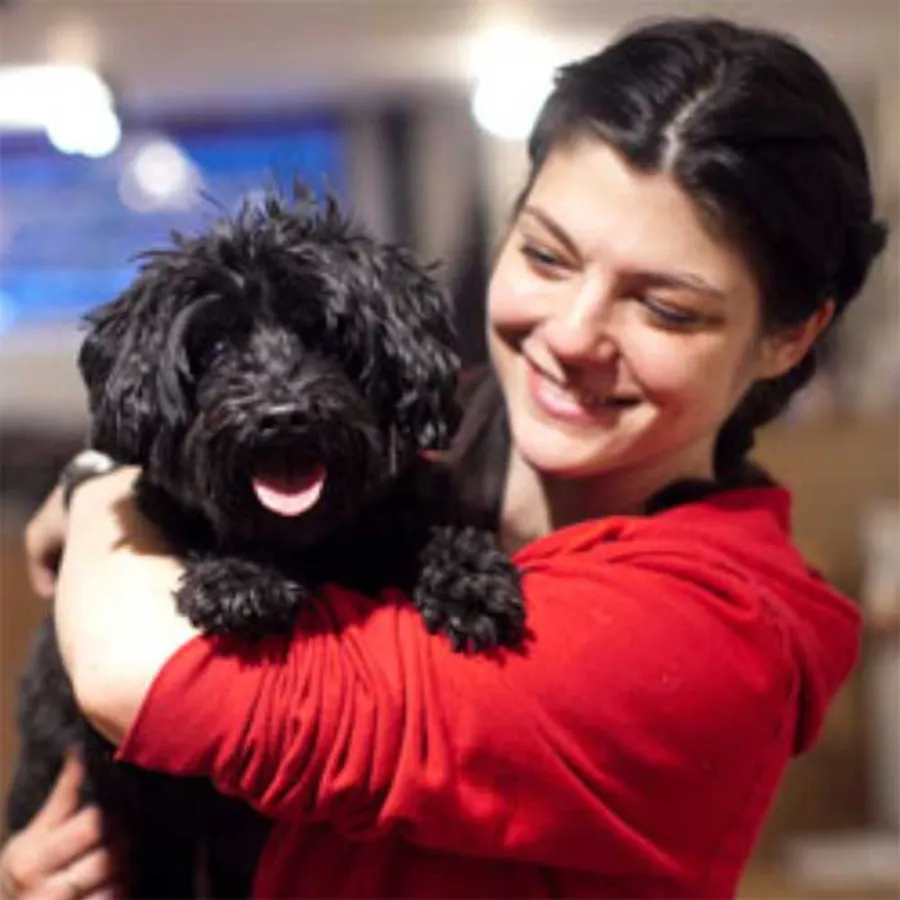
Amos Grossman Pedicone died on November 3, 2020. He was 15.5-years old, and lived with Annie Grossman since his puppyhood. He was a black Yorkiepoo who enjoyed playing fetch in the ocean, swimming in fountains, and learning new tricks -- sometimes pretty fabulous ones. But this episode isn't about his accomplishments, or about his braininess or cuteness. It's about death as part of dog ownership, and about how dog ownership can be part of a person's self-care. It's about how people can love a dog that doesn't belong to them. It's about how training can help us be able to enjoy our dogs and spend more time with them, and can help them be happy to be in the role of being the objects of our affection. It's also about how dogs are the opposite of death and heartbreak. But mostly, it's about Amos. He will be missed.
Join the School For The Dogs Community app!
On iTunes
Transcript
Annie
So my dog died a month ago on November 3rd, Election Day. And I have been attempting to record this episode for the last few weeks, but it's been hard to get myself to sit down and do it. To sit alone in a room and talk about losing my dog best friend over the last 15 and a half years, you know?
And it's not like I have to race cause someone else is going to scoop the story. It's not like I have an editor breathing down my neck. I mean, I could just choose to not record a podcast episode about losing my dog.
But this is a podcast about living with dogs, loving dogs, teaching dogs, learning from dogs. And unfortunately death is part of pet ownership. So I sort of feel like I would be chickening out if I neglected to talk about this part of my experience of this relationship. Also, this is School for the Dogs Podcast, of course, and Amos was a big part of how School for the Dogs came to be in existence.
You know, some people I know have become dog trainers because they were really interested often from an early age in animal behavior in general, and dogs are a relatively easy animal to focus on if you're interested in animal behavior, since you can study them and work with them without having to go scuba diving or camping out in a tree.
I know quite a few dog trainers who consider themselves, I think animal trainers first, dog trainer second. And I also know a lot of people who got into dog training because they had a really difficult dog. But I don't think I fit into either of those two categories for me. I think my dog training life started with a love of dogs in general and then a great love for one dog in particular. I didn't become a dog trainer to change Amos in any way. I became a dog trainer because I wanted to figure out how to be a better person to my dog, how I could spend more time with him.
I think I mentioned this in an early episode of the podcast, but I went through this real soul searching period during the last major economic downturn, like in 2008, 2009, 2010, where I was really thinking hard about how I could make a living doing something different than I had been doing. And I spent a lot of time with Amos in the dog park, writing lists of things I liked and things I could imagine spending my time doing.
And at some point I kind of realized, I just want to be doing what I'm doing right now. I want to be hanging out at the dog park with my dog, having my dog sit next to me on the bench, watch him play with other dogs, talk to other people about their dogs, learn about dogs. This is my bliss. And how can I create a life for myself where this is what I get do?
And goddamn it, I did it! I mean, that's was 10 years ago and it's certainly been a journey. And God knows these days, I spend much more time looking at spreadsheets and paying bills than I do actually hanging out with dogs and the people who love them. But overall, I would say I have spent a huge amount of time over this last decade learning about dogs and teaching dogs and talking to people about their dogs and helping people with their dogs and watching dogs and watching people with dogs.
And I am so, so, so, so fortunate, and so glad that I have spent so much of my life in that way. Like, I can't imagine any other way I would rather be spending so much time, and I feel so lucky that Amos got to be with me for so many of those years. You know, for the six years before I met my husband, I was pretty much single. Kate and I were just working around the clock, building this business. And when I wasn't doing that, I was hanging out on the couch with my dog or going out to dinner with friends with my dog, and training him to do things that were just fun for both of us.
He loved training. He loved shaping games. I used to do these orientations once a month or so at school for the dogs with seven or eight clients who would come for an introductory session. And I would have Amos there as the demo dog and he would get so excited when I started putting the chairs in a circle to get ready for the sessions, and each session, I would pick some new thing we were going to shape him to do. Like put two feet in a box or knock a cone over with his nose.
And if there were eight people, I would say, okay, we're going to see if we can get there in 16 clicks. Each of you is going to have a chance to click two things that are going to be approximations of the final behavior. I'd always try and pick something new, but let's say it was like, knock over this cup with your nose. We would start by having the first person click and treat a couple of times for him simply approaching the cup. And the next person might click and treat him a couple of times for touching the cup with his nose, and then the third for putting some pressure on it.
And the thing is, as every day went by, he got to be a better and better learner. So he would actually usually be able to do one of my little shaping challenges in just a dozen clicks or so. Sometimes not, but you know, there was something to be learned when he didn't succeed, too. There's always information there about what you as a trainer could have done differently and could do differently next time.
Anyway, he was often at the studio with me, especially when the studio started out and it was in my apartment. I would put him up. We had a little mini fridge or mini freezer in the training space. And I would put him up on that during puppy play times like him on his lifeguard chair, overseeing everything.
When we were in our first studio on East second street, or second studio, I would sometimes bring him there and stack him on the top of a bunch of climb platforms. So he was up in his throne there where he could hang out while I was teaching.
Actually I had this great backpack for him that we used to sell in our shop, but it's from this French company called Bobby and they stopped making it. But this awesome backpack that I used to bring him everywhere in with his little head coming out the side of this bag. And I would even have him there sometimes if I was teaching in a puppy play time, I would just keep him on my back
As he got older, he really didn't like puppies, which is not abnormal. I think a lot of just like a lot of older people don't have patience for tiny kids, some dogs just don't have patience for puppies who can move in unpredictable ways and haven't learned how to be polite dog citizens yet.
Anyway, my point is that I feel really lucky that I got to have this amazing buddy for so many years. And I think I will always think about School for the Dogs as something that came out of, in part, my relationship with him and the special years we got to spend getting to understand each other and just exist in the world together.
And I think he really helped me see that it can add so much to your life to own a dog. To be the person in a dog's life who's helping that dog live the best life for that dog. That giving your dog the best possible life is actually kind of like, it feels so good that it's a kind of like self care. It can be a hobby that actually benefits another living thing, but is actually about your own enjoyment.
Like there are plenty of people whose hobby is taking care of their cars, or taking care of their furniture, or caring about a sports team, but you're not taking care of the car for the car’s sake and you don't care about a baseball team for the team's sake. When you're taking care of a pet, it can seem like you're doing it for the pet, but I actually think it's a sort of wonderfully selfish hobby in that it's a hobby that, you know, I have engaged in because I love it.
It makes me feel so good to love and care for a dog. And it's almost like the fact that it actually resulted in my dog living a happy life is almost an accidental byproduct. But part of what made me happy was watching him live a life that I think was full of good stuff.
And I guess there's a way in which I think of School for the Dogs as, in part, my effort to help other people see that there are so many ways that you can enrich the moments that you spend with your dog. That you can make your world more comfortable for your dog, that you can travel with your dog. That you can figure out ways to inject the enjoyment of this hobby into as many moments of your life as possible and give your dog ideally the best possible life at the same time. And that is only going to further your passion for this hobby.
I'm not sure if I'm making sense, guys. I hope I am. Anyway, in thinking about recording this episode, I've thought, how do I distill a 15 year long relationship where I spent almost every single day with this creature into something that someone can listen to in under an hour. Do I organize it chronologically? Do I talk about achievements, accomplishments and degrees? Do I talk about places we went together, places we lived together. Do I recall her, my best memories with him? Do I talk about our first moments together or our last moments together?
And I think actually the thing that feels like it makes most sense to talk about is my ex-boyfriend. I bet you did not think that's what I was going to say, but I've been thinking about how Amos first came into my life, and I realized that there were actually two ex-boyfriends who led us to end up together each in a different way.
So the first ex boyfriend was this doctor who I dated when I was in my early twenties and I was completely head over heels in love with him, but it always felt like it was not going to last for a variety of reasons on his side. It always kind of felt like it had the fleeting nature of like an affair or something, even though it wasn't. And eventually he moved for work and was just kind of like, you were part of my life in New York and I'm not going to be in New York anymore. I'm starting a new life. He wasn't open at all to like trying to be long distance or whatever.
And, you know, I was crushed. It's funny how a breakup can feel like a death because the person might still exist, but that relationship that you have and your access to them has gone in the same way it is when someone dies. Or sort of like it does when someone dies.
Anyway, I was totally heartbroken. And a year later he came back into town and asked me to go out for a drink with him, and of course I figured he was going to want to get back together. And he was not at all interested in getting back together, and the day after that, I couldn't move. I couldn't get out of bed. I remember actually at some point that day, I did manage to get outside for a minute. And it was really hot outside. Like, that kind of like heat where you feel like someone's just like sitting on you.
And between the heat and everything else, I just felt paralyzed. I mean, I must've just been like the cliche twenty-five year old writer living in a ground floor studio apartment in Brooklyn, unable to pull herself together because her boyfriend didn't want to get back together with her. And in this hole that I was in, it occurred to me that one thing that would make me feel like I could go on existing in the world. One thing that would force me to get out of bed and that would probably improve my mood. One thing I could do would be to get a puppy
And I've gone through moments where I've thought this is kind of shameful, to be honest, where I've thought, I'm glad I wound up with Amos, but I don't think that anyone should think that getting a puppy is going to be some kind of panacea. Puppies come with their own challenges. It's a major commitment to another living creature. These kinds of decisions should be more thoughtful, but it's interesting in 2020, how many people have gone out and gotten dogs for a number of reasons.
But I think one of those reasons is that they can help make us feel better when we're down. Puppies are the opposite of death and heartbreak. And honestly, I think having this adorable puppy to care for, to pour my energy into, to love, to learn about, to spend time with, I think all of that did help me feel a lot better and of course led to so many other wonderful things in my life.
I think part of that is actually because of another ex-boyfriend, actually a guy who I dated only for a few months during the year between when the doctor broke up with me and when he declared he wasn't interested in getting back together with me. I dated this guy who was super nice. Super nice guy, but kind of like a minor ex-boyfriend in my canon of ex-boyfriends. Like there are the ex-boyfriends whose phone numbers I still have memorized. And this is not one of them.
But one thing that I really loved about him was his dog, or I should say his relationship with his dog. He had this tiny Yorkie who was adorable and sweet and hilarious and he just loved her so much. And he brought her everywhere with him in like a messenger bag that she was happy to climb into.
Now I have to admit most of my friends thought it was very strange that I was dating a straight man who had a tiny accessory dog a la Paris Hilton, but I saw it differently. He wasn't carrying that dog around because of the way it looked or to get attention. He just loved that fricking dog and wanted to spend as much of his life with her as possible, and it was something that she also seemed to really enjoy.
And I remember, this was back in the days of Friendster. I think he had a Friendster page for his dog. And I remember him trying to explain to me that she had her own social circle that wasn't attached to him. That like she had her own friends and her own relationships. I do actually kind of remember thinking that was sort of ridiculous.
But overall, I think he made me reconsider what dog ownership could be for a young person. That having a dog didn't mean I had to be tied down to my apartment and it didn't mean I had to move to the country. It didn't mean I couldn't travel or work at an office job. I think it helped open up my brain to the notion that I could have a dog who could be with me during all different parts of my life. And maybe it would be fun for the dog too.
I'm not sure I would've put it in these kinds of words, but as I've been trying to think about what he sort of helped me see about dog ownership, this is how I've been thinking about it. And this desire to spend as much time as possible with my dog to bring my dog places, to incorporate him into my life.
To me now, this is all tied together with training. You might not want to train your dog to be an agility dog. There might not be some major problem that you're trying to solve with dog training. Dog training might just be part of how you are helping your dog feel good in all these human situations that you are putting your dog in, and how to behave in those situations in such a way that will make it possible for your dog to keep doing those things with you.
I mean, if you enjoy eating outdoors, and you can train your dog to hang out on a mat next to you outside while you're eating, and people are coming and going, and to not bother you during your meal, it can be a big win for both of you. You're both getting to spend more time together and doggy lives are too short. Like if you love your dog, the training that you can do to get you to the point of being able to go out for lunch with your dog, it's just more time for you to feel good and enjoy your hobby. Like if your hobby is your car, you're going to want to spend as much time in your car and with your cars as possible.
But like I said, you know, in this case, it's a hobby where there are thoughts and feelings and emotions. And if you can, in the same breath, alter those thoughts and feelings and emotions to make the dog want to be there, then it's just kind of this reverberation of happiness, because then you're happy because the dog is happy.
Overall, I think Amos, this 18 pound black Yorkie poo made my life so much happier in every way.
And the term emotional support animal kind of drives me crazy because I feel like every person I know who has an emotional support animal thinks that they're getting away with something by having an emotional support animal. It seems like there should be at least some people who feel like they have a legitimate reason to have an emotional support animal. I don't know if I had a reason to have one, but I can tell you that I think Amos was such an emotional support to me in so many ways, so much of the time.
I mean, even just socially. When he was with me in social situations, I think I felt more, more engaged with people. I remember, and I'm being honest here about this, cause I think probably there's someone listening who is, or was similar. You know, when I was a kid at a friend's house, if somebody was having a party, I was always hanging out with the dog at the party. In high school for one year I was at a school that was very small, and there was a dog at the school and I was always hanging out with that dog. In the yearbook. I was voted nicest to dog.
But you know, I wasn't trying to please the dog or make the dog feel good. I was hanging out with the dog because it made me feel better. There were so many, so many situations over the years where having Amos with me just made me feel better about everything. And I think it made his life experience richer. But again, that was like a secondary part.
We traveled a lot together, especially when I got together with my now husband who runs student travel programs in Europe. Amos spent three summers chaperoning students in Italy, France and Greece. And I feel like if someone were writing the style section story of our lives together, they could say something like Annie Grossman felt that it was important that her dog Amos do a grand tour of Europe each summer. Like, I feel like journalists so often have a tendency to frame these things as if it's like, you're doing it for the dog.
But no. I mean, Amos lived all the things he lived because I wanted him to be with me. And it resulted in him having, I think, a very rich and happy life.
And it's funny now when I think back to the minor ex-boyfriend's comment about how his dog had her own social circle, I think about Amos's social circle. And he really did have friends beyond my group of friends. He had his own relationships, which I think is pretty awesome. And I think speaks to the fact that we should think more broadly about dog ownership. Yes, he was my dog. He was my responsibility. But I love the fact that other people, some people who I probably don't even know enjoyed spending time with him.
I'm thinking about, for instance, there was a while where I lived in Williamsburg and my best friend was working at Vice, which was in Williamsburg. And sometimes Alex would bring Amos to work with him because Amos and Alex had their own special relationship. He maybe didn't belong to Alex, but he was still his good friend.
So he would go hang out at his office with him. And then I would sometimes be walking in Williamsburg with Amos and people would say hi to Amos, people I didn't even know! Cause they worked with him at Vice. And you know, I love that. So many of my friends, I think really loved Amos and really knew him, like had their own relationships with him, because I feel like it's going to help me hang on to him. I think there were a lot of people who loved him and I'm grateful for that fact.
Also grateful to Dr. Andrea Tu. And Dr. Lisa Lippman, two friends of mine who were just wonderful in helping me through the last couple of weeks of Amos's life, as was Dr. Sally Haddock at St. Marks veterinary hospital. She diagnosed him in the middle of October with a very large mass on his liver that looked like it was probably cancer, but it was unclear. And I spent the two weeks after that, trying to figure out if it was cancer, if it was, what kind? Was he healthy enough to get a biopsy done?
We were in and out of vet appointments, but his health just really declined very quickly. He spent a week basically just wanting to sleep, and then he stopped wanting to eat. And then his kidneys started to fail and he was clearly very uncomfortable. And, you know, he had slowed down over the last few months, but he was still in pretty good shape.
This summer, we were out in Montauk one weekend and he was chasing sticks in the water. Like it was his job. He loved swimming. It's funny. He wouldn't be that interested in a tennis ball. If a tennis ball was just kicking around in the living room. But if there was a ball or any kind of stick near any body of water, he would go crazy, just desperately wanted to fetch it. And yeah, he just loved, loved, loved, loved swimming.
There was a fountain in San Francisco where we lived for a little bit in Huntington park that he loved. And in Rome and Prati, there was this fountain that he would want to go fetch in every day if we let him. Anyway, as late as this summer, he was still swimming. And he was just very, very spry for a long time at. Even at four 14, people would say, how old is your dog? And I'd say 14, and they'd say 14 months?
And, I've had the feeling that I think be common for pet owners. I felt this way also when, my cat died, like, Ugh, if only there was more I could have done, or if I had done X, Y, or Z sooner, or if I had paid more attention to why, or like, I've definitely had those thoughts. Like maybe if I had brought him in for a checkup sooner, they would have found the mass sooner and maybe they could have operated on it.
But I remind myself that he was 15 and a half, that that's old for a dog. And I wish he could have lived till 20. But I guess I'm also in a way grateful that it worked out the way it did because I wasn't in the position really of having to decide whether or not to invest huge amounts of money into chemotherapy or surgery in order to extend his life by some unclear amount of time. Because I think that's a really hard position to be put in. I mean, on the one hand, you're dealing with your best friend who you love more than anything. On the other hand, death is going to happen at some point, and most people's pockets aren't bottomless.
And I'm also grateful that I really never had to see him as a very depleted version of himself. He didn't ever show any kinds of senility. He still had his vision and his hearing and most of his teeth. Like I always imagined the sort future decrepit, skinny, sad version of himself that maybe he would be as an old man. And I thought about how I would love that old man dog as much as I always loved him, but that it would be sad because I would also remember how vibrant and wonderful he wasn't as youth.
And that's just another hard reality of pet ownership. That you can experience these animals both as puppies and as old people. It was really hard seeing him unwell, but I'm glad it was a short period of time. And I'm sure that in time the memories of him being his best self will far outweigh the memories of those final difficult days. And I think that's really the, the most that you can hope for when you have a dog spend his lifetime with you.
I asked Jason, my husband, to bring him to the vet when it was time to put him down. I realized if I had the choice to not be there myself, I didn't want to be there. I held him for the two hours before it was time. And then I put him in his backpack with Jason and they went off.
I realized I didn't really want to have the memory of seeing him dead. I know some pet owners feel it's really important to be there for that moment. But I felt like I wasn't there when he was born, and I felt comfortable with him being in the arms of my partner during the last moments. And later that day, he came home with the bag empty except for the blue sweatshirt Amos had been wearing.
And what can I say? I miss him a lot. His leash is still hanging by the door. Magnolia came home after he had been put down and walked into every room in the apartment saying, Woowoo? Woowoo? Looking for him. Woowoo is what she says for dog. She, and he had a really special sweet relationship. And it's really nice to know that although she probably won't remember him, that he still is going to be in her somewhere. That in some way he will have helped shape her idea about dogs and and about the world. And I'm fortunate that I have lots of great photos of them together, which I hope she'll enjoy as she gets older.
Jason is having Amos's ashes made into a necklace for me from an Etsy shop called close by me. And all right. I think I'm done here. I think I'm done sitting in a room by myself, talking out loud about ex-boyfriends and my dead dog. What am I doing with my life? [laughs]
Oh, big news for podcast fans. The community app that I've been talking about is live. Now you can find it. You can go there on a web browser, just go to schoolforthedogs.com/community. You can also find it in the app store or the play store look up school for the dogs community, it's free. There's some paid add-ons you can get, but it is free to join and to join the conversation.
It's really cool. We basically built our own little Facebook app, so please come check it out. Come say hi, there is a podcast group within it. There's an introduction section. So that would be a great place for you to go ahead and introduce yourself and poke around and see what we've made. I am psyched about it.
Also a reminder that I have been going live every Thursday after noon. I think I might start actually going live within the app, but you can also sign up to join schoolforthedogs.com/Qanda. If you want to attend my Thursday live sessions, and you can ask a question in advance, if you'd like at anniegrossman.com/ask.