April 3, 2019 · 38 min
A busy person's guide to Operant Conditioning
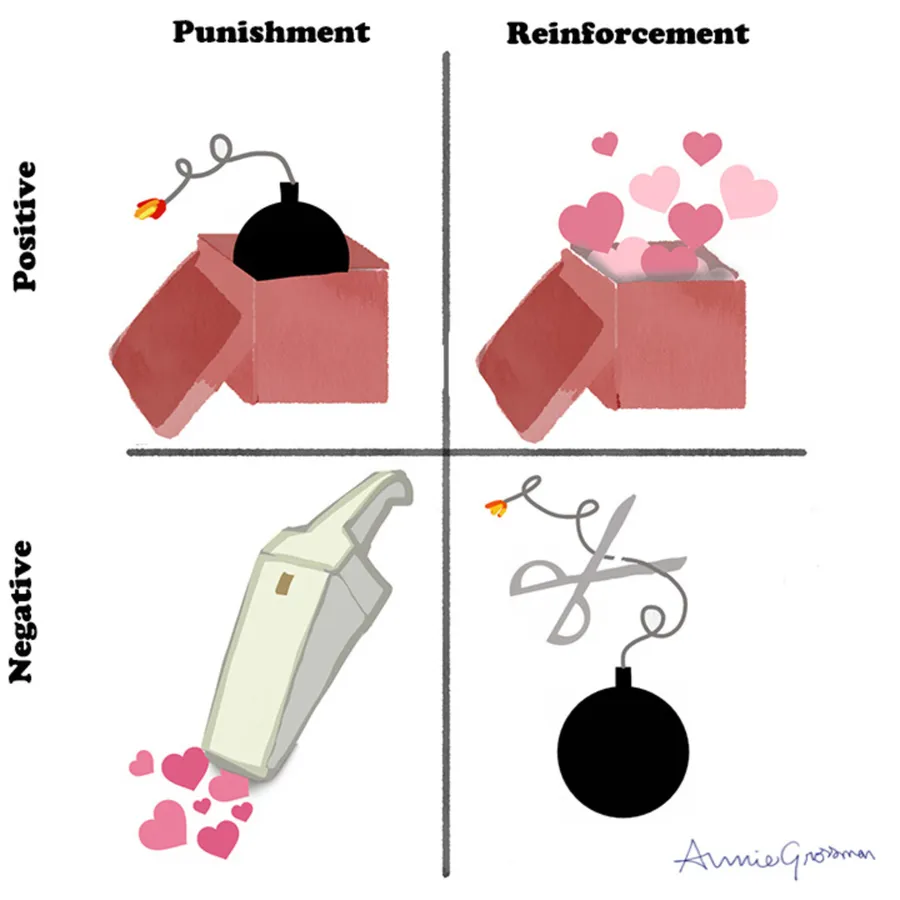
Positive Reinforcement, Negative Reinforcement, Positive Punishment and Negative Reinforcement: You may have heard these terms thrown around, but they're often misused or little understood. Together, they describe four different ways all animals learn by consequences-- aka, Operant Conditioning. In a rush to put up a podcast episode while her young baby naps, Annie challenges herself to describe each "quadrant" of Operant Conditioning in two and a half minutes.
Notes
Phoebe controls the TV with her eyes
Operant conditioning explained on The Big Bang Theory Being
Episode 42: Let's talk about dog breeding with Cherrie Mahon
Partial Transcript
Annie
Hey everyone. Annie here. And I'm with my three-month old cohost who is being quiet right now, but she may have something to say shortly. And because I am a full-time mom in addition to running School for the Dogs and in addition to doing this podcast, I am trying to be more efficient and how I do everything. Because although I have seven hands and four brains, it's hard to get it all done. So for that reason, I am challenging myself today to keep this episode short. And the thing I want to talk about today is operant conditioning, which really has four major parts. So I decided to see if I could describe each of those parts in two and a half minutes. Making all of operant conditioning, something that can be contained in 10 minutes. And let's see. Let's see if I can do it.
But first, what is operant conditioning and why do I want to talk about it? Well, there are basically two ways that all animals learn. There's two kinds of conditioning. Conditioning is a term that's synonymous with learning. And those two ways of learning are operant conditioning and classical conditioning.,,
Full Transcript at the podcast