
November 9, 2026 · Annie Grossman
When Your Dog Outweighs Your Confidence
On having a ninety-pound dog and a fear of falling on the city streets
Hi humans! You look so human-y today!
Thanks to those of you who attended last Wednesday’s Dog Talk, and apologies to those of you who tried to attend but couldn’t get in— there were technical problems that were my fault. This is what happens when your CTO is a dog. But I think we have everything under control now, so I hope you’ll log on for Dog Talk again this Wednesday at noon ET. My kids may join me this week, because they will be off of school. I suggested they go to a one-day gymnastics camp but they said they’d rather stay home and talk about dogs so… clearly there is something wrong with them.

I told my 5-year-old we’d be taking questions about dogs. She asked if she could wear her dog shirt. Apparently that was only the first question.

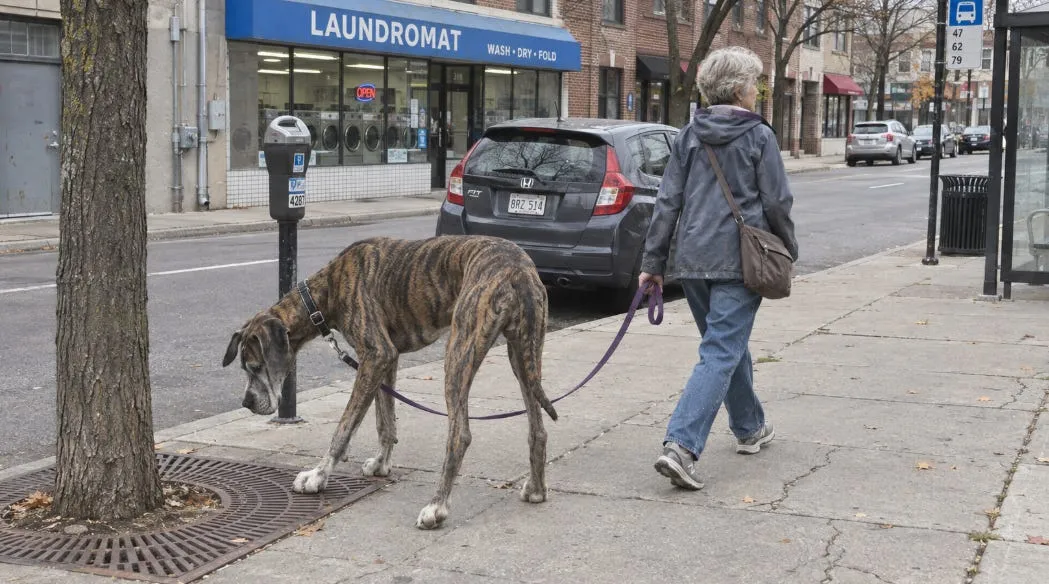
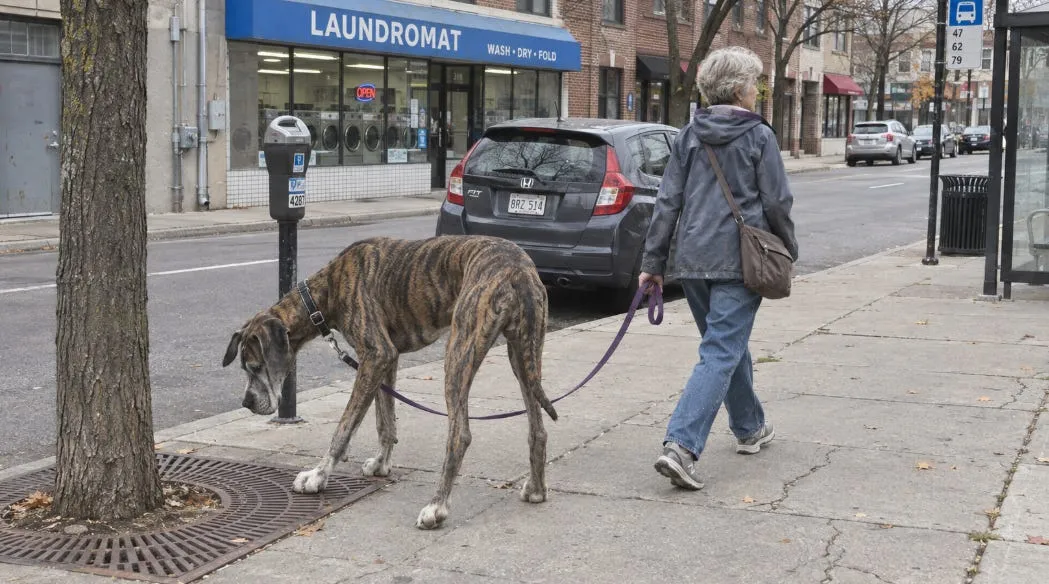
Last week, Andrea, a DBADTYD subscriber who lives in Manhattan part time and in upstate New York part time, spoke to me about some of the challenges she has faced walking her ninety-pound dog in the city.
One concern is that she is afraid of falling. Interestingly, this a fear of many people I know who do not have a ninety-pound dog! Andrea has come up with a very straightforward solution that gives her one-hundred percent assurance she will not be pulled over by her large familiar: She has someone else walk him!
A professional, no less!
When she is in the city, she usually walks with her dog and the walker. Which gives her the chance to work on his lunging behavior without having to worry about being pulled over. She asked for some tips for dealing with this behavior, especially in situations where the dog spots another dog before she does.
Here are some things I suggested:
-
Choose your walking times wisely. Central Park, where she likes to walk her big guy, has off-leash hours from 6AM to 9AM and from 9PM to 1AM every day. I’d keep walks to within leash hours. Or else, walk very very early or very very late at night, but it is, of course, hard to get a walker who is going to be available in those times.1
-
Notice what he does as soon as he notices another dog. Does his body stiffen? Does he start to fixate? If you use a marker, like a clicker, you can pinpoint that moment (the earlier the better) and then reward him in the other direction. It’s like you’re teaching him to say “Hey there’s another dog!” in a soft voice. Kind of like you’re cutting him off before he can say the whole sentence. Thanks for the info! We don’t need you to do the whole routine, buddy! Use a really good treat outside to get his attention— think hot dog bits or turkey or shredded cheese. I like to use a clicker in these instances, rather than a marker like a word, as it does a better job of slicing through time and space and getting the dog’s attention. Ultimately, you’re teaching that spotting another dog is a cue that you are going to deliver something good in the other direction.
-
Work on U-turns so that you can quickly get your dog to switch direction using a verbal cue. You can start in your living room, where the odds of a strange dog appearing are (one hopes) pretty low. Say “This way!” turn, and give treats in the other direction. Do many reps before you try it with a leash on. Then try it outside when the street is quiet.
I also like to make the spot right next to my leg a little magic zone. Give the treat there so he learns where to come when you turn. Over time, “this way” can mean something very specific to him: Oh, I know this move. I go with you, and good things happen right by your knee.
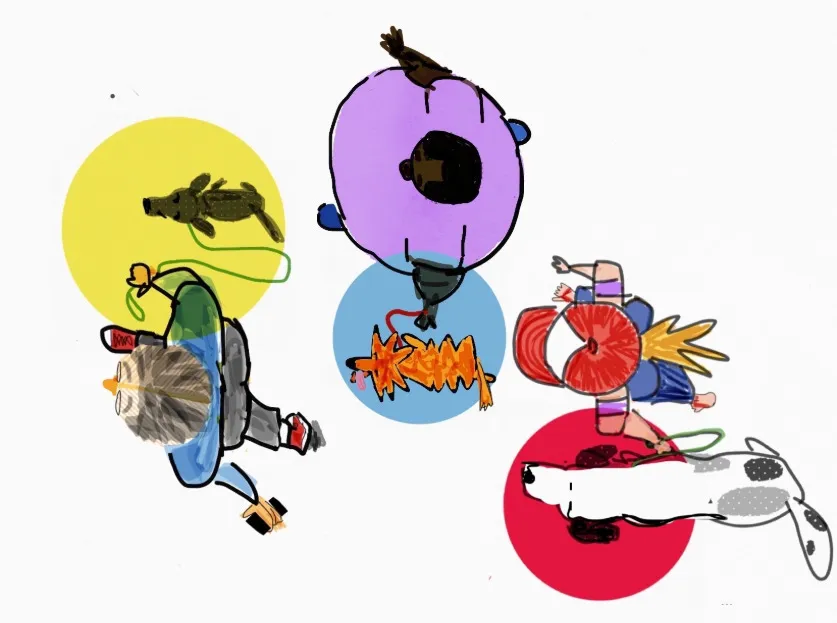
The “Magic Zone” is the spot where you want your dog to be walking. Pay them where you want them to work! Illustration by author.
With my dog, Poppy, I’ve been working on teaching her to switch sides when we are outside. We’re still at the “inside” level though. But she loves working on this because it’s so easy. I’ve been using little rubber “poly dot” circles2 to give her a place to target. The cue is tapping my leg. I tap my leg, wait for her to touch the poly dot, and then give the treat at the knee. To build the behavior, in the beginning, I just tapped my leg and put treats on the dot— one of those you-can-literally-train-this-with-your-eyes-closed training games, since I was just creating a pattern, not waiting for a behavior. After she ate the treats on one poly dot, I tapped my other leg and put treats on the dot on the other side. Once we have a nice rhythm of her going back and forth, I raised the bar so that she had to actually be on the dot to get the treat. And I also started giving the treat at my knee.
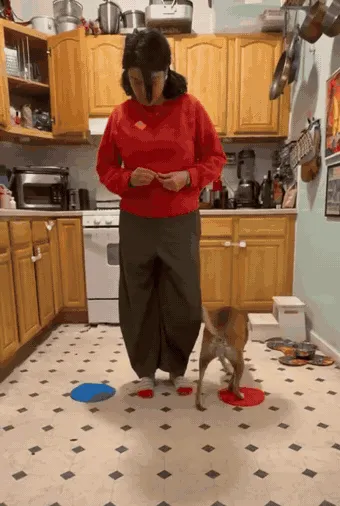
First stage of teaching my dog to go from one side to the other involved little more than slapping my leg and then putting treats on the corresponding dot. If your dog has a tendency to cross in front of you, toss a treat behind you while you’re starting out, between when you put treats on the dogs.
I think we’re getting ready to add the leash to them mix, and then we’ll take it to the street.
Alright, I hope to see some of you this Wednesday!
IG: annie.grossman
Footnotes
-
Although, if you’re looking for a walker who will work with a difficult dog or come at odd times, this is my friend Shelley’s specialty… ↩
-
This is an affiliate link. I love using these dots in training. Buy them and I will get a 3-percent commission which I will surely use to buy more poly dots. ↩
Originally published in my newsletter, Don't Be a Dick to Your Dog.