
August 14, 2026 · Annie Grossman
The Fulcrum Between What You Want and What Your Dog Wants
On secondary reinforcers, a frivolous lawsuit, learned helplessness, AI, and the late Alexandra Kurland.

Hello humans and dogs who are getting too much screen time:
The British online magazine UnHerd just published a piece I wrote about being sued for having an online store that a blind woman supposedly found difficult to use, resulting in “a concrete and particularized injury.” This lawsuit was basically the final blow that led to me closing my business, School For The Dogs, on the first of the year last year (a painful ordeal I wrote a series of essays about: Postscript For The Dogs). It’s a frustrating tale about predatory lawyers, holes in the Americans with Disabilities Act, and the struggle of trying to run a mission-driven small business in NYC in the 2020s. Check it out here! (NB: Just click the X at the top of the pop-up to read without having to pay).
Some bits and bobs:
-
I appreciated all the nice feedback on my piece last week about Cesar Millan’s appearance on The Huberman Lab. I wish I hadn’t felt compelled to write it, but… nice feedback is still nice! Thanks especially to those of you who shared it with others. A couple of people asked whether I’d heard back from Huberman. Nope! He’d said he would read my book—which offers a more detailed critique of Cesar Millan’s oeuvre—and get back to me, but… crickets. I have since sent him both my essay and this one by Kerry Nichols, author of Puppy Brain.
-
I just finished reading The Girl With The Duck Tattoo, by Sarma Melngailis who used to have a restaurant on my block. The story is about the demise of her business, and it makes my own business woes look like a vacation. I so empathized with many of the stressful things she dealt with: Agonizing over making payroll, taking high interest loans, feeling like both the victim and villain of the situation. The big difference is that, unlike me, her situation was brought about by a relationship with a sociopath who took all her money and claimed he’d make her dog immortal. It’s a wild and sad tale. What’s interesting is that she describes herself giving into her captor’s coercive control because she was in a state that sounds a lot like “Learned Helplessness,” a technical term I dissect in my book. It’s basically where an animal is punished to the point where they just give in and stop trying to fight back — a state that can look, to the trainer/oppressor, like good behavior but is really just an animal who has given up on life. I spoke about how dogs trained using aversive techniques can wind up in this state on this week’s episode of Anke Herrmann’s podcast Soul Touched by Dogs. This is very much what happens to the dogs on Cesar Millan’s shows. And get this: In talking about how she got into this state and, in it, was so easily made to do self-destructive things, Sarma mentions… Dr. Andrew Huberman! She quotes him saying: “The more stressed a human or an animal gets, the easier it is to recruit them into some sort of delusional thinking.” If only he recognized this is how Millan “trains.”

-
Reminder that I will be on a panel at the Train With Love + Science retreat (Brattleboro, VT) in September — I hosted its first iteration in 2024 which is why it’s named for my book! — and I’ll be presenting in October at the CANIS Conference (Shaumburg, IL)! More info (and registration links) here.
-
If you read the aforementioned essays on the closing of my business baby, you’ll know that there’s a surprise character who makes her appearance at the end: a human baby! Well guess what: She just turned ONE!

Happy Birthday, Rose Louise! Don’t I make the cutest babies?!
And now, a somewhat esoteric digression about clickers, money, artificial intelligence, and a mystery that led me back to the esteemed horse trainer who died last month, Alexandra Kurland:
Last week I shared a free guide I made called How Not To Be a Dick To Your Dog. In it, I talk about training using a clicker or some other type of secondary reinforcer. When I first learned about clickers before I had ever used one I thought they were some kind of unnecessary gimmick. You don’t need a thing to train a dog, I thought. I was kind of right: You don’t need a clicker. But a clicker is just one kind of secondary reinforcer you can use, and a secondary reinforcer is a hugely powerful training tool once you understand what it is. So… even though this guide is meant to be short and too the point, I wanted to explain what a secondary reinforcer is rather than just saying “use a clicker.”
What’s funny is that I uploaded the guide to ChatGPT when I was done writing it and asked for feedback and it basically said “this is great except remove all the stuff about secondary reinforcers — too niche, too jargon-y, no one cares!” To which I said: No! I’m going to talk about secondary reinforcers, dammit! I will not be controlled by robots! It then told me that at the very least I should remove this graphic I’d made.
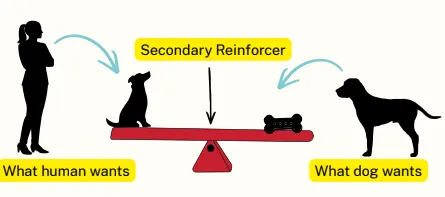
So, naturally, I included the graphic.
Although it may be describing a point that’s a bit esoteric, I just love thinking about a secondary reinforcer this way: the fulcrum between what you want (in this graphic, it’s a sit) and what the dog wants (a vector Milk-Bone).
Money is a secondary reinforcer, and it could be used in the same equation: You have a car with three wheels and PepBoys has a tire; money is the thing that exists between these two things. It seems so obvious but I’d never thought about money or any other secondary reinforcer in this way…until someone explained it in terms of clicker training.
Someone… but who? Where? When? I couldn’t remember! So… I opened up my Google Drive and asked the AI to solve this mystery by looking through fifteen years of unorganized documents. This seemed like the kind of punishing task it deserved.
And guess what: It solved the mystery! Even more amazing: The person from whom I first got this idea was none other than the late Alexandra Kurland, the renowned horse trainer passing I recently wrote about!
It was given to her by Kathy Sdao, author of one of my favorite training books, in answer to the question “What Is Clicker Training.” I’m sharing it here with Kathy’s permission. Interestingly, she doesn’t use the word “fulcrum” but that’s the term under which my brain seemed to file this “two sides” idea.
For me the defining element for clicker training is its use of a marker signal that links a desired behavior with something the animal will actively work to gain.
Using a clicker is not a necessary requirement. The signal can be anything: the mechanical clicker, a whistle, a tongue click, a verbal signal, a flashing light, a hand signal, etc. How the signal is used, not what it is, is the important element.
There are two sides to the click: what happens before, and what happens after. What happens immediately before the click is a behavior the trainer would like to strengthen. What happens immediately after is an event the animal would like to strengthen, such as receiving food. The click unites these two desires. So behavior leads to click leads to reinforcement is for me the major defining element of clicker training.
(A memorial for Alexandra will be held on August 9th on Zoom. More information here).
(This post/email includes Amazon affiliate links)
Originally published in my newsletter, Don't Be a Dick to Your Dog.