
April 3, 2026 · Annie Grossman
4.5 Million Views, Zero Dollars, and One Very Bad Idea About Dogs
What a viral video reveals about how people think about behavior


Lately, I’ve been trying to resist the urge to open Instagram.
It feels like walking into a loud room where people are yelling at me about war, plastic surgery, and things I should buy.
It also makes me anxious in a more specific way: I see other dog trainers promoting themselves, their work, and their views, and I think, I should be doing that too.
The thing is, it doesn’t really feel like my thing.
Part of what I like about being a writer is that I can communicate my thoughts without putting on makeup or dancing in front of strangers.
Every now and then I have an idea for a video I could make—something simple, something in my comfort zone, something that might help promote my book and spread the gospel of reward-based, non-coercive dog training.
But then I think about the time and effort it would take and… I’d have to put on makeup.
So the video never gets made.
This Will Only Take a Minute…
The other day, though, a friend sent me a clip of someone reacting to a video using Instagram’s green-screen effect—just their head and torso in the corner, making faces.
I thought: Sheesh, I could do that.
So I pulled up a clip a friend had sent me months ago, turned on the green screen, and filmed myself silently reacting to it.
It took maybe two minutes.
Within an hour, the video had 100,000 views.
By the next day: a million.
Two weeks later: more than four million views, 26,000 likes, and 2,7000 comments.
The total watch time on this twelve-second video?
Over a year and eight days.
Oh, Martha
The video, which you can see on my Instagram here, is one that is from an interview that Martha Stewart did last year with The Washington Post. In it, she explains that when she gets a new pet, the first thing she does is bite it on the ear.
“Hard,” she says.
This is how “it knows then that I am its mother.”
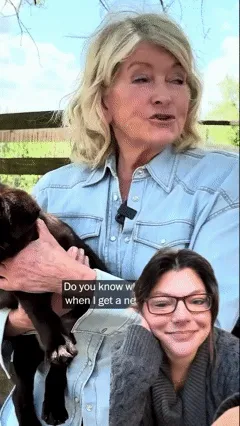
Via @annie.grossman on Instagram
Now, I have spent a fair amount of time with puppies and their mothers. I’ve worked with puppies and their mothers in several professional capacities: as a dog trainer, as a shelter worker, and as an associate producer on the Animal Planet show Too Cute: Puppies and Kittens.
I have never seen anything like this happen.
I asked several breeder friends.
None of them had seen it either.
And yet, there it was—presented without commentary in a clip from a major news outlet.
It just underscored what I already knew: The mainstream media will disseminate almost anything about dogs as if it were fact, especially if a celebrity says it.
Virality Bites
This was the first piece of content I’ve ever made that “went viral.”
In my somewhat oblique attempt to promote a book I spent a decade writing, I spent two minutes making a video that resulted in Meta getting a year’s worth of human attention.
It really is amazing how you can create something with almost no effort, reach millions of people, and then come away having had your life impacted… basically not at all.
I gained some Instagram followers, which is some kind of currency, but it’s not like I made a cent.
I probably should’ve created it in a way that gave people more of a push to buy my book, but I did it at a moment where I was preoccupied with getting the laundry done before the baby woke up so… I didn’t.
What I did get, I think, was a bit of reassurance.
I often feel like nobody cares that there is so much terrible dog training advice floating around online.
But this clip did seem to horrify people.
So maybe they do care.
I suppose this is good news as I have amassed quite the library over the years of terrible clips of people offering up really awful dog training advice. My husband, who at first could not believe I stooped to making a “reaction” video — he gave me a look that could only be interpreted as saying “Whats next, a get-ready-with-me video?” —quickly changed his tune. “Just post all the awful videos you have and just have yourself looking horrified in the corner of the screen!” he said. “You can DO THIS!”
Commenters Know Best
The comments were, predictably, all over the place.
“I bit a sandwich hard! And it knows I’m its daddy,” one person wrote.
“Martha is the Michael Vick of Connecticut,” wrote another.
Some people said we should give her a break—that this is just how things were done “back then.”
(In How To Train Your Dog With Love + Science, I write about being told as a kid to bite my dog’s ear as punishment — punishment for the dog, that is.)
Others argued that this kind of thing is necessary to train a dog.
That part didn’t surprise me at all.
In my experience, many old-fashioned punitive training methods are still being marketed as cutting edge.
The comments that always get to me, though, are the ones that confidently misunderstand the most basic science of behavior.
In my book, I try to offer a kind of fifth-grade-level introduction to operant and classical conditioning — most people never learn anything about the science of behavior in school; even Psych 101 classes seem to often not cover it well, if at all. But I think a basic understanding of it this area of natural science could benefit everyone.
Not just for dog training, but for understanding behavior more broadly.
The fact that people don’t know the fundamentals is, in my opinion, a problem.
But an even bigger problem is that people think they do.
(I recently had someone on Substack tell me they “train with the template of operant conditioning” and “only use positive reinforcement,” never punishment—but also that they “interrupt behavior” to stop bad behavior and to “reset the dog’s brain,” and that positive reinforcement “doesn’t work in the real world.” I pointed out that, technically speaking, punishment is anything that decreases the likelihood a behavior will reoccur, whether you call it it punishment or interruption—and asked what, exactly, counts as the “real world.” She replied, irate, and accused me of trying to be “a scientist.”)
One Instagram commenter addressed me, I guess excusing Martha’s behavior by saying that if I didn’t understand there are “four quadrants of reinforcement,” I shouldn’t call myself a dog trainer.
This makes about as much sense as saying that water is made of one oxygen and one hydrogen atoms—and if you don’t know that, you can’t call yourself a scuba diver.
(For the record: there are two quadrants of reinforcement and two of punishment. And you could know none of them and still be a fine trainer.)
Another person told me you can’t use positive reinforcement to reward positive behavior without also using negative reinforcement to deal with negative behavior.
I replied that behavior isn’t objectively “positive” or “negative,” and that in the context of operant conditioning “positive” means adding something, while “reinforcement” means increasing a behavior.
So positive reinforcement means increasing a behavior because there’s a consequence that involves adding something.
Negative reinforcement means increasing a behavior by removing something.
He responded he knew all about operant conditioning and called me a condescending jerk who didn’t know what I was talking about and was just offering up a “word salad.”
At that point, I closed Instagram and went to be with my kids.
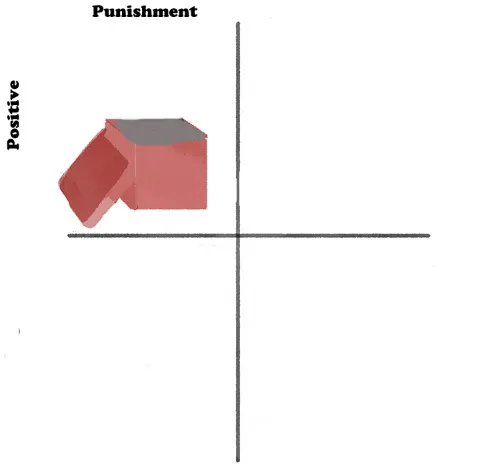
My attempt to breakdown the “quadrants” of operant conditioning and clarifying the meaning of “positive” and “negative” in this context, which can be confusing.
The Problem
This is what we’re up against:
Millions of people learn about dogs from twelve-second clips.
Meta gets the watch time. Dogs get chewed on.
What a time to be alive!
I’ve never been a billionaire, or smoked weed with Snoop Dogg, or been to jail, so obviously The Washington Post doesn’t care about my opinion about dog training.
But, as a dog professional —and a mother—here are my thoughts:
You don’t need to “show” you’re an animal’s mother.
Call yourself whatever you want, but, if you have a dog, and you are a human, you are—almost certainly—not the actual mother.
But you can be a trustworthy figure whose presence reliably signals safety.
You can arrange contingencies so your dog lives in an environment where good things are likely to happen when they do things you (and they) like.
You can provide plentiful access to what your dog needs and wants.
In short, you can be… someone your dog is happy to be around.
Do anything else and, in my opinion, you’re being a dick to your dog.
This and that…
The person I sparred with about punishment on Substack accused me of writing this newsletter with an agenda… to which I said YOU BET I HAVE AN AGENDA! I’m here to try to promote my book, How To Train Your Dog With Love + Science. I’m putting in the work here so I don’t have to lip synch on OTHER platforms! If you’d like a copy, I will send you one when you become a yearly subscriber, which is just $20/month.
Reader Joanna C. won last week’s giveaway of Andrew Garn’s book, The New York Pigeon! Thanks for supporting my work, Joanna, and I hope you enjoy your copy of this beautiful book.
(This post contains Amazon affiliate links; image of Martha Stewart and a dog created by Open AI)
Originally published in my newsletter, Don't Be a Dick to Your Dog.