
July 25, 2018 · Annie Grossman
The Dog Training Triad Part 2: Rewards
Part 2 of the Dog Training Triad: the difference between rewards and reinforcers, and how to choose the right rewards for your dog.
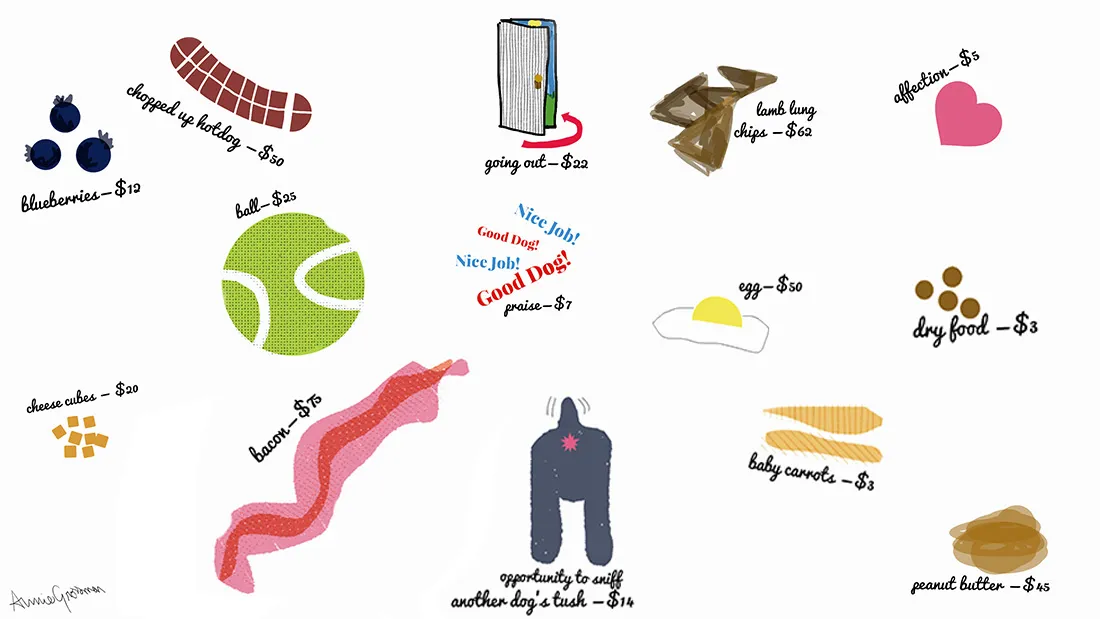
If you subscribe to our podcast, you know that we’ve done a series on what we call The Dog Training Triad. This Triad is made up of three parts: Management, Timing, and Rewards.
We covered the first part of the triad in a recent blog post. Management is all about setting the stage so that your dog can succeed— it involves changing behavior by doing all we can to change the environment.
Rewards vs. Reinforcers
We tend to use the words “rewards” and “reinforcer” interchangeably. And… we think that’s perfectly fine! Which is why we do it! But, technically, they really aren’t the same thing. Basically, a “reward” isn’t always a “reinforcer,” and a “reinforcer” isn’t always a “reward.”
Let’s take the first part first: When a “reward” isn’t a “reinforcer.”
You get a “most valuable employee” award… You receive a passionate kiss from your boyfriend… Your soccer team wins and everyone gets taken out for ice cream. But… If you hate your job and are planning to leave your company, or if that kiss is delivered in front of all your work colleagues, or if you’re allergic to dairy, none of these things is likely to be reinforcing. A well-chosen “reward” should be something that your training subject likes; it is only technically a “reinforcer” if it encourages the likelihood that whatever the behavior that preceded the delivery of the “reward” was will reoccur.
And… a “reinforcer” isn’t always a “reward”…
A reinforcer is something that encourages a behavior. We usually think about reinforcers that are “positive,” in that the behavior results in an “addition” of something that we like. You work, and you get money that wasn’t there before, and that makes you go to work again the next day. Because money appeared, as opposed to it being taken away, it is “positive.” But sometimes behaviors are encouraged because behaving in a certain way makes something “bad” go away. In that case, we are dealing with a “negative” reinforcer — “negative” because something is being taken away, and “reinforcer” because the behavior is encouraged. An example would be paying a bill — the behavior is encouraged because it makes the bill collector go away (going away= “negative”). Or the beeping sound you hear when you don’t put on your seatbelt: The behavior of putting on your seatbelt is encouraged because it makes the sound stop).
Choosing rewards
One of the most important things you’ll ever learn about your dog is what he likes. In fact, you can expect to spend the rest of your life with your dog cataloging what he enjoys. No two individuals enjoy the exact same “cornucopia” of things — that is as true of people as it is with dogs. Some people like to sleep late and watch NASCAR. Some people like to wake up early and meditate. I like chips. You prefer popcorn. And, of course, what “pleasures” one person might seem perfectly punishing to someone else! Personally, I wouldn’t be caught dead running a marathon, or eating shark fin soup, or getting tied down with leather straps and whipped. But other people pay good money for the privilege of doing these things! So, you simply need to start cataloging everything your dog likes. What would be the equivalent of his $100 bill? What would be a $1? In new or challenging situations, you’ll definitely want to use the big money!
Food Rewards
The main reward we use at School For The Dogs is food. Of course, you do not have to use food to train, but I have never found a dog who doesn’t want to eat several times a day… and, if he enjoys his food, that means his food is acting as a reinforcer, even if you’re not tuned into what behavior it is reinforcing. Much of the time, the reinforced behavior might just be bending over his food bowl. Why not use the food to reward more specific behaviors?