
May 19, 2026 · Annie Grossman
Stupid Pet Tricks, Smart Training
How The Late Show with David Letterman accidentally taught a generation about behavior science
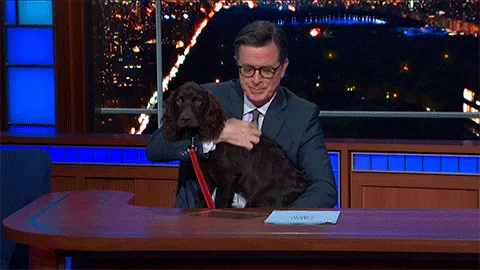
The Late Show’s host, Stephen Colbert is both a national treasure and a dog lover. Here Benny, his Boykin Spaniel. The Boykin is the state dog of South Carolina, where Colbert is from.
As you may have heard, The Late Show is ending this week, after a 33-year run.
I have been watching this show since I was a teenager, back when it was hosted by its first host, David Letterman.
I even watched him before I hit the double digits, when his show was Late Night With David Letterman.
“The kids love me!” he used to always say, and I would think: It’s true!
Here is one likely reason: Letterman would invite people onto his show to demonstrate funny things they could do with animals, some of which must’ve involved some pretty good training.
Watching these old TV clips now, I fall in love with a 1990s family that trained their dog, Olive Oil, to jump rope with their two ponytailed daughters. The parents swing the rope and all three girls start jumping. Everyone cheers. This is the best family ever.
Watch the video in the original post on Substack →
Sadly, the segment was not called “Animals Doing Cool Things.”
It was called Stupid Pet Tricks.
As the years went on, the tricks did become pretty stupid. The nadir may have been the 2001 episode where a woman’s “trick” involved stuffing her face with cottage cheese and letting her pet duck, Regis, eat it out of her mouth.
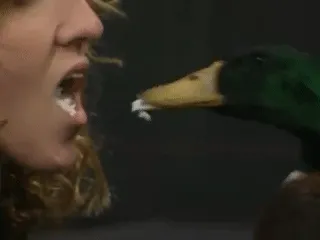
How someone gets the idea to try this to begin with, I’ll never know.
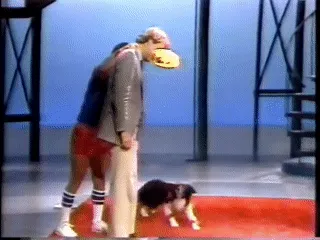
But before things got that stupid, Letterman showcased some genuinely impressive stuff. In 1985, he welcomed a young man in big glasses named Peter Bloeme — a name Letterman thought was hilarious (it’s actually pronounced “Blurm”).
Mustached and sprightly, he looked like a nerd superhero. Red short shorts, tight shirt, knee socks, and a sidekick: a border collie named Wizard. They wore matching red armbands. For six minutes, Wizard retrieved frisbees at lightning speed, sometimes using his nose to bop them back before they landed, other times catching them twenty feet away in midair and bringing them back. At moments, the two almost looked like they were tandem juggling frisbees. It’s really something.
Watch the video in the original post on Substack →
Among the millions watching that night was a young man named Martin Levy.
“It was the coolest thing I’d ever seen,” he told me. “I wanted a dog I could play frisbee with too.”
Fast forward a few decades and Levy is now an orthopedic surgeon — and also a dog frisbee instructor. In his spare time, he writes fiction from the point of view of dogs.
But what brought me to Levy’s door wasn’t actually the training he does with his four border collies.
It was the training he does with medical students.
The Broken Border Collie
Levy didn’t enter the world of dog training with strong ideological ideas about how dogs should be trained. He was a science guy; behavior stuff belonged to the psychology department. But the more he learned about positive reinforcement, the more sense it made — especially when the job at hand is teaching a dog to play frisbee. The reward is part of the thing. Training a border collie to chase a frisbee must be like training me to go get ice cream.
Growing up, his father squirted the family dogs with lemon juice, but he’d never thought much about it. “It was just what they did,” he said.
But he can pinpoint the exact moment when he came to see how damaging punishment can be. It was almost accidental.
He was practicing agility with his third border collie, Penny — a dog he refers to as “the smartest dog on earth” — and she kept knocking over a pole she was supposed to clear. Frustrated, he grabbed the pole and softly muttered “damn” as he banged it against the ground. It was really more a displacement of frustration than an act directed at her. But she didn’t know that.
She ran into a tunnel and cowered.
It took him an hour to coax her back out.
“I thought I had broken her,” he said.
The whole thing got him thinking about his orthopedic residents.
“You see, we would get these really bright kids coming in. Highly motivated on day one. And then six months later I’d be hearing how stupid and lazy they were. And I finally said to my group: ‘We’re taking all these really smart, highly motivated kids, and we’re breaking them.’”
His students were taught more or less the way he had been taught: shown a procedure, told to practice it, then expected to return later having improved. Often they came back having practiced incorrectly, which frustrated the teachers. If there was harshness, so be it. This wasn’t kindergarten.
For years, Levy and his colleagues told themselves that the students just needed to toughen up. Levy started wondering if the problem was the teaching.
“What am I doing to humans?” he said. “It may not lead a person to fall on the ground and stop eating, but they’re still affected by it. And it doesn’t improve performance. And all I care about is improving performance.”
What he realized was not that orthopedic surgeons need freeze-dried chicken bits. They don’t. The reward centers of their brains are activated simply by getting something right.
The problem was that they weren’t getting enough information about what they were getting right.
And things were further muddied by all the noise about what they were doing wrong.
Around this same time, the American Board of Orthopedic Surgery asked training directors around the country to propose methods for teaching technical skills. Levy thought the whole approach made no sense.
“It was all procedural: ‘This is how you fix a fracture. This is how you fix carpal tunnel.’ And I thought: That’s the craziest thing I’ve ever heard.”
“I mean, if you’re gonna teach a dog to get me a beer from the refrigerator, you don’t just say: ‘Go get me a beer from the refrigerator.’”
The behavior had to be broken down.
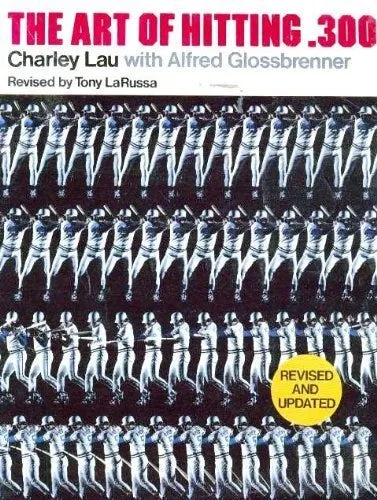
This was something Levy had first learned not from dogs or medicine, but from baseball. In his twenties, his bible had been Charley Lau’s 1980 book The Art of Hitting .300. Lau, a Major League batting coach, became famous for analyzing swings frame by frame using videotape. What looked like one behavior — “hitting a ball” — was actually made up of dozens of tiny movements and choices: foot placement, weight shifts, eye focus, timing.
“There was a stepwise way to learn to hit a ball,” Levy said.
Maybe, he thought, the same thing applied to using a bone saw.
Frame by Frame
For a moment, imagine you’re Charley Lau, pausing videotape of a batter mid-swing.
Those tiny frozen moments — a slight shift in weight, the angle of the wrists, where the eyes are focused — are the moments you want more of.
You define what those moments look like, then figure out how to create more of them in the future.
Now imagine that instead of a baseball player on a wood-paneled television, you’re looking at your dog.
That is the essence of good dog training.
And, I think, the essence of good teaching in general.
“Good” is simply information delivered at precise moments.
When Levy demonstrated a surgical knot for me, he occasionally uttered a flat, monotone “good” as I worked. It wasn’t praise exactly. It was information. A tiny bookend marking a behavior he wanted repeated. (I giggled to myself when I imagined his surgical students’ parents learning he sometimes told them they were “good” upwards of two hundred times a day!)
Like Levy’s pupils, I didn’t need food afterward. “Good” has been conditioned pretty thoroughly over the course of my life. The satisfaction of getting it right was enough.
But dogs don’t come into the world already understanding the value of words like “good” or “yes.” So when we train dogs, we pair those words with something meaningful to them.
And this is where dog training becomes surprisingly useful for understanding learning in general: conditioning a marker word is incredibly easy.
Take a handful of treats.
Say “yes.” (Or “good” or anything that can be uttered quickly, really).
Then give your dog one treat.
Repeat that ten times.
That’s it.
You’ve taught your dog that the word predicts something valuable.
What’s useful about conditioning a word in this way is that it becomes flexible currency. “Yes” might predict a tiny piece of hot dog, or a thrown tennis ball, or access to the couch, or a scratch in exactly the right spot. The word itself just becomes information: That thing you just did worked.
Once you have that, you can communicate with remarkable precision. You can slice time into tiny meaningful pieces.
And that’s really what all good training is: figuring out how to tell another creature, as clearly as possible, exactly what is working.
(A version of this essay appears in my book, How To Train Your Dog With Love + Science; become a paying subscriber for $20/year and I’ll send you a copy).
(Please note: This post may include Amazon affiliate links).
Originally published in my newsletter, Don't Be a Dick to Your Dog.