
May 8, 2026 · Annie Grossman
Ask Annie: How Can I Stop My Dog From Counter Surfing When They're Alone In The Kitchen
The case for training humans before training dogs
Hello humans! I periodically answering subscribers’ dog training questions. You can submit one here! I am also going live to talk dog the last Wednesday of the month at 5:30PM ET. Sign up here if you want to add it to your calendar!
Last week, I was joined my friend Sara Matters, a Burlington, VT-based trainer. We talked a good deal about the below question, which was asked by another trainer.

How do I help clients train dogs not to counter surf when they’re left in the kitchen unsupervised? One dog is a six-month-old Bernese Mountain Dog, the other a one-year-old Portuguese Water Dog. Both in the prime of adolescence. I explained that any dog—but especially an adolescent dog—is unlikely to make a good decision if there are highly motivating things on the counter. We could teach “leave it,” “go to place,” or hand targeting, but all of those require the owner to be nearby and paying attention. I would love to hear how you train people who are struggling with their dogs counter surfing.
—Kathy R.
Human Training For Kitchen Lovers
So much of dog training is really human training.
The best way to stop counter surfing?
Train the humans to stop leaving food on the counter!
This is, apparently, easier said than done.
Except if you’re me. I don’t cook.
Whether this is because I’m extremely lazy or extremely committed to preventing counter surfing is not a question I’m at liberty to answer at this time.
But on the rare occasion I do cook —which is the word I like to use for putting the milk in cereal—I take the food off the counter and go eat it.
Or, I stand there and eat it in the kitchen.
So I’ve always been a little baffled by people who prepare, say, a brisket, and then leave it unattended while they go take a shower or do some gardening.
And yet, this issue comes up constantly.
Given how common this issue is, you’d think people would anticipate the problem. Yet I’ve never heard anyone say, “We got a small dog so they wouldn’t reach the counters,” or “We avoided an open floor plan because we wanted to be able to close off the kitchen” or “I don’t cook because I have a dog.” 😜
Why Counter Surfing Is So Persistent
Here’s the crux of the issue:
Once a behavior works even once, it becomes part of your dog’s repertoire thanks to the powerful force that is variable reinforcement.
Your dog steals a chicken thigh from the counter one time? Congratulations. You’ve just created a very compelling slot machine.
Variable reinforcement is incredibly powerful because the possibility of reinforcement keeps the behavior going.
Think about how often you check your email. Or social media. Or your text messages.
Most of the time, there’s nothing especially exciting there.
But sometimes there is.
That possibility is enough.
You’re much better off with a dog who never learns that counters sometimes produce food. So preventing access from the get-go is a very good idea.
And if you truly must leave food unattended, do what you can to keep your dog out of the kitchen.
Honestly, staying out of the kitchen is a lifestyle I highly recommend. I do it all the time.
My Own Version of This Problem
I don’t deal with counter surfing with my own dog, but I do have a similar issue: begging at the table.
I have never once fed my dog from the table. My husband doesn’t. My kids don’t.
But an old babysitter didn’t know we had a rule about this. I neglected that bit of human training.
So she started feeding the dog from the table while she ate lunch.
Years later, it’s still an issue.
My dog is basically always hoping one of us will magically turn into the babysitter (Sometimes even I wish this — I watch my kids for no money!)
But here’s the good news: The longer a behavior goes completely unrewarded, the more likely it is to undergo extinction.
That’s behavior-science jargon for: it fades away.
This hasn’t happened entirely in my house because my little kids often miss their own mouths while eating, and my dog is the beneficiary of their ineptitude.
But I can imagine a household where food never appears on counters and no one ever feeds the dog from the table.
In that kind of environment, those behaviors would likely decrease dramatically over time.
You may still see occasional relapses—behaviors undergoing extinction often flare up now and then before fading—but things should trend in the right direction.
Make Something Else Pay Better
There’s a concept in behavior science called the matching law, which, very loosely, says:
We tend to do the thing that pays off the most, most often.
I check my email way more than my physical mailbox.
Why?
Because checking my inbox is reinforced constantly. Checking my physical mailbox pays off maybe once a day.
Dogs aren’t that different.
So here’s a slightly weird suggestion I sometimes give clients:
Every now and then, smear a little peanut butter or cream cheese down low in your kitchen. Along the baseboards. On cabinet doors. Somewhere your dog can legally investigate.
Now your dog has something appropriate to search for in the kitchen.
If good stuff reliably appears down low, and almost never appears up high, your dog is more likely to invest energy in the low-to-the-ground behavior.
Looking down low is also calorically cheaper than jumping up.
Like us, dogs often choose the option that requires less effort.

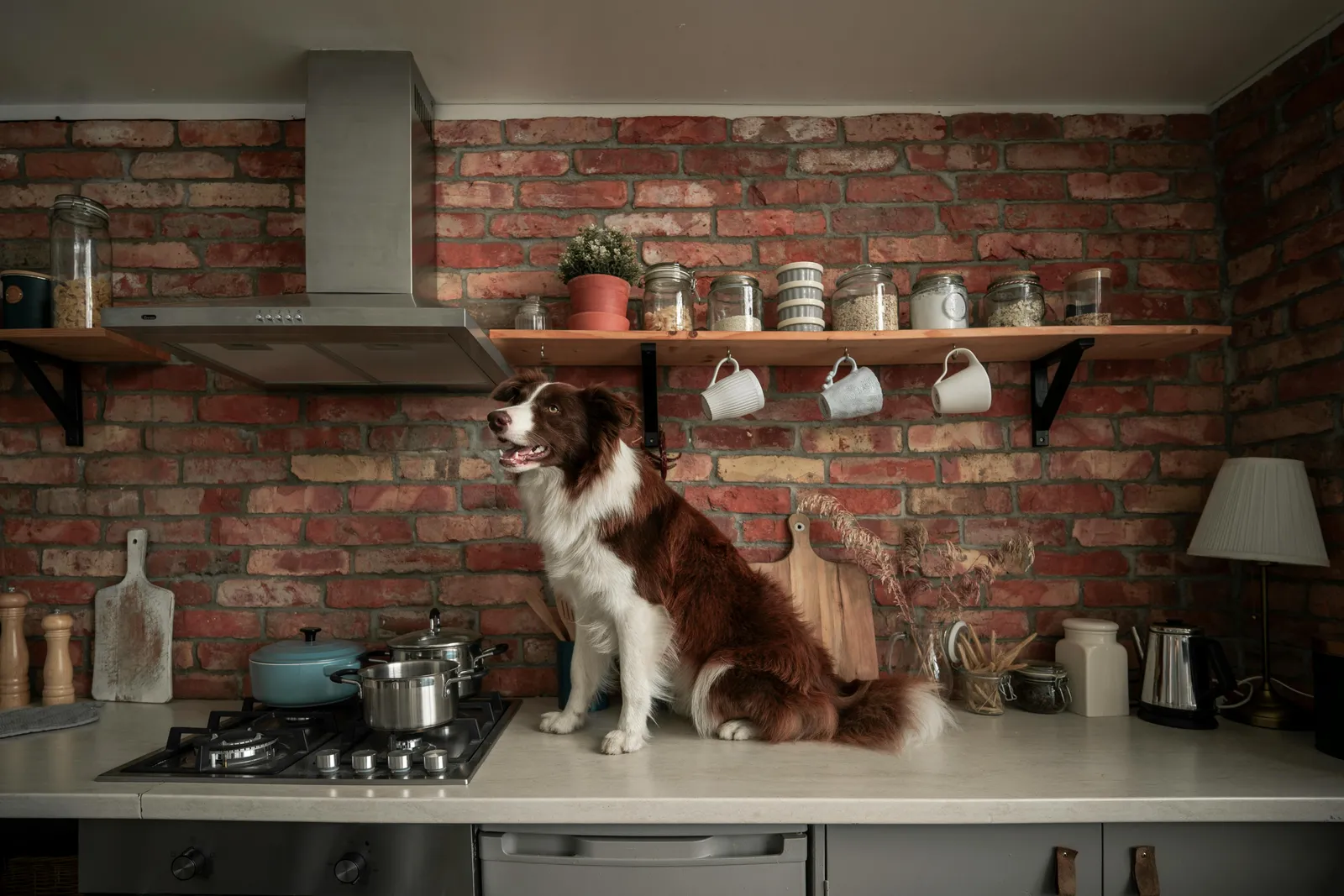
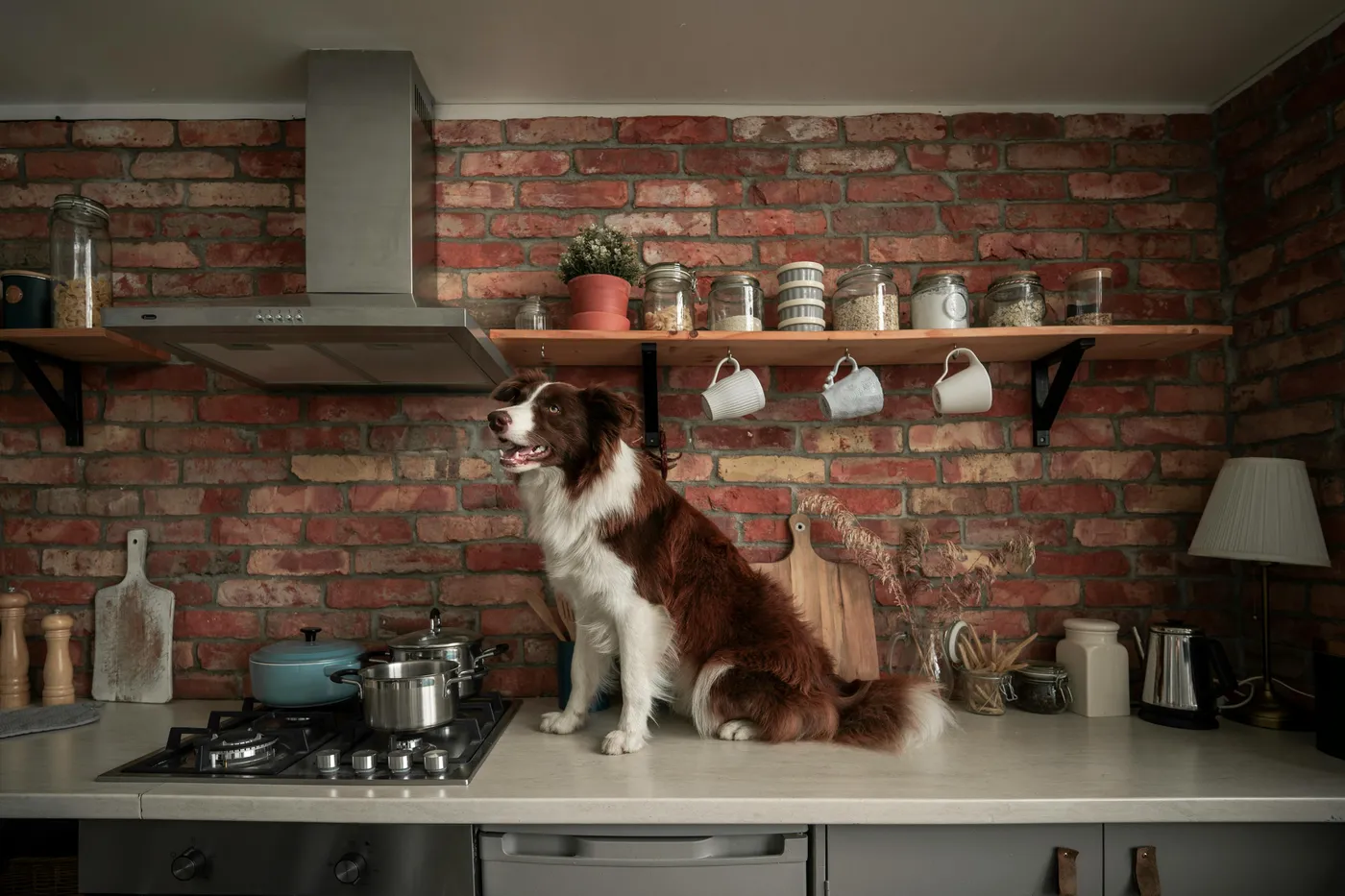
Stock Photo Dog says “I was not aware that food on counters was a thing.” Good job, Stock Photo Humans!
Pay for Four-on-the-Floor
Another option: use a remote treat dispenser like the Treat & Train.
If you’ve ever met me, you know I’m obsessed with the Treat & Train. It’s a remote-controlled device that spits out treats. (I literally devote a whole chapter of my book to its origin story.)
I especially like it for situations where you want to separate the presence of a person from the delivery of reinforcement.
Counter surfing is a great use case.
You can reward your dog for staying on the ground without needing to stand there delivering treats yourself. You can use a camera to monitor them. You can set the dispenser on a timer. You can place it on a mat or settle spot and reinforce calm behavior there.
Essentially, you’re paying your dog for being low to the ground.
At a high enough rate that it becomes the better deal.
The only catch is that the Treat & Train currently seems to be OUT OF STOCK EVERYWHERE. (Deep breath, Annie.)
The good news is there are now plenty of devices that do similar things. Pet Tutor is a solid alternative. I just prefer the simplicity of the Treat & Train. No Bluetooth. No app. No camera. It does one thing, and it does it well.
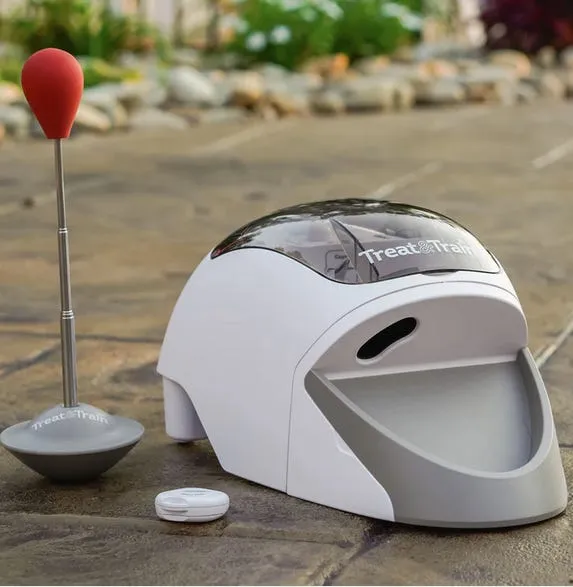
Treat & Train, how I love thee.
Could You Teach a “Don’t Counter Surf” Cue?
A client recently asked me:
Could you teach a cue that means “don’t jump on the counter”?
Maybe.
But would you be giving the cue before the jump? Or after?
Because that distinction matters.
Once the dog has already jumped, the behavior may already have been reinforced. And your attention—even if it’s annoyed attention—may itself be reinforcing.
So I’d rather focus on preventing the behavior from happening in the first place.
And then, on the rare occasion you mess up and your dog does score a roast chicken off the counter, just interrupt it with as little drama as possible.
Then give yourself a big smack on the head for being outsmarted by the only member of your family who enjoys licking their own butt.
Remember:
Dogs do what works.
Originally published in my newsletter, Don't Be a Dick to Your Dog.