
May 1, 2026 · Annie Grossman
Why That Dog Guards His Toy—and Jia Tolentino Steals From Whole Foods
Scarcity, trauma, and the (weirdly) thin line between survival instinct and entitlement
When I was in college, I babysat a girl who came from a family of eccentrics. There was a story about her grandfather that has stuck with me all these years—a story I’ve thought about oddly often in my work as a dog trainer.
It’s odd because it has nothing to do with dogs.
On a trip to the Catskills in the 1980s, her family was in a bungalow that had stove-top burners that had to be lit with a match. Her grandfather would light a burner once and then refuse to turn it off for the duration of the stay.
Why?
Because gas was included in the cost of the rental. Matches weren’t.
Deprivation and Surplus
What has to happen to a person to make him spend his mountain vacation hoarding matches?
This isn’t a rhetorical question. I actually know the answer.
The Holocaust.
The girl’s grandfather was born in Poland in 1906. During World War II, he and his wife ended up in Auschwitz. The fact that they survived was a miracle. Most of their friends didn’t. Their parents didn’t. Their oldest son didn’t.
Once I started working with dogs with all kinds of behavior issues, I found myself coming back to this story because it related to a simple idea that helped me make sense of how different animals (human, canine or otherwise) could thrive—or not—in the world we ask them to live in.
No two animals are born into the same environment, but broadly speaking, they’re born into either surplus or deficit. Each individual has baked-in tendencies that may either help or hurt them in whatever environment they land in. Fear, greed, aggression, suspicion, vigilance—these are not moral failings. They are survival tools. Some of us get a pinch of each. Some of us get a heaping tablespoon. That’s the luck of genetics.
Same with triggers. The thing that flips one animal into a defensive state — the events causing that ingredient to be stirred into to the bowl — may barely register for another individual. That’s part of what separates the neurotics from the optimists.
I’ve seen shelter-born puppies who are aggressive from the moment they can walk, and others who grow up under the same conditions and become mellow adults who will happily let adolescent dogs hang from their ears.
That variability in temperament is useful to a species. Some individuals survive by being scrappy, suspicious, and possibly hostile when necessary. Others keep the peace in times of plenty.
But the wrong temperament in the wrong situation can cause problems.
The dog who viciously resource-guards his overflowing food bowl may have done well guarding his kill on the savanna. But in a one-bedroom apartment and prey in the form of a Lambchop stuffy …not so much.
If my former babysitting charge’s grandfather had never been a near-victim of mass genocide, maybe the switch wouldn’t have flipped in a way that made him such an extreme skinflint. But just as a dog who has suffered abuse may continue to perform defensive behaviors long after he is safe, it makes sense that a man who survived Auschwitz might continue to be what dog trainers refer to as a “resource guarder.” His weird behavior, from that angle, totally registers. But lately, I’ve started to marvel at how this “it’s mine!” -type tendency can be triggered among those who are comfortable, elite and (supposedly) socially progressive.
Genealogy of Criminality
The story of this grandfather wasn’t only shared with me. It appears in Maus II. The girl I babysat was Nadja Spiegelman, daughter of Art Spiegelman, who wrote the Pulitzer Prize-winning graphic novel about his parents and the Holocaust.
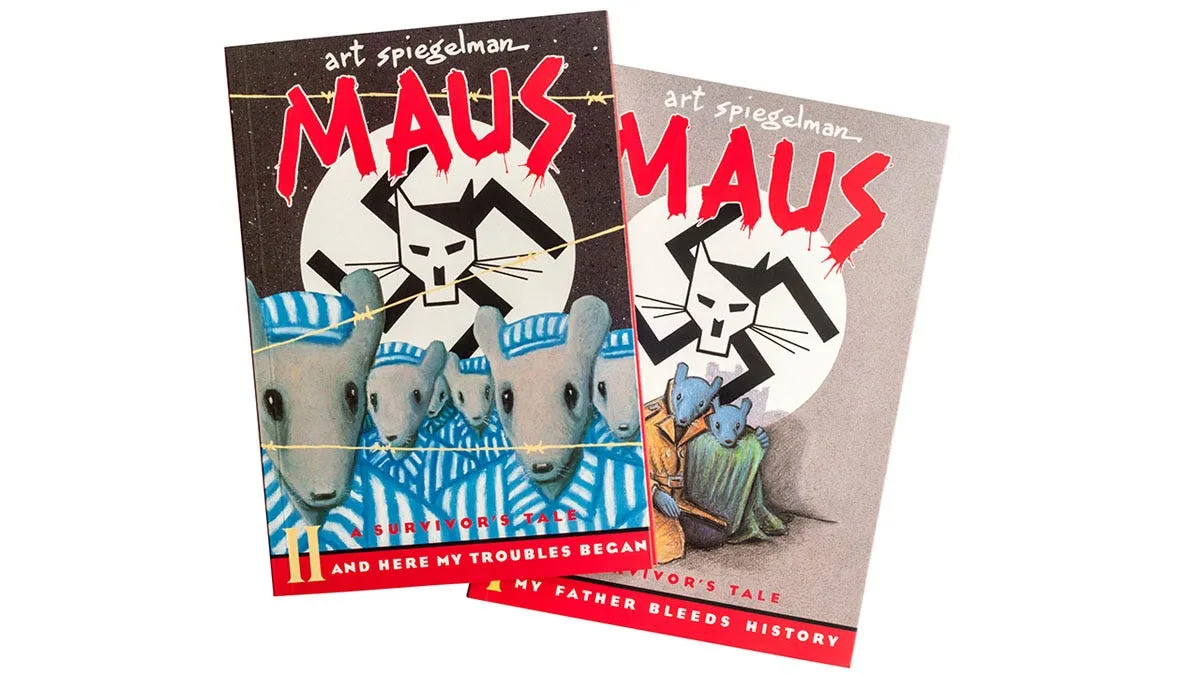
Nadja Spiegelman’s father, Art Spiegelman, won a Pulitzer for his Maus books.
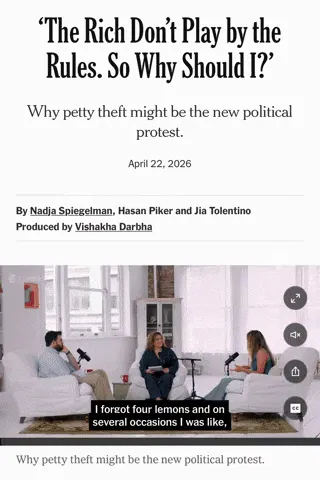
I haven’t seen Nadja in close to three decades. But, the other day, I tuned into The New York Times Opinion podcast and there she was—she is now a Culture Editor there. She was interviewing two other thirty-somethings about stealing as an act of corporate sabotage. She called the practice “microlooting.”
The two guests were Hasan Piker and Jia Tolentino.
Piker is a socialist influencer who I honestly only know about because Hello! magazine interviewed me last fall about an incident in which he livestreamed himself appearing to shock his Husky with a remote collar.
Tolentino is a staff writer at The New Yorker whose work I enjoy (I actually was included in a 2019 video that accompanied an article she penned) but whom I also hate because I am not a staff writer at The New Yorker. She is also younger than I am, prettier than I am, her name is more fun to say than mine, and, during the time period that she was on a book tour promoting a bestselling essay collection praised by the likes of Obama and Zadie Smith, I was on my knees mopping up dog urine at my training studio and crying into my pillow because I didn’t have the leadership skills to get my employees to turn on the shop light at the start of their shifts.
I’m kidding.
Mostly kidding.
I really had no major feelings about her before listening to this podcast. Now… I have notes.
The conversation was about shoplifting as a form of protest against companies that, according to the interviewees, are already stealing from us: through wage theft, price gouging, obscene executive compensation, all to feed the general billionaire need to send girlfriends to space, have nineteen children, become president, or whatever else the ultra-rich are into these days.
The trio is friendly toward Luigi Mangione and nostalgic for theft with a cause—from the Boston Tea Party to Jean Valjean and Robin Hood. “If someone were to be stealing with a purpose, we love that in America,” Tolentino says. “We do. We can love it again. We just have to do it with a purpose.”
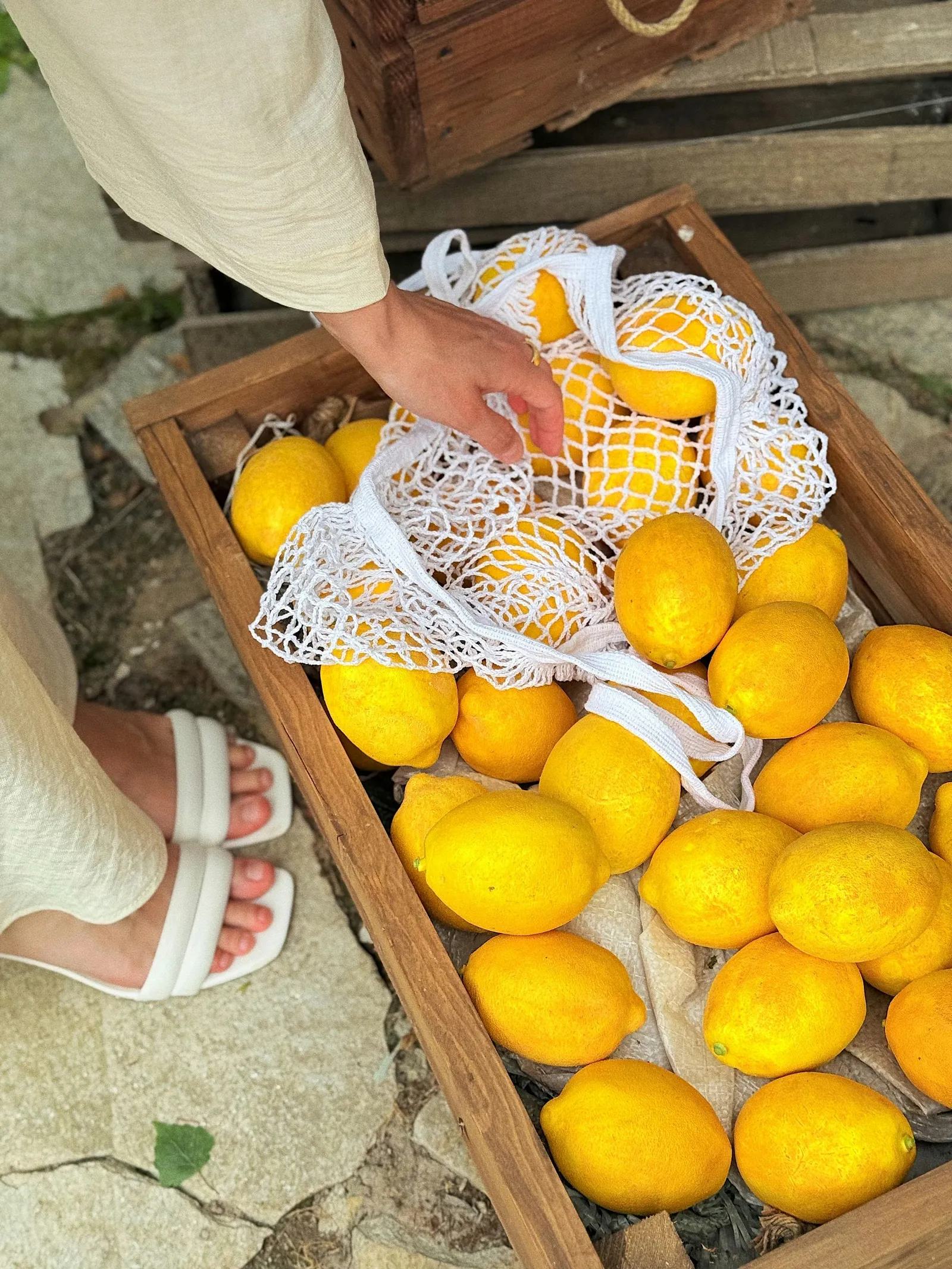
Her personal preferred site of protest is Whole Foods, which is owned by Jeff Bezos (he of the Earth-orbiting girlfriend, now wife). She humble brags about shopping there for an elderly neighbor, realizing after checkout that she’d forgotten lemons, and deciding to just grab them and “get the hell out.”
Piker jokes, “They should throw you in jail!”
Everyone laughs.
The thing is, people do go to jail for lesser crimes! They’re just usually not graduates of elite schools with six-figure editorial staff jobs and spreads about them in Vogue.
Tolentino says “I don’t feel bad about it at all.”
When asked if she would consider stealing from the Louvre, Tolentino says she would not be logistically capable of executing such a feat, but would she cheer on the news story if someone else did it?
“Absolutely,” she says.
Piker concurs. “I think it’s cool!” he said. “We’ve got to get back to cool crimes like that: bank robberies, stealing priceless artifacts, things of that nature.”
The general argument of the conversation was that it’s okay to steal from big corporations because big corporations steal from us. They underpay workers. They overcharge customers. They make record profits and pollute the oceans while everyone else is told to bring their own tote bag and feel guilty about plastic straws.
And, you know, I get it. When the people on one side are holding such big sacks of money, scarcity seems like the default state for the rest of us. And the idea of stealing from CVS feels less bad than stealing from the mom-and-pop pharmacy on the corner.
But it is still stealing!
I was telling my husband about the podcast and he said, “I think being a business owner made you more conservative.”
He might be right. I’ve generally thought of myself as a progressive. But if this is what’s happening in the name of progress, I guess I’m in the camp of wanting to conserve a society where stealing is still considered immoral.
I went into small business ownership fifteen years ago with ideals that certainly were socialist in nature: I wanted everyone who worked for me to have all the things. I wanted people to be paid as well as possible. I felt bad that they had to buy their own insurance coverage. I wanted to be generous with vacation and give employees a say in how things operated. I even tried to figure out if I could turn the business into a co-op.
But if my values had been the total opposite of all that, I’m not sure anyone on my payroll would’ve even noticed. To them, I was still the owner of the means of production.
I was The Man.
No one ever felt like they were paid enough. Petty cash went missing several times. Other types of theft we’re more insidious. Once, on the security camera, I watched the front-desk person put the “closed” sign on the shop so she could smoke weed with her friends. An employee livestreamed herself showing up late to work because her dogs wanted her to sleep in. Hours were padded and time sheets fudged.
Meanwhile, I was going into debt putting payroll on my personal credit card.
I think justifying stealing from the giants does little more than turn more people into… people who feel entitled to steal from anyone they think is in a position of power. Even in times of plenty. I’m sure my employees felt their actions were righteous, thanks to a system that automatically casts the employer as an oppressive force.
I ended up having to file for bankruptcy. So it’s kind of funny this the experience left me feeling aligned with… Jeff Bezos. I think he probably feels what I sometimes felt about my employees: if you don’t like it, you can leave! And the customers? If you hate the place, you can shop elsewhere.
Because: Capitalism.
Is the “It’s mine!” mentality brought on when people are tricked into thinking they’re living in a time of scarcity?
Pipeline Problems
So what about my theory that some of us are born with an extra-strong ability to survive scarcity, and that those instincts can be triggered by a certain level of environmental stress?
I think it holds.
But I also think we are living in an upside-down world where plenty of successful people can be switched into a grab-what’s-yours state by things way less drastic than mass genocide.
If you’re a human who is sticking it to the bungalow rental company in order to avoid the cost of an extra match, and the reason relates to trauma associated with the Holocaust… it’s weird. But I get it.
But if you’re living in a multimillion-dollar Brooklyn brownstone and working for Condé Nast, but still feel so disenfranchised that you’re stealing fruit from Whole Foods as a political act? It’s weird in a way that isn’t cute.
The really disturbing thing is that the implications are bigger than some lifted lemons.
At the end of the episode, Spiegelman asks Tolentino, “What’s one thing that you think should be OK but currently isn’t OK?”
Tolentino says:
“Maybe things like blowing up a pipeline? Let’s say that.”
Originally published in my newsletter, Don't Be a Dick to Your Dog.