
September 25, 2012 · Annie Grossman
Puzzles for dogs (and why they matter)
Food in a bowl doled out at regular intervals can make for a bored and unhappy dog. The solution? Toys that are like Sudoku puzzles for the canine set.
For most of the tens of thousands of years that canids have existed, they’ve been hunters and scavengers. Wolves and feral dogs may still work for their food, but most of the canines in the world today are domesticated and usually get their meals for free. For animals who evolved to use their minds and muscles to feed themselves, this kind of luxury lifestyle can lead to boredom. And boredom can lead to the destruction of your favorite slippers, barking that makes the neighbors revolt, and dogs that are living lives that are less happy than they could be. It can also lead to stress, which can cause the kind of cortisol spikes that might ultimately shorten your dog’s life.
Really, this isn’t such a different problem than one that humans face. Today, I listened to a new Marketplace podcast about how people who retire later tend to live longer; what’s more, retirement postponement is also thought to lead to better mental health. They quote economist Josef Zweimuller saying: “Among blue-collar workers, we see that workers who retire earlier have a higher mortality rates and these effects are pretty large.” Retirement researcher Mo Wang says: “Working actually gives you a way to structure life, and that’s very important. Usually, people travel right after they retire. But then after one or two years, they sit at home watching TV.”
Eventually these people are carted into nursing homes. And what to they do there? Mental work that serves no outward purpose: Think jigsaw puzzles, crossword puzzles, Wheel of Fortune. Readers, these are the happiest people in the world! Okay, probably not. Maybe if they’re still allowed to smoke.
Desperate for a job, your bored dog will appoint himself neighborhood watch dog and bark his head off at people in the hallway. He’ll chew parts of his body raw. He’ll become unhappy, anxious, destructive, annoying, and paranoid. And he certainly isn’t allowed to smoke.
We can help our domesticated canines satisfy their natural urges to chew and problem-solve by giving them toys that make them work for their food.
Fortunately, there is a plethora of these kinds of toys available to dog owners. They’re generally called “work-to-eat toys,” “puzzle toys,” or “enrichment” toys.” I’ve found that putting all or most of a dog’s daily rations into these devices can be the solution to many behavior problems, from separation anxiety to unwanted chewing and beyond.
The Kong
The granddaddy of all work-to-eat toys, the Kong is a chew toy made of nearly indestructible rubber. It was originally based on a part of a Volkswagen bus’ suspension device that the creator’s German Shepherd found particularly irresistible. Kongs can be stuffed with a wide variety of yummies. You can stuff it with whatever your dogs’ weakness might be: cream cheese, Cheez Whiz, wet dog food, peanut butter, liverwurst, frozen blueberries, hamburger meat or squeeze a Bark Pouch into its center. Yummers.
The Bob-a-Lot
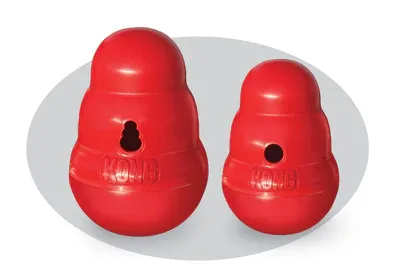
This genius little device is weighted on the bottom, so it wobbles all around like those inflatable “bop bags” we had as kids. It comes in a few different sizes. The yellow part at the top screws off, allowing you to put kibble inside, or any kind of small and fairly hard treats. If you feed your dog kibble, you can put his entire meal in this thing. It makes mealtime last ten times as long, which is a good thing for reasons both behavioral and healthful. My dog eats about four of his meals from it each week. A tiny sliding door over the outside hole and a movable flap covering the internal one makes it possible to basically set it to different levels. Kong makes a similar toy, the Wobbler, which is just as good except that there are no doors or flaps, so the levels can’t be changed.
Here, Amos demonstrates how to use it. I had the outer door flap mostly closed here, so you’ll see there isn’t much food coming out at a time. But never fear: Eventually, he did get it all.
The Dog Casino
The Dog Casino is a one of the many fine toys by Nina Ottosson, a genius Swedish pioneer in the world of interactive dog puzzle toys. Her offerings come in a variety of levels of difficulty and in both plastic and wood. This one is the first that my dog Amos tried out, and he loves it. I started him on it by taking out all the bone-shaped light blue pegs until he learned to pull open the drawers with his paw. When he got that, I put some of the pegs in —they act as locks. So then he had to pull out the pegs before the drawers could open.
Here he is with just one drawer left to unlock.
Many of Ottoson’s line of toys require that you work with your dog a little bit to help him along. It’s really fun to watch them solve the little mystery of each game, and to figure out how to help them get it. With Amos, I first rewarded him for just touching the handles with his paw or nose. When I withheld a few rewards, he started to get annoyed and his pawing increased until he managed to get it open just a enough to lead to the big reward inside the drawer. The magic of learnin’! To help him figure out to life up the pegs, I smeared peanut butter under them. Now that he’s a pro at this one, I often put his entire dinner in it —wet food or dry. But I only put them in some of the drawers. That’s why this is called The Casino! Amos would indeed fit in at the old age home. He just needs a cigarette. That, and a Mah Jong set.