
November 4, 2026 · Annie Grossman
If dog trainers are really "at war" with each other, it's not over treats.
Who gets to decide when it’s okay to use force and punishment to control someone we love?

Too Many Treats? That’s the War?
Hello humans, and dogs who are good at pretending reading is boring.
There’s been a lot of unrest in the dog training world lately. Truth be told, there is always unrest in the dog training world.
I try not to get sucked into the drama, but I want to sum up the two latest conflagrations, because they have something in common. Both took a fight that is, at its core, about animal welfare, and, in different ways, arguably reduced it into something sad, or cute, or a bit silly. Which, I’ve come to think, is how we treat pretty much everything about pets.
Kerfuffle one: the sad dog with the ball
The first had to do with the CANIS Conference, a large multidisciplinary gathering for people in dog training, dog sports, shelter work, and veterinary behavior. It was held last month outside Chicago, and I went because I’d been asked to give a talk on how trainers can help dog owners understand the science of behavior without drowning them in jargon. It was a super fun talk to give, and I plan to put together a version for non-conference-goers before the year is out.
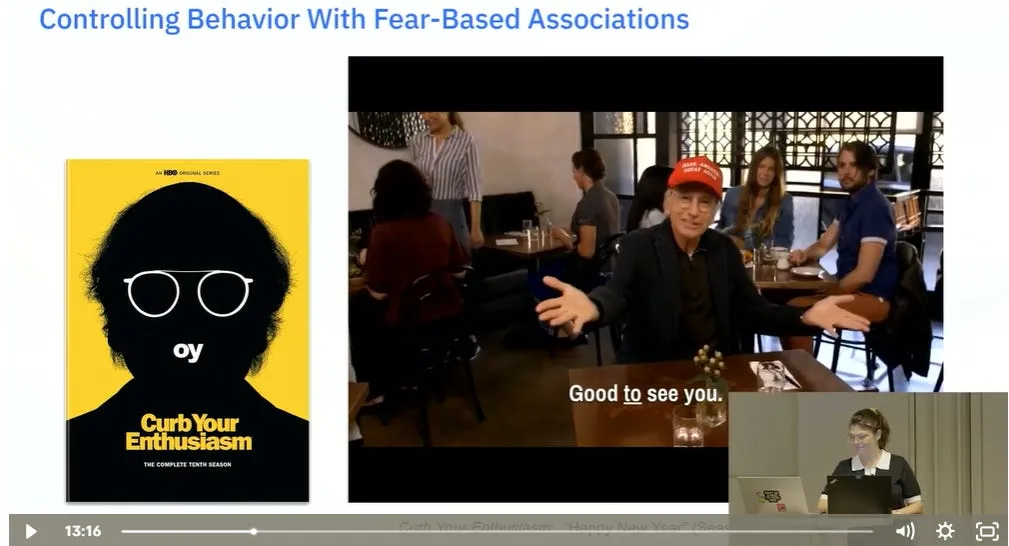
Pretty sure I was the only CANIS presenter showing Larry David clips.
Unfortunately, I pretty much had to turn around and fly back home right after, because I have a one-year-old who is addicted to my breasts, which I’d brought with me on the trip. Without them, she was suffering a toddler version of delirium tremens.
But I was there long enough to catch the opening presentation, where Michael Shikashio, the trainer who organized the conference, showed an AI-generated video (at least I think it was AI). A guy sits at his computer with his back to his dog, typing things along the lines of “I know more about dog training than you do!” The dog holds a ball, pushing it at him, hoping to play. Seasons change out the window. The dog goes white in the face; the guy goes gray at the temples. He never turns around. At the end, the dog is gone, and the man is sobbing next to an empty dog bed.
I thought it was so over-the-top maudlin it was funny. Others, from what I gather, were not laughing.

A still from the video shown durng Shikashio’s Welcome speech at the CANIS Conference in Illinois last month.
Roughly speaking, there are two “sides” in dog training these days. There are those of us who call ourselves “positive reinforcement” trainers, who generally try to avoid using training methods rooted in punishment and coercion. Then there are those who are on board with tools like prong collars and shock collars in addition to using various kinds of rewards, including food. They usually call themselves “balanced trainers,” suggesting an even “balance” of carrot and stick.
Shikashio, from what I know of him, is on the “positive” side of the spectrum, but he is open to learning about other’s stances and protocols; he hoped his conference could give both sides a chance to listen to and learn from each other, civilly, face to face.
And… guess what! Everyone was so excited about that prospect!
JK!
Before the conference even started, balanced trainers were commenting that trainers on their “side” hadn’t been invited to speak.
And we weren’t even thirty minutes into the thing when some positive reinforcement trainers felt that the sad-dog-with-ball video was making light of something grave. Like, no, we can’t all just make nice and go play ball with the dog when so many dogs (and people) are suffering because they’re being “trained” with methods that are often abusive and completely unregulated.
I find these debates so stressful that I mostly stay out of them, so if my summary lacks nuance, it’s because I’ve only allowed myself quick whiffs of the online fallout—when I enter the stinky bathroom that is social media, I try to hold my breath. But I got wind that the ire got bad enough that Shikashio announced last week that he was going dark on social media for his own sanity1. Smart dude.
It sucks that someone who put more than a year of work into creating an in-person kumbaya moment ended up basically hounded by the very people he was trying to bring together. It also sucks that so many people who probably thought it’d be fun to have a career working with dogs are now, well, trolls.
Kerfuffle two: the little rascal
The other drama is about an incredibly dumb Wall Street Journal article that came out last week.
I know that referring to some well-intentioned journalist’s effort at an institution like the Wall Street Journal as “incredibly dumb” maybe makes me sound infantile but it’s honestly the best I can do while still being true to who I am as a self-respecting professional.
Like, it was dumby dumb dumb.
The article tried to dissect the “war” between trainers on different ends of the spectrum and missed the mark. Its premise is that too many owners hand out a “fistful of liver biscuits” to “placate the little rascal” who snaps and yaps at “anything that moves.” It centers on a California-based trainer who calls himself a behaviorist, a title that in the industry generally signals one of a handful of certifications you can only get if you have an advanced degree in the sciences. If this trainer has any degrees or certifications, they’re not mentioned in the story
Actual quote from the trainer: “It’s all treats, treats, treats, so help me God! It’s no different than giving your kid a BMW for his sixteenth birthday!”
There are many problems here. Let’s look at three of them.
One: The most impressive qualification the trainer has in this story is that he trained Liza Minnelli’s dog. Actually…Liza?! I take it all back. LIZA!
The real problem isn’t that the reporter quoted someone with no credentials of note. It’s that in an industry with no licensing at all, there’s sort of no such thing as credentials of note. Anyone can say they’re a professional dog trainer. Anyone can say they trained Liza Minnelli’s dog. Heck, I’m training her dog right now! Anyone can call themselves a behaviorist. Or Liza Minnelli.

This person is not Liza Minnelli. But… if she wants to call herself Liza, she can! She’s also free to call herself a professional dog trainer! (Alexis Michell on RuPaul’s Drag Race)
Two: This gets into the weeds a bit, but to put it as simply as possible: behaviors serve a function (a goal, in layman’s terms), and, for a dog, often that function has nothing to do with getting a treat. If you go to work and on pay day, your boss tries to pay you by giving you a bouquet of roses, it probably didn’t reinforce the behavior of you going to work (although…depends on your profession!).
Likewise, the barking dog in this story. If the little rascal is yapping at something that moves, his goal is probably not to get a cookie. More likely, he’s trying to make a scary thing go away. Treats might occupy his mouth, which stops the barking for a second. Better, the treats may help build a new association with the moving thing, which can mean less fear, and therefore less barking. I’m all for an analogy, but calling that spoiling, on the level of a teenager getting a BMW, makes no sense.
Three: How do I put this… One word comes to mind.
Really.
Really?
Really!!!
This is the cause of the “war”?
Some trainers who use treats sometimes (the “balanced” ones) are upset because other trainers use TOO MANY treats?!
Oh. Got it. OK.
I thought the issue was that some trainers were upset by other trainers who use electric collars that are completely unregulated, teach people to smack their dogs with rolled-up towels, and go on major science podcasts to explain that the key to controlling dog behavior is prayer.
Excuse me while I go drink myself to death.
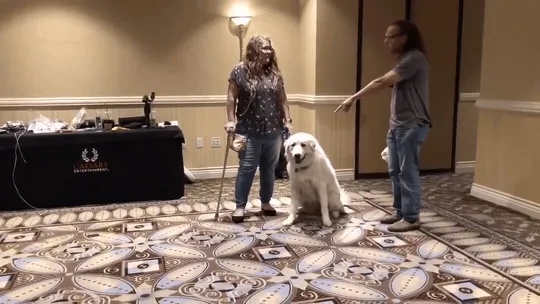
A scene I describe in my book: Professional dog trainer Jeff Gellman demonstrates how to “bonk” a dog with a rolled up towel on YouTube. If it had been done NOT in the name of training, I wonder if it would’ve been flagged as animal abuse… 🤷
This isn’t the first time the Journal has been flip about dog training methods.
A few years ago, it ran a story in which the reporter boasted about using a shock collar on his barky dog because other methods were just too much trouble (The headline read: “I’m Disciplining my Dog, Not Torturing Her.”)
After reading this, I sat down with my friend, fellow journalist-turned-dog trainer Kiki Yablon, to talk about how she and I, in our previous lives, also wrote articles that reveal how much we didn’t know about what we didn’t know about dogs.
My theory is that journalists fall into this trap because pets, when put next to stories about elections and football, are generally considered frivolous.
Why don’t we take this seriously?
Newspapers have whole sections devoted to “serious” subjects that double as hobbies: real estate, cars, sports. But in my experience, if a paper has a pet section at all, you’re more likely to find dogs in Halloween costumes, a tip about putting cotton balls in the little rascal’s ears before bathies, and a lede like: “Last Tuesday, Tabitha went to ballet class, had her roots done, and ate an ice cream sundae. Tabitha is a Goldendoodle.”
You are unlikely to find stuff about, like, SCIENCE.
Why? I don’t know.
Maybe because science be scary and puppies be cute?
Because science seems black and white, and stories of rescue and redemption feel more human?
Because it seems reductive to suggest your furry best friend—your soulmate Yorkiepoo—could be studied by someone in a lab coat?
I don’t have the answer. I’m open to other theories.
Maybe the Journal is just reflecting a bigger idea: that while pets are a huge part of our lives, offline and online—let us not forget that the internet was built on the backs of Shiba Inus—it’s sort of silly to take any of it too seriously. Lighten up!

Because the way we treat pets doesn’t really matter outside of pets, right?
Obviously I think that’s wrong. I think the way we relate to our pets is tied to the way we relate to each other, and to the world. My dog is a living being who, despite all the “Who rescued who?” bumper stickers I might own, really didn’t ask to live in my home.
What if how you decide to share your life with a dog matters? What if it matters.. a lot?
What if it’s an opportunity to show your kids how to care for those who depend on us?
What if it’s a chance to look at our own behavior and how our environment shapes it, by looking how we shape our pets’ lives?
What if it it’s a chance to examine our ethics and values?
Is it OK to eat some mammals while we buy health insurance for others and let them curl up on our pillows?
When, if ever, is it justified to use pain and discomfort to control an animal’s behavior, say, if that’s what it takes to keep the animal alive?
And would that be a life worth living?
Who decides?
When, if ever, does behavioral euthanasia make sense?
When does one animal’s freedom put others at too much risk?
These are questions about dogs, but they’re also questions about humans. Humans to humans! Humans to dogs! The reason people who think about this stuff get so worked up is that it feels like life-and-death stuff. Because, often, it is.
Bottom line: Good dog training is practicing kindness. Which we should all be trying to practice, dammit.
There are no laws that license dog trainers or regulate the methods they use. Maybe someday enough lawmakers will care.
Or… maybe the people who care about our robots will get there first.
This just in: Anthropic, the company behind the Claude chatbot, just announced that next week it instating a usage policy that prohibits “sustained and needless abusive or cruel behavior toward our models.” The company says the rule is meant for extreme cases, where users repeatedly act cruelly “with no discernible purpose.”
Needless.
No discernible purpose.
If you think about it, that’s exactly the question dog trainers have been screaming at each other about: When is causing an animal discomfort necessary, and when is it just cruelty?
A tech company is working to spare large-language models from being abused in the name of training.
Don’t tell your dog.
IG: @ annie.grossman
Footnotes
-
A commenter says that I am wrong about why Shikashio left socials — apparently it was because of some other industry-based online conflagration, not this one. As I said, I tend to follow this kind of drama in only a pretty cursory way, so I jumped to an eroneous conclustion. Will try to do better fact checking in the future. ↩
Originally published in my newsletter, Don't Be a Dick to Your Dog.