
March 2, 2014 · Annie Grossman
Irene Pepperberg's "Alex & Me": A Unique Interspecies Love Story
Explore the fascinating world of animal intelligence with insights from Irene Pepperberg's work on birds and dogs, revealing unexpected cognitive abilities.
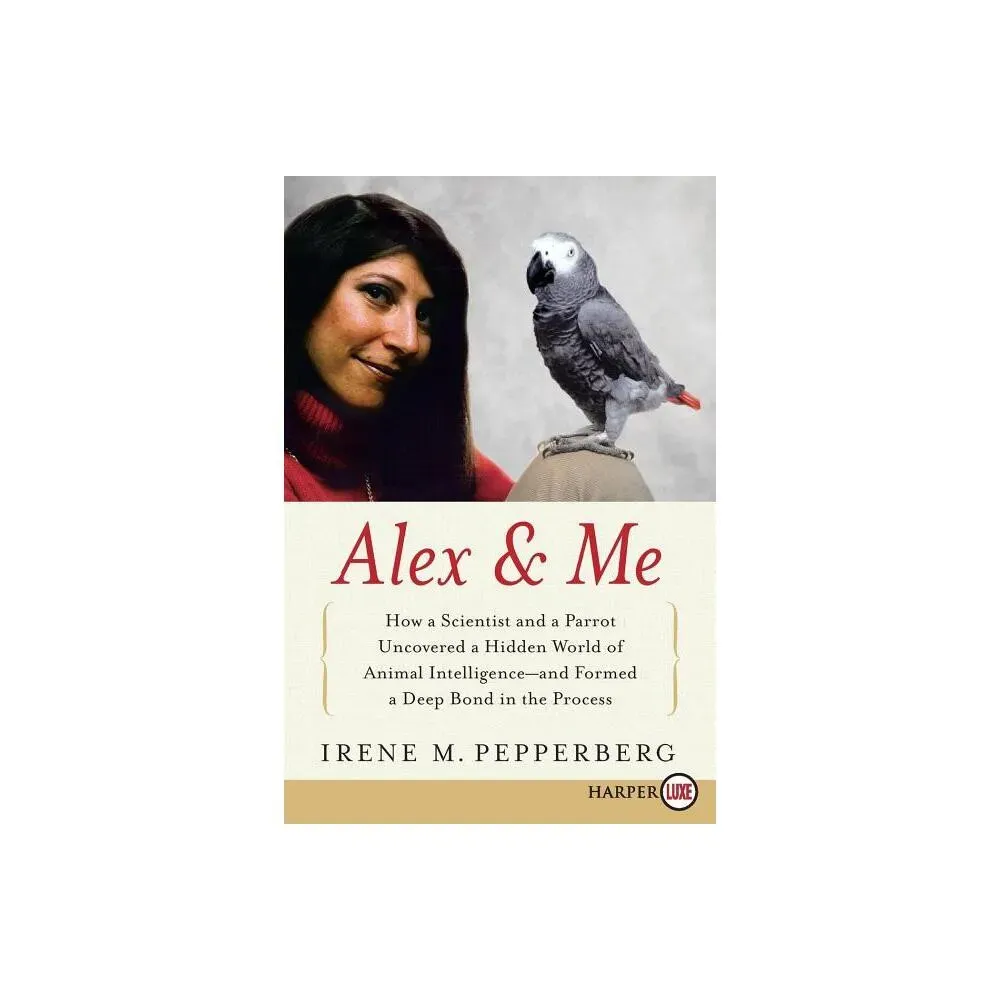
Irene Pepperberg’s best-selling book, Alex & Me, is an interspecies love story and a science textbook in one — an irresistible tragicomedy-slash-romance-memoir-science-y feminist thriller. (Yes, Random House, you may blurb that).
In her decades of work with her African Gray parrot Alex, her study subject-cum-best friend, Dr. Pepperberg showed birds have an intelligence that few expect from anything other than humans. Alex could do math. He could sort objects based on characteristics like size and texture. He could make portmanteau words to describe things (“banerry” was his word for an apple, because it had qualities of both a cherry and a banana). He also understood the rather complex system of using language to manipulate situations: In one of the more heartbreaking sections of the book, Alex, sequestered in a cage at the vet’s, pathetically cries out to Dr. Pepperberg: “I’m sorry.”
Dr. Pepperberg, who is a Research Associate at Harvard University and an Adjunct Associate Professor at Brandeis University, has worked to show some of the chinks in the wall we tend to put up between the experiences of human animal life and non-human animal life. I think it’d be fair to say that she has done for bird intelligence awareness what Jane Goodall has done for chimps and Konrad Lorenz did for geese. And Jim Henson for frogs.
Here is Alex demonstrating his smarts to Alan Alda:
Watch the video
When Alex passed unexpectedly in 2007, he got the press coverage of a Kardashian. The New York Times ran the headline: Alex Wanted a Cracker, but Did He Want One? Jay Leno said, “This parrot was very intelligent. They say he knew over one hundred words. They say his intelligence was somewhere between a dog and Miss Teen South Carolina.” This was a few years before I got seriously interested in dog training, but I followed the news coverage. As a nascent dog trainer, the science interested me; as a devoted animal lover, I was touched by the loss I imagined Dr. Pepperberg was feeling. How strange, I thought, to be receiving such public career accolades at a moment that coincides with one of the saddest moments in this woman’s life.
The book came out the next year. I gave it to my dad for Christmas. He read it, raved, and then gave it back to me to read. Then he bought a copy for everyone he knew.
I was anxious about reading a book where I knew the animal died. I can’t deal with dog deaths in movies and my tolerance isn’t much lower when they do it on paper. But I steeled myself. And boy, was it worth it.
This book made me laugh, cry, and then google where I could get a master’s learning about animals. It watered a germinating seed of an interest. Ultimately, I decided I’d rather blog about the subject than go to school. Neither pays very well; one requires fewer footnotes.
Another nice thing about writing about a subject you love versus studying it is that there is less of a need to specialize. I find dog intelligence and behavior pretty amazing, but I also am fascinated by the fact that whales and snails and worms and elephants all learn by pretty much the same methods as do dogs and humans. I’m so grateful that there are people like Dr. Pepperberg who’ve devoted themselves to relatively niche areas of animal study, fleshing out the endless minute details—wondrous idiosyncrasies—of what it means to be whatever kind of species you may be or love.
A couple of years ago, I attended the International Association of Animal Behavior Consultants annual conference held in Providence, RI. Truth be told, I got sick shortly after getting there and spent most of my time there partaking in the uniquely human practice of praying to the porcelain god. I missed a lot: The renowned Nicholas Dodman speaking about “Feline Elimination Issues”; a demonstration of teaching pigs to push beach balls and fiddler crabs to ring bells. But I did have a moment to corner Dr. Pepperberg and ask her about dogs.
AJG: You are one of the most famous bird owners of all time. But have you loved other non-human species?
IP: I had a beagle/dachshund-mix named Winston when I lived in Chicago. But my ex-husband kept him when we broke up. I got the bird. I guess you could say that was sort of how my then-husband felt about my research. You get the bird, I get the dog.
Had you had dogs when you were growing up?
IP: I had birds as a child. So I knew early on that they were really, really smart. I knew they talked. I was getting my doctorate in theoretical chemistry when I first saw the NOVA programs on dolphins and birds, and I thought, ‘Well no one is doing animal communication work on birds and their talk so why don’t I do that.’
So if you’d had dogs as a kid instead of birds, things could’ve gone in a whole different direction!
IP: In some ways I would confuse them—I was so used to dealing with birds that it was an adjustment communicating with Winston. I remember one time I was cooking dinner and he was whining about something at my feet and without thinking I said, ‘Please just tell me what you want.’ Then, of course, I thought, okay, stop, let’s reset. He isn’t going to answer. He isn’t a bird. I was used to Alex, who would just tell me when he wanted something.
Did you train Winston?
IP: I did. I didn’t use clicker training, but I used the same methods, just not with a clicker. We had a setup so he could knock open the door in the dining room, and that led to the garage, and then there was a door that led outside. I trained Winston to be able to come back in and close the door on command. He’d turn around, jump up, and close the door, then he’d get a treat. It was great. I was thrilled with it. But then one time he came into my study and knocked the door open, and I said to him, ‘Close the door,’ thinking he could transfer the knowledge. But he looked at me like, ‘Wait, this isn’t the right situation.’ I realized it didn’t have to do with his lack of intelligence; it had to do with the training. He hadn’t learned to transfer. A parrot would’ve transferred that immediately.
So you’d say parrots are better at generalizing? They’re better at knowing that most doors work in the same way?
IP: Well, we train parrots on concepts. When you have a concept, it’s not an action responsible for a reward in a very consistent way, but that there is the idea of the object. For Winston, the door he could close was the door down in the dining room. That was it. I’d never trained him on multiple ideas. There wasn’t a concept of doorness. So it was a very different type of training. I’m sure if I’d spent time teaching him to use every door in the house, eventually it would’ve been different.
What did Alex think of Winston?
IP: Alex and Winston never met. Alex was always at the lab. He met another dog once. They had a dog in the media lab who would come to visit once in a while. They’d stare each other down.
For more on Dr. Pepperberg, visit the website for her organization, The ALEX Foundation.